Friday, April 24, 2026
E-Paper
Home Blog Page 77516

Cultural practices in Jammu

Lalit Gupta

Name of Book : ‘Duggar Ke Sanskritik
Aanchal-Part 1′
Writer : Kewal Krishan Sharma
Publisher : Shiva Printers, Paloura,
Jammu Price : Rs 300

The culture of Jammu traces its roots right from pre-historic times. It is formed of very many layers such as shamanism, animism, pre-Vedic cultic practices of different races and groups along with religious and ritual world view espoused by Vaishnavism, Shaivism and Shaktism. In course of time, Muslims, Sikhs, Buddhists and Jains have further enriched the composite cultural fabric of Jammu region.
In recent times there is an emerging assertion by communities from the so-called marginalized pockets of Jammu and Kashmir for sub-regional identities which are further shaped in the name of ethnic and social identities. In this background, religion vis-à-vis identity politics appears to be a sensitive issue on regional level, especially when culture is increasingly being brought into the public sphere as a tool for political and other contestations.
In this light, Kewal Krishan Sharma’s latest book ‘Duggar Ke Sanskrit Anchal-Part-1’, with its emphasis on the shared cultural practices amongst communities irrespective of their geographical locations, is a welcome publication on culture and heritage of Jammu.
The use of word ‘Duggar’ in title of the book by author, is not meant to allude to a homogenous political entity, but rather refers to the area of influence of languages like Dogri and its ‘sister’ languages and dialects such as Bhadarwahi, Kishtawari, Padari, Shirazi and Pahari.
The salient feature of the book is that it provides an overview of cultural practices of Dogras and other ethnic groups in Jammu region. Beginning with a description of general rite of passage followed by Hindus such as jaat karam, namakaran, anna-prashan, mundan, upnayan and marriage, the author illustrates various sanskars in Kishtawari culture with quotes from Kishtawari folk songs.
Next chapter describes the sacred days and festivals such as Baisakhi, Naga Panchami, Raksha Bandhan, Janmashtami, Navratre, Dussehra or Vijay Dashmi, Karwa Chouth, Dhan Treudashi, Dipawali, Bhratr Duj, Tulsi Puja, Guru Nanak Jayanti, Lohri, Basant Panchami, Shivaratri, Ravi Das Jayanti, Holi, Mahavir Jayanti, Id-ul-Fitr, etc.
The chapter on Dogri language presents an interesting comparison between Dogri and Kishtawari proverbs. In the chapter on Music and Art, the author while classifying different kinds of folk songs has also given examples from folk poetry. There is also mention of some folk beliefs and faiths.
The subsequent chapter of the book is about Bhadarwah’s Art, Culture and Language in its historical backdrop. The author gives a brief history of Bhadarwah, its important places and tourist spots, an introduction to society and folk life, professions and cottage industries, Naga worship, important fairs and folk dances.
The next chapter highlights common festivals and celebrations of Bhadarwah and Kishtawar such as Kanchouth, Gauri Tritya and Dharam Divas. The section of Bhadarwahi literature also makes special mention of folk songs like Aianjali, Sukali, Musadhe and Ghuraie.
The chapter on Kishtawar Art, culture and language begins with a general introduction about the area, its historical setting, rulers etc. The section on Kishtawari language forms an important aspect of the chapter as the author not only builds a case of Kishtawari language’s roots in Sanskrit with help of common words but also highlights typical linguistic structure of the language. The list of analogous words in Dogri and Kishtawari adds a further dimension to the historic cultural exchange between the two languages. Other sections of this chapter give an overview of literature created in Kishtawar in languages like Sanskrit, Hindi, Persian, Urdu, Kashmiri and English. It is followed by a section on folk sings, folk tales, local festivals, folk beliefs, well known pilgrimages, Urs of Sayed Shah Mohammad Farid-ud-Din and Shah Asrar Sahib. The chapter on Padar Culture and Languages focuses on historical background, common words with Bhadarwahi and Kishtawari and brief introduction to Padari folk songs. The last chapter highlights the salient characterstics of Shirazi and Rambani dialects, and common pool of words with Bhadarwahi and Kishtawari languages.
Since the author belongs to Kishtawar, his knowledge and understanding of the linguistic features of sub-regional languages and dialects and their level of interaction, development of literature along with intimate description of folk life emerges as a highlight of the book which joins the growing list of publications on the culture and heritage of Jammu region.


Cipher Decipher

Hi Friends! We are back with your favourite column for the week. Please have a look at OUR MESSAGE  before you  send in your message to us.

1. To all from Komal Mengi: “ Give yourself sometime to calm down and then gently discuss the situation”.
2. From Mukesh Kumar to all: “ Everybody wants to go to heaven but nobody wants to die”.
3. To all from Rafaqat Ali: “ The big suspense of life is that you do not know the person who is praying for you and the person who is playing with you ”.
4. From Sanjay Dhar to all: “ A truly wealthy man is not the one who has, but the one who gives away what he has”.
5. To all from Gourav Gupta: “ The republic was not established by cowards and cowards will not preserve it”.
6. From K K Gupta to all: “ Perfection is achieved not when there is nothing more to add but when there is nothing left to take away”.
7. To all from Rishab Gupta: “ When the world pushes you to knees, you are in a perfect position to prey”.
8. From Anil Kumar Nanda to all: “ Cultivate positive attitude, good thoughts optimism in world, thoughts, deeds for shaping a bright future for themselves”.
9. To all from Waqar Ahmed Mughal: “ Confidence and hardwork is the best medicine to kill the disease called failure. It will make you a successful person”.
10. From Ruchika Gupta to all: “ Respect people who find time for you in their busy schedule. But love people who never look at their schedule when you need them”.
11. To all from A B Gupta: “ The greatest of journeys begin with a small step”.
12. From Abhi Gupta to all: “ Focus is more valuable than IQ. Discipline is more valuable than talent”.
13. To all from Sivy: “ Life smiles at you when you are happy but life salutes you when you make others happy ”.

BEST MESSAGE
The award of rupees 200 for this week’s best message has gone to ABHI KHULLAR S/o SUNIL KUMAR R/o H.NO: 99/5 ROOP NAGAR, JAMMU-180013 for the message “ Good people without discipline are worth nothing”.
Congrats. The prize money would be sent to you through money order

“Feel like feeding laddoo to everyone”

“Feel like feeding laddoo to everyone”

Top 5 Childhood Cancers

Top  5  Childhood Cancers

Duggar delicacy

Ayodhya Nath Kerni
In the remote areas and hilly terrain of district Udhampur there were no transport facilities. There was no Jammu- Srinagar National highway prior to first quarter of 20th century. There were no ways and means to supply milk to towns and cities. Population was less dense in the past and there were large number of cows and buffaloes kept in houses. There was no scarcity of fodder and sufficient grass was available for grazing the cattle in meadows. Milk available in each house was more than the family requirement but there were no resources of sale to the market.
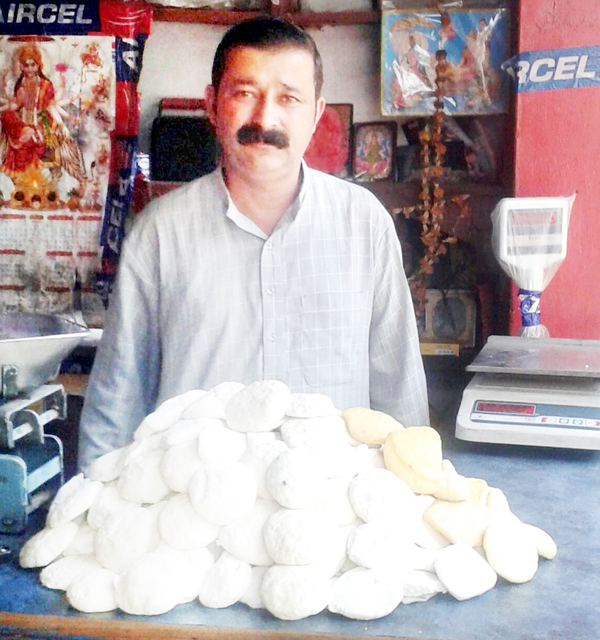
May that be the reason to introduce a milk product indigenously known as ‘kalari’ by the forefathers. The traditional method of preparation of kalari do resemble with the paneer(cheese) only with a minor difference. While preparing paneer container of milk is put on heat and milk is got boiled then got split by putting a sour substance like lemon etc. Same is tied in a cloth and placed underneath a weight of stone. After two hours cheese is prepared and cut into pieces as per the requirement. As far as the preparation of kalari is concerned milk container is kept on heat for a little while to get it as lukewarm and remains of split milk known as ‘Mathar’ is poured into the milk. The milk is split and out of the released fat small tikkis are prepared manually. These tikkis say kalaris are laid over pine leaves and carefully kept in a basket to dry up and ripe in sunlight. As and when they dry up the kalaris are brought to market for sale.
Paneer is prepared at other places also in our country and even in other countries of the world. Paneer dates back to ancient India. Kalari is a new product and found in Jammu region only. Kalari prepared of cow milk when dried gives a light yellow look and seems very attractive. Kalari prepared with buffalo milk gives a white shade. Kalari prepared with goat milk is also white but inferior in taste as compared to cow milk kalari. Kalari can last long as compared to paneer. There is a decline in the quality of kalari these days owing to large demand. Kalaris are not allowed to completely dry up and brought for sale by the producers to near by shops keeping in view the weight considerations. In case kalaris are put to dry up completely; there is loss of weight but quality is improved. The producers fearing the loss in weight bring kalaris for sale so that they may get more money for a substandard item. The adulteration in preparing of kalaris can not be ruled out.
Kalari is roasted in a pan and salt is sprinkled over it before serving. The sandwich of kalari is also served. It is very tasty and a favourite dish of Jammuites. Kalari is presented in varied delicacies and is quite tempting. These days kalari has become a part of various snack stalls arranged in different parties and functions. Nutritional value of cow milk kalari per 100 gms is as under :-
Energy 412 KJ (98kcl) Iron 0.07 mg
Carbohydrates 3.38 gms Magnesium 8 mg
Suagar 2.67 gms Phosphorous 159 mg
Fat 4.30 gms Potassium 104 mg
Proteins 11.12 gms Sodium 3.64 mg
Vitamin A equiv 5% Zinc 0.40 mg
calcium 83 mg
Kalaris are available at the following places of district Udhampur:-
Ramnagar, Panchari, Chenani, Dharamthal, Samroli and at Udhampur itself. Now a days Gujjars in Pirpanjal Hills are also preparing and supplying kalari of buffalo milk which is white in look. The shops situated on National Highway e.g. Samroli, Dharamthal etc. are also keeping kalari for sale. One such shop is situated at Dharamthal 18 km away from Udhampur on the way to Patnitop. The shop is run by Sham Lal for last 20 years. He states that his sale of kalaris is approximate three quintals a day. The shop is located on National Highway and visitors passing through purchase kalaris from his shop. Most of the customers who come to visit Patnitop or Sudhmahadev purchase kalaris on their way back to Jammu. He says that he is maintaining good quality control and people like to purchase kalaris from his shop. Kalari is the most suitable item to be offered as gift to relatives and friends staying away from this area. It remained a usual practice to send kalaris as a gift item in the past.
There are half a dozen shops in Udhampur town who keep kalaris for sale. ‘Singh Cafeteria’ functioning for past many years is quite famous for sale of roasted kalaris. People love to visit this famous cafeteria located near Gole Market and like to enjoy Kalari along with a cup of tea. Kalari is a mouth-watering item and one could certainly develop cravings for it. We can witness large number of people visiting the cafeteria to enjoy kalari and chutney. The flavour and aroma of kalari would attract any person passing through the road outside cafeteria to enjoy fragrance and to eat atleast one kalari in Singh Cafeteria. Kalaris are also available in Jammu city and maximum kalaris are supplied by Udhampur only.
The climatic conditions of Udhampur district including far flung areas are most suitable for keeping desi variety of cows. Fodder in shape of natural green grass and leaves are available in the area free of cost to upkeep the cows. The farmers should be provided bank loans on liberal conditions to purchase cows. They should be rather encouraged to produce more milk and prepare kalaris so as to get good returns. The natural herbal grown in lush green pastures and grazed by cows improve the quality of milk vis a vis kalari. Kalaris prepared of cow milk are more attractive and tasty as well. Kalaris of cow milk can fetch desired price of the product. There is a heavy demand of kalaris in the market. The large scale production can improve the economy of farmers and equally it can satisfy the customers with quality product.

A jewel in the crown of Jammu

A jewel in the crown of Jammu

“Feel like feeding laddoo to everyone”

Just months after her marriage with producer Aditya Chopra, Rani Mukerji returns to the silver screen as a tough cop
in Mardaani, her home production. Sreya Basu chats up with the actress in Mumbai

Now that you are married to Aditya Chopra, do we address you as Rani Mukherji or Rani Chopra?
My name is Rani Mukherji and I would like you to call me Rani like everyone has been calling me since the time I entered Bollywood. I love my name a bit too much. So for films, my name will remain Rani Mukherji. But in personal life when I get my children admitted to school, then there will be a change in my surname.
What message do you want to give through your film Mardaani?
This film is extremely close to us as it is our way of awaking the spirit of “mardaani” in all women and girls.
Do you have a mardaani in you?
From my childhood my dad (Ram Mukherjee) used to recite to me – Khoob Ladi Mardani Woh To Jhansi Wali Rani Thi. My dad is from Jhansi and my name is Rani and I remember he took me to the Jhansi Fort many times for early morning walks and there he used to tell me a lot of stories about Jhansi ki Rani Lakshmibai. I used to feel so inspired by her getting to know how strong she was … strong not in the sense of just physicality, but how strong she was in her spirit. That is what all we women are. We all are descendants of Shakti and we all have that power in us.
Have you ever shown your Jhansi ki Rani avatar to Aditya Chopra?
Many a time.
How has been your marital life going?
The joy is such that I feel like feeding laddoos to everybody every day.
What made you plan a secret wedding in Italy?
I was not the one who planned this, I had no hand in this. My husband took me there to get married and I could not say no to him. After all, I was about to get married and I have to save my marriage as well.
Coming back to films, of late you are mostly doing women-oriented films. Is that a conscious choice?
I have been portraying mardaani roles from my very first film Raja Ki Aayegi Baraat (1997). In all the films I have done so far, I have tried to portray women power through my characters and convey a strong message to my audience. I have always been attracted towards such roles.
How was it playing a cop for the first time?
I am lucky that such a role landed up in my lap. It was a great experience. As a part of my research I had to meet many real life police inspectors. They inspired me a lot. I got to know how much our women police officers contribute to our security system which otherwise we don’t tend to realize. Both men and women tend to look down upon women cops as those who are not strong enough. But the truth is, women officers are as good as male officers and at times, better. (TWF)

Fresh Pak airstrikes kill scores of militants

ISLAMABAD, July 5:
Pakistani air force jets today pounded the restive North Waziristan tribal region near the Afghan border, killing scores of militants, mostly Uzbeks, as part of the massive military offensive against the Taliban.
The early morning attack was launched in Miranshah and Boya village after militants hiding in the areas continued their uninterrupted fire against Pakistani forces.
“The airstrikes were launched against five terrorist hideouts to flush them out,” military spokesman Major General Asim Bajwa said.
“Caves and huge cache of arms and ammunition were destroyed and scores of terrorists killed in early morning strikes, silencing the firers,” Bajwa said.
He said most of the terrorists killed in the strikes were Uzbeks. Al-Qaeda affiliate Islamic Movement of Uzbekistan has had a large presence in the country’s tribal belt since the US-led invasion of Afghanistan in 2001.
Bajwa said a soldier was killed when an improvised explosive device (IED) went off during a clearance operation. It was second death of a soldier in two days.
Pakistan on June 15 launched the long-awaited operation named ‘Zarb-i-Azb’ against Tehrik-e-Taliban Pakistan in the region bordering Afghanistan. The militants, however, have continued to attack security forces and civilian targets.
The operation was launched following a deadly attack on Karachi international airport which killed 37 people, including the 10 attackers.
At least 386 militants and 20 soldiers have been killed in the massive offensive, which has displaced nearly 600,000 people forcing them to live in temporary shelters.
The Pakistan Government is struggling to deal with the mass exodus as displaced people complained of lack of food and other facilities. (AGENCIES)

We will form next Govt in J&K on our own: BJP leader

SRINAGAR, July 5:
BJP today said people of Jammu and Kashmir are looking up to it and the party will form the next Government in the state on its own.
“We are ready for the elections. We are confident that we will form the next Government here. People want a ‘Modi Sarkar’ (Government) here too,” co-incharge of BJP’s State unit R P Singh told reporters here on the sidelines of a function held to induct new members into the party.
Singh said people of the State want a corruption-free Government which can bring in a lot of development.
“People in Jammu, Kashmir as well as Ladakh are looking up to BJP. They want a corruption-free government and are fed up of state parties like NC (National Conference) and PDP (Peoples Democratic Party) as well Congress,” he said.
Assembly elections are scheduled in the state later this year.
To a question about the strike called by separatists yesterday on the occasion of Prime Minister Narendra Modi’s visit to the state, Singh said, “Such things do not matter. What matters is what the people want and they want to have development and prosperity.”
When asked about Kashmir’s Grand Mufti (head priest) Mufti Bashir-ud-din’s statement that people of Kashmir will not accept a separate homeland for the displaced Pandits, Singh said, “Pandits are a part of Kashmir and have a right to return,” he said.
At the function, several persons, including political activists, advocates and retired Government employees, joined BJP. (AGENCIES)

Governor meets Dalai Lama

SRINAGAR, July 5:
Governor N N Vohra today called on Tibetan spiritual leader Dalai Lama, who is in Leh region for the Kalachakra ceremonies.
“On the eve of the 33rd Kalachakra Initiation, the Governor visited Chuglamasar at Leh and had audience with His Holiness, the 14th Dalai Lama,” an official spokesman said here.
“The Dalai Lama is in Leh to bless the several lakh devotees who shall be visiting there in connection with the Kalachakra ceremonies,” he said.
The Governor and the spiritual leader exchanged views about the crucial importance of all nations working towards world harmony and peace amongst people of all races, regions and religions, the spokesman said.
Vohra also greeted the Dalai Lama on his 79th birthday and wished him continuing successes in his ongoing endeavours to restore faith and compassionate understanding in the world at large, the spokesman added.
The Kalachakra (wheel of time) ceremony is held for world peace and for the smooth flourishing of Tibetan Buddhism. (AGENCIES)