

NEW DELHI, Aug 10: Government auditor CAG has flagged major discrepancies at fertiliser PSUs including lack of whistleblower mechanism and violation of key guidelines in the appointment of directors.
According to the Department of Public Enterprises (DPE) guidelines, at least one-third board members of Central Public Sector Enterprises (CPSEs) should comprise of independent directors.
In its report on Financial Reporting of CPSEs, CAG has said that the review of composition of the board of directors revealed that Madras Fertilizers Ltd, National Fertilizers Ltd and Brahmaputra Valley Fertilizer Corporation Ltd did not have the required number of independent directors on their board.
Other CPSEs including Fertilizer Corporation of India Ltd, Hindustan Fertilizer Corporation Ltd, Rashtriya Chemicals and Fertilizers Ltd, Fertilizer and Chemicals Travancore and Projects & Development India Ltd did not have any independent director on their board.
“The board is the most significant instrument of corporate governance. The presence of independent representatives on the board, capable of challenging the decisions of the management, is widely considered as a means of protecting the interests of shareholders and other stakeholders,” the CAG said in its report.
DPE guidelines stipulated that government nominee directors should not exceed one-sixth of the actual strength of the Board of Directors and it is preferable to have only one representative on the board. However, in no case, they should exceed two.
Whereas in two fertiliser PSUs FCIL and FACT government nominated directors were more than the required number, the report added.
In another similar violation of guidelines, almost all fertiliser sector PSUs including BVFCL, FCIL, HFCL, MFL, PDIL, NFL, RCF and FACT did not have independent directors on the audit committee.
According to DPE guidelines, there should be an Audit committee with a minimum of three directors as members of which two-thirds shall be independent directors.
The audit committee also reviews functioning of ‘Whistle Blower Mechanism’ in case it exists in the company.
The listing agreement contemplates that a mechanism is to be establish for employees to report to management the concerns about unethical behaviour, actual or suspected fraud or violation of the company’s code of conduct or ethics policy. (PTI)
CAG flags violation in directors’ appointment by fert PSUs
A new direction in relationship
Col J P Singh, Retd
Meeting between Indian premier Narendra Modi and Chinese president Xi Jinping on the sidelines of BRICS Summit in Brazil is considered as a grand event. Nirmala Sitaraman, MOS Commerce, accompanying the premier stated that lot of ‘goodwill’ was generated during this meeting which can be seen from the fact that meeting scheduled for 40 minutes lasted for 80 minutes. Xi Jinping lauded the meeting by saying that “when China and India meet, the world watches”. This statement signifies the focus the two countries attract the world over. The world sees China as hegemonic and India as ameliorator. Narendra Modi is seen as a popular, powerful and charismatic leader. Xi is seen as reformist. The world leaders see both countries on the rise and wish to engage with both the leaders due to their friendly foreign policies. That is why world watched when Modi and Xi meet in Brazil. Xi has shown great liking for Modi and pledged stronger ties with India in his first meeting with Indian premier. He invited Modi to Beijing for the APEC (Asia Pacific) Summit in November and accepted Modi’s invitation. Briefing the journalists, Syed Akbaruddin, MEA spokesperson said, “This is an important invitation because this is the first time India has been invited in an APEC meeting. We think it is a significant gesture” Xi also invited India to join the ‘Asian Investment Bank’ as a founding member.
China is a country which world dreads today for muscle flexing and threatening international trade through South China Sea. In Asia, the rise of China and its territorial disputes with its neighbours has raised concerns to the extent that Europe’s past could as well become Asia’s future. Japanese Prime Minister Shinzo Abe has equated recent China – Japan tensions with British – German rivalry prior World War 1. This statement was in the backdrop of Chinese and Japanese vessels entering into direct confrontation in South China Sea over contested Senkaku Islands. China has remarkably enhanced her defence budget, (boosted by 12.2 % from 114 billions to 132 billions) amid rising tensions with Japan. Our relationship with China is also rooted in geopolitics. Our borders are unresolved. New Delhi blames China of occupying 38,000 sq kms of Indian territory while Beijing lays claims over 90, 000 sq kms of land in Arunachal Pradesh. The border issue led to an ignominious war in 1962. There are frequent cross border intrusions although no armed clashes have taken place over the years. Border dispute mechanism is firmly in place. Last year new Chinese premier Li selected India as his first destination for a summit meeting and bid for promotion of trade and culture. Hence there is very strong evidence that peace on the borders will sustain while the bilateral trade flourishes. Currently India and China are maintaining good momentum of bilateral relations. The positivity from top leaders meeting augurs well for strengthening political and economic ties. Yet there are fears from China’s spectacular rise as economic and military power although China asserts that it has never waged a war of aggression to occupy an inch of land of other countries but continues to defy talks on Tibet. Narendra Modi had taken a stringent position on Chinese incursions during his electioneering. All this put together perverts our thinking about China. American philosopher S. George has said, “those who fail to learn from history are condemned to repeat it”. In a media interview China’s President Xi Jinping said, “The Chinese people love peace. It is not in the genes of Chinese nation to invade other countries or seek world hegemony”. This statement will be studied by scholars widely. Luckily the current Chinese leadership does not perceive war as means for attaining super power status thus providing a fair play field for the promotion of trade which works out in India’s interest.
If Chinese rise is peaceful, our bilateral relations will surely move in a positive direction. Hence India need not be wary of Chinese intentions. Very few Indians may be aware of Chinese history and the history of our border dispute. I am not, nor even of my own country. But I am confident that Prime Minister Modi understands China better than his contemporaries. Despite all the hiccups, China is redefining its relationship with India today. Flourishing bilateral relations benefit India immensely. Therefore we should harness the opportunity, learn all about China and learn the Chinese language which shall promote people to people contact so important for strengthening relations.
China is India’s greatest trading partner. Our combined trade runs into over 60 billions per year. But the trade deficit is huge. Two leaders decided to work together to reduce trade deficit and create an atmosphere of trust and mutual growth. Our premier conveyed India’s desire to have peace on the borders while two nations work together for mutual growth. It is high time India manages its relations with China that way. Two leaders also discussed bilateral, regional and global issues and scope for cooperation in regional and international affairs.
World considers India in race with China for regional leadership. India is not in race with China alone. Growing India is more in race with all growing countries of the world which will leverage China’s extraordinary rise. There are areas where China and India will continue to compete. They are (i) regional influence (ii) sharing of river waters (iii) dominance in Indian Ocean (iv) access to energy and resources in the sub-continent. Hence India must co-opt competition and cooperation (co-opetition) to extract maximum benefits from Chinese growth. Is China our friend or foe? We should judge it by the old saying “hold your friends close and the enemies closer”. Let Hindi Chini Bhai – Bhai be Hindi – Chini BUY BUY.
ASEAN nations are involved in a bruising territorial dispute with China. They are struggling to remain cohesive and relevant. Today even US is sailing into their waters and exhorting them to stand up to China. US direct involvement is seen as destabilising as is in Middle East. For many, India is seen as a natural balancer in this region. Today’s Asian leaders talk more of economic growth which they say will be seriously hampered if there are tensions in the region. Luckily Chinese present leadership is not guided by impulsive adventurism. They know the effects on economic front for pursuing military confrontation. There are substantial opportunities for India to benefit from China’s growth and ASEAN apprehensions. There is need to create opportunities for Chinese to start manufacturing in India rather than dumping their goods. China can also help us in developing our woeful infrastructure sector. We have no world class highways or terminals whereas China has plenty of them. However we are world class in Pharmaceutical, Textiles and IT industry. We need to make more efforts to crack the Chinese market for these portfolios and invite China in our infra sector.
We must be excessively curious about our neighbours if we have to emulate their successes and help them in their failures. Modi has already made a beginning by SAARC initiative followed by most impressive visits to Bhutan and Nepal. Earlier by considering China and Srilanka as hostile neighbours India has done a great disservice to itself. Since both the leaders have established good rapport and accepted each-other’s invitation, let us take full advantage of Modi’s image and China’s rise. Unfortunately past few years of policy paralysis and declining credibility of political leaders pushed us into cynicism and despair. Let us shed off cynicism and ride on hope. China has taken a big step in capturing world job market whereas young India is not seen much except in the Silicon Valley. Luckily Modi is riding on a galloping horse and will win a friendship race against China. President Xi has announced a growth target of 7.5 %. Similarly our budget is also reformist and growth oriented. Let the growing economies marry soon and give us a happy honeymoon.
A poet reciting his poem during a programme organized by JKPSS to pay tributes to woman sculptor, Gobind Kaur.

A poet reciting his poem during a programme organized by JKPSS to pay tributes to woman sculptor, Gobind Kaur.
Visa fee hike
Dr Bharat Jhunjhunwala
India has raised the issue of increase in H1B Visa Fees with the visiting US Secretary of State John Kerry. The Fees have been increased by about USD 2250 or Rs 1.35 lacs. Most IT professionals travel to the US on these visa and will have to pay more. Indian IT companies also send large number of Indians to work in the US. They too will be impacted. As per one estimate visa expenses amount to 0.4 percent of Infosys’ revenues. Nasscom had said the law might impose an additional burden of $250 million or Rs 1,165 crore on the Indian IT industry. According to analysts the visa fee hike will have a negative impact of only around 50-60 basis points on the profitability of large Indian IT firms.
The fee has been hiked essentially to protect influx of non-whites. Large number of Hispanic peoples were entering the US from the long border that country shares with Mexico. And, Indian and Chinese were coming though the H1B route. President Obama has imposed this fee hike to raise money for erecting fencing and strengthening police force along the border. He has tried to kill two birds with one stone. Increase in visa fees will help reduce influx of Asians and erection of fencing will reduce influx of Hispanics. Objective is that the White culture is not impaired.
Problem is that the declining numbers of Whites in the West is the result of their culture. It is precisely this culture the West is trying to preserve. The disease of is being treated as the medicine. White women are producing less number of children. Correspondingly the population of immigrants is increasing. A report in Forbes magazine explains: “A generation ago Spain was just coming out of its Francoist era, a strongly Catholic country with among the highest birth rates in Europe, with the average woman producing almost four children in 1960 and nearly three as late as 1975-1976. There was, he notes, ‘no divorce, no contraception allowed.’ By the 1980s many things changed much for the better, as young Spaniards became educated, economic opportunities opened for women expanded and political liberty became entrenched. Yet modernization exacted its social cost. The institution of the family, once dominant in Spain, lost its primacy. Priorities for most young and middle-aged women (and men) are career, building wealth, buying a house, having fun, travelling, not incurring in the burden of many children. Many, like their northern European counterparts, dismissed marriage altogether; although the population is higher than it was in 1975, the number of marriages has declined from 270,000 to 170,000 annually.” A similar story is unfolding in the US. It was recently reported that for the first time the immigrants constituted of more than half of children below 5 years of age. It is projected that within five years children of immigrants will constitute of more than half of the population under 18 youth. The rise of immigrants, therefore, is not of their own making. The immigrants are shining just as the sea shore begins to be visible when the tide recedes.
This better performance of immigrants is not restricted to Indian Americans, however. In an article in New York Times it is told that the children of Chinese, Korean and Vietnamese immigrants experienced exceptional upward mobility regardless of their parent’s socioeconomic background. Further, Nigerians made up less than 1 percent of the black population in the United States, yet in 2013 nearly one-quarter of the black students at Harvard Business School were of Nigerian ancestry. In 1990, United States-born Cuban children whose parents had arrived as exiles, many with practically nothing, were twice as likely as non-Hispanic whites to earn over $50,000 a year. These examples show that immigrants do better than natives. Reason is that those emigrate who are more aggressive and willing to take risks.
That said it seems that Indians perform better than other immigrants. Satya Nadella was appointed CEO of Microsoft. Nina Davuluri won the Miss America title. Bobby Jindal is not only Governor of Louisiana but also a potential candidate for the US Presidentship. Nikki Haley of Indian Origin is the first woman Governor of South Carolina. The average income of Indian Americans at USD 88,000 per year is nearly double the income of average American at USD 49,000 per year. This performance of Indians may be attributed to our cultural traits.
This performance of the immigrants, however, does not ‘stick.’ It dissipates within a few generations. A report in Forbes magazine tells that group success tends to dissipate after two generations. Asian-American kids overall had a 63-point edge over whites in SAT scores in 2012. But a 2005 study of over 20,000 adolescents found that third-generation Asian-American students performed no better academically than white students. This means that the distribution of aggressive and passive temperament among the children of the immigrants is normal. Thus after a few generations they perform equally. The great performance of Indian Americans outlined earlier in this article is mainly due to the fresh immigrants who display more aggression.
Question is whether the White culture will be saved by reduction of immigration from Asia in particular. Assume the US is able to reduce the influx. Two problem will still remain. One, large numbers of immigrants who have already entered-especially Hispanics and Black-are producing more number of children than Whites hence decline in numbers of White will continue. Secondly, the H1B entrants are like Glucose to the American economy. They provide a constant stream of adrenaline. The immigrants create new technologies and jumpstart the economy. Reducing numbers of H1B immigrants will lead to decline in the economy and the clout of the White culture will itself dissipate into thin air.
The issue for us is that the PIOs are seen to lose steam after a few generations. Part of this is due to the normal averaging out of the aggressive traits among the second generation immigrants. Some children of aggressive parents would not be aggressive. The other part appears to be due to the dissipation of our cultural traits over time as seen in the average performance of later generation immigrants. This means that the immigrants are unable to hold on to their ‘superior’ cultural traits; instead they get swept in the mediocre of the host country. Unlike our emigrant ancestors like the Buddhist monks who travelled across the seas and taught new ways of living to the native peoples; our immigrants are travelling across the seas only to imbibe the average culture of the host countries. We must introspect as to why our expatriates are unable to spread the Indian culture as our ancestors did across the world.
India: Policy pitfalls and way out
K.N. Pandita
The question expressly asked is this: With a massive mandate from the electorate, will NDA Government, led by Narendra Modi, succeed in bringing about a thaw in country’s frozen and typecast domestic policy? If the axiom that a country’s foreign policy is actually the extension of its domestic policy is accepted, any fundamental change in domestic policy should have its reverberation in that state’s foreign policy.
We know that UPA Government’s long stint in office witnessed emergence and gradual rise of various categories of regional and sub-regional identities in the country, each of them aspiring for assertion. Hindsight shows that UPA Government lacked the quality of astute statesmanship in accommodating them on the premise of country’s federal structure rather than succumbing to lust for power. The emerging identities did not hide focusing on power sharing politics on regional level.
As these identities moved upwards to a higher pedestal to become partners in governance, they became conscious of the ground reality that, although the Congress was a majority group, yet in coalition arrangement, they could dictate terms, or conversely, could malign the mainstream party by bringing against it the allegation of over-riding its urges. Astute Congress leadership could have skillfully contained unreasoned ambitions of these entities. That is precisely what the then Prime Minister P.V. Narasimha Rao wanted to do. But the coterie at the Congress High Command not only obstructed him but also clipped his wings and finally sidelined him.
The fault of Congress lay in sticking to power like a leech and not making a single tactical move that would have shown the collating identities their proper place. Dispassionate analysis will reveal that this inexcusable passivity provided fertile ground for corruption and misrule to flourish. At the end of the day, it spelt the doom for Congress party.
Narendra Modi is fortunate not to inherit the disastrous legacy of coalition Government compulsorily cobbled together by myopic regional upstarts. It happened for him not because of any inexplicable mechanism at work but because of people fully understanding the darker side of regional potentates anchored in parochial and communal politics. He should be able to take such bold decisions in domestic policy as would find reverberation in India’s foreign policy. This is urgently needed.
Much is said about India as an Asian giant and regional power. Occasionally, a western dignitary on a goodwill visit to India, cheers up his host by speaking a few glossy words about India’s ancient civilization predicated by imagined role in continental or sub-continental politics and strategy.
How far has India been able to influence regional politics and strategy is what should become a subject of intense debate among political commentators. A country of India’s physical expanse, location and human and natural resources is presumed to be an important actor on Asian scene.
How far does the ground situation endorse this line of thinking?
A few instances of recent past will show that India’s foreign policy under UPA had become a prisoner of her domestic constriction. Three times did the Sri Lankan Government offer India the project of developing Hambantota sea port at the extreme southern tip of the Island. This tsunami-ridden port falls in the constituency of President Rajapakse. But UPA Government dithered and succumbed to relentless opposition and intimidation by DMK, its jingoistic aggressive coalition partner. And when China stepped in and wrested the opportunity from India’s hands, UPA went around trumpeting her usual rhetoric that China was throwing a naval cordon around her in the Indian Ocean, and was looking for a foothold close to Indian coastline with ill intentions. It was too conceited not to understand that it was trying to cash a counterfeit coin.
After the implosion of Soviet Union and declaration of independence by the Central Asian Republics in 1991, Indian policy planners toyed with the idea of initiating trade relations with that region. But owing to decades-long hostility with its western neighbor, overland transit route to Afghanistan was not the option. Somehow, the Indian policy planners at the foreign office concentrated on the Iranian port of Chahbahar, out of the Straits of Hormuz in the Persian Gulf just 70 kilometers to the east of Pakistani port of Gawadar as India’s outlet to Central Asia. Talks were held with Iranian authorities on the development of Chahbahar port which India would be allowed to use for transshipment of Indian merchandise to Central Asia through Chahbahar- Sirakhs (on Iran-Turkmenistan border) rail link, which India undertook to build.
Building of Chahbahar as a viable seaport was a rare concession Iran had made to India after refusing it to China. But it is eleven years down the line and India has not taken even the first step. Speaking at a press conference in New Delhi, Iran’s Consul General in India Hasan Nourian did not mince words and said that Iran had waited eleven long years for India to build Chahbahar seaport but she has been dragging her feet. As against this, China completed building of Gawadar seaport for Pakistan in record time of three years despite threats and sabotaging by Baluch nationalist insurgents. Reports indicate that Iran and China are discussing the project.
India dithered in Chahbahar project because of pressure from the USA which had managed imposition of UN sanctions against Iran. Same was the case with IPI gas pipeline project for which negotiations went on for a couple of years. Chahbahar debacle has proved big setback to India’s policy in Afghanistan, and the expected quantum of trade with Central Asian Republics may never be reached.
The strategically important Central Asian Republic of Tajikistan, contiguous to Northern Afghanistan, could have, at one point of time, become India’s strong foothold in the vast Eurasian region. We lost it because of our pusillanimity. And now China offers mega schemes for management of Tajikistan’s water resources. Non-conventional diplomacy resulted in India losing Aini airport under Russian pressure.
Again India seems to be dithering in Myanmar also. It is doubtful if she can succeed in checkmating growing Chinese influence in this neighbouring state. Myanmar had offered India construction of two hydro-electric power projects to be undertaken by NHPC. It could have given her a strong foothold. But India dithered saying the projects were “too expensive”. Against this, China is going ahead with 33 projects in that country. Don’t forget that recent revelations tell us that ISI has been actively networking with the Muslim dissidents in Myanmar.
Incidentally, after realizing the importance of developing Sittwe seaport in western Arkans in Myanmar to the opening up of turbulent North East, particularly Mizoram, and assigning the task to Essar Group, India has not shown any progress in the execution of Kaladan project, a commitment with Myanmar that would link Mizoram with the seaport and open up new avenues of trade and commerce with ASEAN. On the other hand China is actively involved in overland road link to Yangun.
Modi Government has inherited many frightening problems and any drastic change in domestic policy, though certainly needed, has to be brought about after cool consideration of its pros and cons. It has to be made sufficiently clear to all stakeholders that a new direction to India’s home policy is inevitable if we are to rebuild our international profile. A good start has been made by inviting SAARC members at oath taking ceremony. They expect pragmatic refreshing of relationship. The time has come. Prime Minister Modi has made exceptionally wise decision of creating new federal Ministry of Development of North Eastern Region (MDONER) and placing it in the charge of former Army Chief General V.K. Singh known for his dynamism and purposefulness. It should augur well for the nation.
Dr Jitendra Singh being felicitated by past Presidents of “Association of Physicians of India” (API) Dr Siddarth Shah and Dr Murugnathan on behalf of ” Hypertension Society of India” at a function at New Delhi.
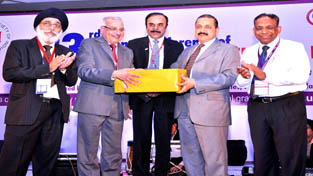
Dr Jitendra Singh being felicitated by past Presidents of “Association of Physicians of India” (API) Dr Siddarth Shah and Dr Murugnathan on behalf of ” Hypertension Society of India” at a function at New Delhi.
Unauthorized health centers
Directorate of Health Services Jammu Division caters to a vast area which is mostly hilly and where habitation is thinly dispersed over the higher reaches. One may say that supervision of health service outlets in these far flung areas poses some physical difficulty. As a result, the type of efficient medical support that would be required for these areas may not be available in full. This line of argument is understandable in the sense that easier the accessibility to the rural areas the better would be the health services. That is why the Government, whether in the State or at the Centre, have been attaching great importance to road connectivity because it is the key to all round development of the country.
This notwithstanding, the Directorate of Health Services Jammu cannot close eye to the need of efficient running of health services on district level and in rural areas. It is one thing to ask for expansion of health services to rural areas and another thing to provide efficient functioning of whatever has been provided. A bizarre case of no fewer than forty unlicensed and unregistered clinical labs, diagnostic centers, dental labs and nursing homes operating illegally and in clear violation of standing court orders in Rajouri and Poonch districts of Jammu region has come to light, and that too through an accidental disclosure. A youth in Rajouri was taken ill and brought to the hospital for treatment where the doctor suggested getting some tests made through a private diagnostic lab in the town. The report of the said lab showed serious health faults. Alarmed at this, the patient was taken to Jammu and admitted in the GMC where fresh tests showed that everything was normal with the patient. This prompted the patient to lodge an FIR against the Rajouri lab and after investigation by the police it was found that the diagnostic lab was not registered and did not have permission to function.
When this came to light, District Medical authorities came into action and after a survey it was found that forty such labs and clinics and dispensaries etc. were functioning under the very nose of the district administration in two border district of Poonch and Rajouri. Now, a detailed report of such illegal clinics in various towns of the districts under discussion like Rajouri, Sunderbani, Nowshera, Kalakote, Poonch, Mandi, Surankote and Mendhar compiled by the Health Department is available with us. The names of these clinics and labs have also been disclosed.
It is pertinent to mention that there are rules and regulations under which proper permission is to be obtained from the Health Department for opening a clinic, diagnostic centre, laboratory or nursing home or dental service centre. The Department of Environment and Municipal Committees are also involved because proper certification has to be obtained for authorized disposal of medical waste. Additionally, it has to be said that there is a court order directing the authorities to seal the premises if such units are not registered and granted valid license under the Jammu and Kashmir Nursing Homes and Clinical Establishments (Registration & Licensing) Act, 1963.
So far only two districts of Poonch and Rajouri have come under the scanner. One cannot say how many illegal and unauthorized such labs and clinics and diagnostic centers are running in other districts of Jammu province like Doda, Kishtwar, Ramban, Reasi and Udhampur. All that can be said is that the Directorate of Health Services of Jammu Division is deficient in maintaining strict control over mushrooming of unauthorized clinics and laboratories in the entire Jammu region. It is by chance that illegal and unauthorized running of clinics and labs has come to light. It is not the result of any action by the Directorate of Health Services. In other words if the Rajouri youth had not filed the FIR against health authorities of the district, the running of illegal and unauthorized clinics would never have come to light and that is a direct aspersion on the efficiency of the Directorate of Health Services of Jammu Division.
In these circumstances, the authorities at the Directorate of Health Services shall have to answer for dereliction of duty. The onus comes to their doorsteps and they shall have to be held answerable. We hope that this instance will serve eye opener for the Directorate and it will galvanize entire machinery into action. Those of the clinics, labs, diagnostic centre or nursing homes etc. which have not proper authorization so far should be inspected by a responsible official team and if found fulfilling the requirements they should be recommended for proper license and authorization letter. But such centers as do not fulfill the norms set forth in the books of rule should be sealed. This will send a message across the State that no unauthorized centre will be allowed to function as it involves the risk of playing with the health of the people.
A scene from the play “Musibat” staged by Natrang in its Sunday Theatre series.

A scene from the play “Musibat” staged by Natrang in its Sunday Theatre series.
A deputation of Sikh bodies presenting memorandum to Devender Singh Rana on Sunday.

A deputation of Sikh bodies presenting memorandum to Devender Singh Rana on Sunday.
Govt expects PSEs to meet high standards in CSR: Radhakrishnan
NEW DELHI, Aug 10: Asking public sector enterprises to weave their CSR activities around long-term sustainable development, the government has said state-run units should earmark more resources towards areas like health, education, drinking water and skill development.
“Our government encourages and expects PSEs to meet high standards in CSR and discharge their responsibilities in a planned manner. Their approach towards CSR planning should be based on long term sustainable development,” MoS Heavy Industries & Public Enterprises P Radhakrishnan said at a function organised by public sector body SCOPE.
“I appeal to PSEs to further leverage your CSR efforts in the area of health, education, drinking water, skill development etc. For underprivileged and marginalized persons so as to develop our society, economically socially and environmentally,” he added.
Under the new Companies Act, certain class of profitable entities are required to shell out at least two per cent of their three-year annual average net profit towards Corporate Social Responsibility (CSR) activities.
The government is also working on rationalising the CSR norms for public sector enterprises in tune with the new companies law.
At present, public sector entities (PSEs) follow CSR guidelines of the Department of Public Enterprises. (PTI)