

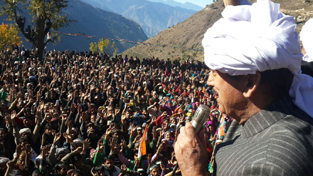
Leader of Opposition in Rajya Sabha Ghulam Nabi Azad addressing a public rally in Chenab Valley on Saturday.
Leader of Opposition in Rajya Sabha Ghulam Nabi Azad addressing a public rally in Chenab Valley on Saturday.
Students enjoying activity during Adventure camp at Heritage School in Jammu.
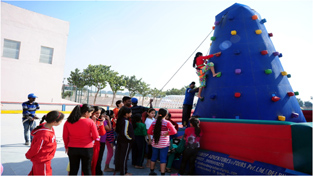
Students enjoying activity during Adventure camp at Heritage School in Jammu.
Asans being performed during Yoga Programme in Srinagar.
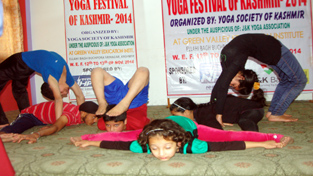
Asans being performed during Yoga Programme in Srinagar.
Children of Aglow Kids Play-Way School performing activity in the school premises during an impressive function.
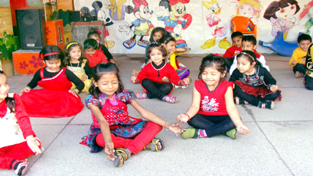
Children of Aglow Kids Play-Way School performing activity in the school premises during an impressive function.
A state of confusion, cynicism and war
M.J. Akbar
The stage was contrived but the empathy was spontaneous when Burma’s iconic leader Aung San Suu Kyii and Barack Obama addressed the media at her home in Yangon on Friday. BBC, the quasi-official voice of Britain, reported that a Nobel Peace Prize winner had met America’s President.
Actually, both have won this award. But memory also passes its own judgement, and often edits out an undeserving honour. Obama will enter history books for many reasons, but joy to the world is not among them. Joy has disappeared even in America, where voters punished him this month by trouncing his party candidates for Congress. Among their grievances was the belief that Obama had weakened America. Their evidence? The rise of the Islamic state in Iraq and Syria [ISIS].
Its self-styled Caliph Abu Bakr al-Baghdadi is now busy patching together the symbols of independence. He has set up a Shura [an early Islamic version of consensus decision-making] and promised to mint dinars that will, literally, be worth their weight in gold – or in silver and copper for lower denominations. Just in case you missed the news, one side will display the seven stalks of wheat mentioned in the Quran, while the other has a map of the world.
Why the map? Because the Caliph wants to bring the world under his rule. How? Check out the silver dinar. It shows a sword and shield, symbols of his Jihad. Separately, Al Qaeda has already declared war on a range of nations, including India and Burma, but this is a purely terrorist enterprise. The Caliph already has geography and for the immediate future has his eyes set on Saudi Arabia. That will give him even more oil, as well as, and this is far more important, control over the holy cities of Mecca and Medina. You cannot be a true Caliph without being custodian of the two mosques.
One western leader who seems clearly disoriented by the thought is British Prime Minister David Cameron. He told reporters in London last week that British youth who had gone to join the Jihad would not be permitted to return home for two years. On the 731st day, however, it would be all be okay. Prodigals would be welcomed back with one of four options: trial; detention at home; police monitoring or a de-radicalization course at some pretty university. He did not extend the offer to the fatted calf which the prodigal son got in the Bible, but there will be enough calves for the Jihadi during home detention, that gracious example of punitive action. Jihadis can also watch all the BBC serials they want; in the grey-dom of British intelligence, this is known as a sophisticated form of torture.
Something strange is going on in Britain, and I am not talking merely of government-speak. According to the Sunday Times of London, an opinion poll conducted by Populus revealed that one in seven Britons felt “warmly” towards ISIS. This is the warmth of approval, not the ire of wrath. Is this the romance of the negative among young Muslims, a form of reprisal against cultural excess and social alienation in their own communities? ISIS certainly has become a visible magnet for an alarming number of young men in Pakistan, and in other Muslim communities. It is still marginal in India, but we should not ignore the peril.
The ISIS upsurge in Pakistan is logical. We tend to forget that the first Islamic state in the post-colonial era was Pakistan. This fact was disguised for a long while because Pakistan won allies in the West. But the essential character of the state will assert itself in the minds of enough citizens. The suicide factories are probably gearing up for production of a new generation of warriors.
The Pakistan establishment, in the meanwhile, has turned this into another cash-in opportunity. For decades it has milked Washington, first to battle the Soviet Union, which ended in a handsome victory in Afghanistan. But next came a classic double game: with one hand, it took dollars to fight America’s enemies, and with the other hand patted the anti-American Jihad on the back. At the moment of writing the Pak army chief General Raheel Sharif is headed to Washington with a new inscription on the begging bowl: cash and hardware, please, to fight ISIS volunteers on Pak soil.
The bookends are confusion in London and cynicism in Islamabad. But the encouraging news is that there is growing clarity in Washington.The extraordinary reality is that, without making any fuss, and with implicit bipartisan consent, America has accepted Iran as a battlefield ally in the conflict against a Sunni Caliph. Iran has boots on the ground; America is using satellite intelligence and air power to degrade and destroy ISIS military capacity to the extent it can.
Obama tried, perhaps, to justify his Nobel Peace certificate for half a decade. We should welcome this failure. A peace prize is folly until the war is won, and this war is going to take time.
1977 revisits us in 2014 ?
B L Saraf
In run up to the state Assembly elections, the way political parties are shaping their stance and politicians brazenly go on party hopping, one can’t escape the impression that J&K is in for the repeat of 1977 exercise. In 1977, Janata Party , an amalgam of socialists , communalists and the centrists came into the existence in the wake of emergency and deposed the Congress Government , led by Indira Gandhi and assumed power at Delhi. In misplaced euphoria the Party government rode rough shod over the Congress lead State Governments and dismissed them. In the states where elections were due, unholy alliances with the disparate and self serving political characters were forged . Jammu & Kashmir was one such state.
In 1975, pursuant to the Indira – Sheikh accord , Mir Qasim lead Congress Government abdicated power in favour of Sheikh Mohammad Abdullah . But he was not allowed to enjoy power for a long and the Congress Party pulled the rug from under his feet in early 1977, and the state came under Governor’s rule . Fresh elections were ordered. The Janata Party saw an opportunity to clobber together the political elements opposed to Sheikh Abdullah , unmindful of their political ideologies and convictions . The Party commissioned George Fernadeze and Ashok Mehta to meet Mirwaiz Moulvi Farooq , Maulana Syed Massodi , Gulam Mohiddin Qarra and others to explore chances of establishing Janata Party in the State and fight the coming elections. The Party came into the existence. Apart from the persons mentioned above, Abdul Gani lone, Shamim Ahmed Shamim , Maulana Ifitiqar Hussain Ansari , Abdul Rashid Kabuli and other prominent political figures of the State joined the Janata Party, and entered the election fray in a full swing . No holds barred election campaign was unleashed . To bolster the chances of its candidates , the big wigs of the Janata Government at Delhi campaigned hard in the state for. They included Choudry Charan Singh – the Home Minister , Jagjiwan Ram- the Defence Minister and above all Prime Minister Morarji Dessai himself . Charan Singh and Jagjivan Ram , in total disregard to the basic rules of courtesy, launched a scathing attack on ailing Sheik Abdullah. Things came to such a passé that it took the political wisdom and sagacity of the PM Dessai to salvage the situation from a brink.
BJP appears to be more or less on the same path . Indications are that , in a rather secretive mode, the Party attempts to rope in those very political elements who they stood against, in not so distant past , and whose ideology it detested . Well , it is no sin to engage, peacefully, even with a sworn enemy . But that has to be in the broader national interest , with due regard to the transparency. It can’t be for a narrow partisan purpose . Indira Gandhi did it in Punjab, J&K and elsewhere in the country , having Congress party’s interest in mine. With the result, both, she in person , and the nation as a whole had to pay heavily for this short sighted policy. A murmur is growing loud that BJP is calculating on various ethnic, social and sectarian groups within the J Kian society for a narrow political purpose and is formulating an election strategy on these permutations and combinations . Well , given that the Sates’ society is vertically riven at the moment, thanks to the ongoing militancy , such a misadventure will be fraught with the serious consequences .
True, a Government at the centre has to strive for nation building and curb the fissiparous tendencies . None the less , it has to tread very cautiously in J&K . Whatever may work smoothly elsewhere the country may act counterproductive here . The inbuilt complexities of the situation can be ignored only at the national peril. In the larger national interests , para trooping of the outside political forces , particularly , in the Valley and a swashbuckling political campaign must be avoided at all costs. National integration has to be strengthened throughout – J&K including . But given a peculiar relationship of the state with the centre it has to be more bottom up than top down. Emotional and psychological integration is sine -quo – non for the physical and political integration .Aggressive political posturing will not do here . Local sensitivities should be kept in mind.
During the highly surcharged election campaign of 1977, some Kashmiris felt that though India was not their first choice, but since Sheikh Sahib had taken them there it was time to tell Indian people that the Kashmiris had associated with you on certain commonly cherished principles . They will, certainly , not allow India luxury of entertaining a feeling that it has annexed them like other states in the country . So , they would vote for Sheikh Abdullah . The more the central onslaught the more their resolve to rally behind Sheikh Abdullah. That was a down to earth assessment of the situation created by the overzealous Janata Party leaders of Delhi. No wonder , their so called stalwarts proved pigmies before the towering Sheikh , at the hustings. The spirit may have metamorphosed to a radical belief since 1990 , but, still , it is not beyond redemption. Love for Sheikh Abdullah may have waned but his thought has not completely evaporated. Despite the hardened prejudices, there is still something for India in Kashmir . That needs to be harnessed with care.
Kashmir youth has aspirations similar to those living elsewhere. Who better person than PM Modi to understand it? Let him work in this direction with earnestness, so that in the valley the aftermath of 1977 election does not visit the BJP in 2014.
(The author is former Principal District & Sessions Judge)
The wall
Anniversaries and jubilees, particularly of happy occasions, often excite one’s mind to look for newer possibilities in the present. A few days back, the Germans celebrated the silver jubilee of the fall of their much hated Berlin Wall and reunification of the West and East Germany. Would it be possible, I wondered, for India and Pakistan too to come together some time in future?
‘Disabuse yourself of such fantasies, son, and the sooner you do, the better!’ Kaga Bhushundi Ji screeched, rather too close to my ear.
‘Why do you say that, Kaga Ji? If Germans could do it, why can’t we?’
Kaga Bhushundi SpeakEth
Suman K Sharma
‘You cannot because in your hearts you wouldn’t like to. In 1947, your people wanted to split apart and they did. But the Germans had no such luck when they saw themselves defeated at the end of the last World War. America and its supporting nations of the West held the western part of the country under their sway and their arch rival, the Soviet Union, imposed its will on the eastern part….’
‘But Kaga Ji, I heard that the Berlin Wall was built in 1961, a good 16 years after the end of the World War II. If the two Super Powers were bent upon dividing Germany against its wishes, why did it take them so long to erect a barrier between the two parts?’
‘Son, let me tell you that neither the Americans themselves nor the Soviet Russia built the Berlin Wall. They only caused it to be built. After its defeat, Germany had to vacate vast territories it had occupied during the War. In that process, lakhs of migrating Germans had to face death and untold hardships. Then came the victors with their distinct agendas. America and its allies realized at an early stage that it was for the good of all of them in the long run if West Germany was enabled to rebuild its industry and become a partner in all-round development of the West. To achieve this purpose they granted to the West Germans, albeit grudgingly at first, some freedoms as well. The Soviet Union, in contrast, was in hurry to plunder its vanquished enemy as a reprisal for the humiliation and the material losses it had suffered in the War. What followed was repression and poverty in East Germany….’
‘Cut it short, Kaga Ji, you are not a Professor of History….’
‘True, son, I am but a humble crow. But let me tell you that even the dumb plants seek out sunshine to grow. Under America’s tutelage, West Germany had become such an industrialized country that it attracted workers from across seven seas to run its factories. The wages there were generous and living conditions far better than in most other countries. As you can expect, the downtrodden East Germans looked for the first opportunity to flee to West Germany. They jumped the check posts at the risk of their lives and they circumvented the restrictions through third countries like Hungary. By the end of 1950s, the mass movement from East Germany had become so heavy that the authorities there were forced to erect the massive Berlin Wall, with fearsome guns, to completely cut off the passage to West Germany….’
‘The rest I can guess, Kaga Ji. West Germany had everything which the people in East Germany wished to have. It took them all of twenty-eight years to demolish the Wall, yet they did it. But we in India and Pakistan have no such wall between us, only barbed-wire fences at some places. Why can’t we just remove them?’
‘Fences can be removed. But you have in your minds a wall much stronger than concrete, the Wall of Distrust. What will you do about it? There is poverty here and poverty there. It will only aggravate your condition and theirs if, only for argument’s sake, you were to reunite. The mutual suspicion which led you and the Pakistanis to part your ways is there to stand for ages to come. Better for you and the Pakistanis it is then to live like good neighbours and cooperate with each other for the common weal.’
With bullets and ballots
It goes to the credit of District Election Authorities in Leh to have taken the initiative of prompting 4000 strong Ladakh Scouts to exercise their right to franchise in the impending Assembly elections in J&K. The Ladakh Scouts, recruited from among the indigenous Ladakhi youth, are of crucial importance to the security of the border in Ladakh. They are locals and know the ins and outs of the geography and topography of the region that lies atop the heights of the Himalayas, which incidentally has become the world’s highest battlefield, if it comes to fighting. Along with the battalions of Indian Army, the Ladakh Scouts have been guarding the frontiers of India to its extreme north and in highly inclement weather conditions when at the peak of winter the temperature falls to -40 degrees Celsius.
Being citizens of the State, the jawans of Ladakh Scouts battalions are entitled to cast their vote on 25th of November for selection of their representative to the Legislative Assembly of the State. Indian democracy reaches even the farthest and the remotest persons on the Indian soil. Ladakh Scouts protect the country with their guns and bullets; they also have another weapon called the ballot with which they reassure that they will have their choicest representative in the Legislative Assembly of the State, where crucial matters of the development and progress of people of the State including those in the mountain fastnesses of Himalayas are discussed and decided. People feel comfortable with voting the candidates of their choice and choosing keeping in mind that they would plead the causes of the development of the region and protect the interests of the people of the region.
Though the four thousand strong voters of Ladakh Scouts are entitled to vote yet in the recent Parliamentary elections only one half of them cast the vote. And out of one half only about 860 ballots were considered valid. In this way 75 per cent of these voters remained outside the loop. The EC has taken notice of this discrepancy and under its programme of Systematic Voters’ Education and Electoral Participation (SVEEP), the District Election Officer in collaboration with the local commander and election staff visited Siachin and Nubra to speak to the jawans of Ladakh Scouts battalions that they should exercise their right to vote and the right process of sending their postal ballots. It is expected that if the Scouts cast their votes in full, it could have noticeable impact on the result of the polling. Apart from that, we consider it a very positive step on the part of the EC to educate the Scouts and others of the good sense of coming out to vote for a candidate of their choice.
Ladakh is a strategically very important region owing to the fact that it encompasses the northern frontier of the Indian Union. Of late it has come into prominence owing to the hostile stance of China with whom our border touches at in Ladakh. Chinese troops have been making unprovoked incursions into our territory and then withdrawing once confronted by the Indian troops. China claims that its limits of her western border end where there is last ethnic trace of Mongoloid race. But Ladakhis, who no doubt are of Mongoloid race, have never shown any sympathy with dictatorial political arrangement that China has. The people in Ladakh region are now part of the vast Indian democratic arrangement. They are fully conscious of the power and importance of ballot. Democratic dispensation has become part of their lives and they hold it dear to themselves. That is why the EC has taken all necessary steps to provide them the opportunity of exercising their right to vote.
Transparency in Public Affairs Responsibility of media critical
Geetartha Pathak
The exact meaning of the Sanskrit origin word “swachh” is transparent and not clean as many of us confuse it to be. Prime Minister Narendra Modi’s ‘Swachh Bharat Abhiyan’ is an ambitious mission which seeks participation of all citizens from different age groups in order to fulfil Mahatma Gandhi’s vision of ‘clean India’. He has received tremendous response from the public. Cities and villages look neat and clean overnight. However, we are yet to get a transparent India.
NATIONAL PRESS DAY
The country has experienced rampant corruption almost in every department that includes the defence and strategic sectors on account of secret dealings between the bureaucrats, political leaders, corporate and the middlemen. In spite of the enactment of Right to Information Act 2005, right information at the right time is rarest in the country. Mega corruption in coal allocations, 2G spectrum, Commonwealth Games, Adarsh Colony, Rolls Royce etc are only a few to name. All these scams wouldn’t have happened had the process of allotment been done in a transparent manner. The exposure is thanks to the CAG and a section of enthusiastic media.
Today, on ‘National Press Day’, the Press Council of India has the theme: “Transparency in Public Affairs: The Role of the Press”. The word transparency nowadays is widely used in the affairs of Government, business and social organizations to denote openness and accountability. Transparency means operating in a way that it is easy for others to see what actions are performed. Public affairs means matters of general interest or concern, especially those dealing with current social or political issues.
Therefore, transparency in public affairs means accountability and openness of the affairs of the Government and other organizations dealing with the public. British Professor of Accountancy and co-author of book ‘Transparency: The Key to Better Governance’ David Heald stated that many societies believe that transparency would reduce governmental malfeasance through its “sunshine” effect. To him, the demand for transparency has grown rapidly, with organizations in both private and public sectors being encouraged to be more transparent. After enactment of RTI Act in India, people are talking about transparency in governance and it is now an issue in times of election, revelation of major corruptions or failure of the State.
Corruption is an old colonial phenomenon, which dates back from the beginning of the 20th century. The disinfectant sunlight could not enter the fortified castle of our country’s administration since the rule of the British. Their weapon to indulge in corruption, by siphoning public fund from the coffers, was blatant secrecy. Therefore, to achieve their mundane goal they introduced infamous acts like the Official Secret Act of India (1923), Indian Evidence Act (IEA) etc. that remain unrevised despite decades of effort. The OSA arms the administration to deny access to any information to the public and the IEA gives opportunity to the courts to decide the scope of the public’s right to inspect.
The long-wrapped shroud over the administration had begun to shake for the first time when the Supreme Court observed in the famous S. P. Gupta Vs. President of India (1982) case that the disclosure of information about the Government and the right to know about Government come from the guarantee of free speech and expression in Article 19(1) (a) of the Constitution. This observation came in a series of judgments in that period.
In spite of its limitations and shortcomings, the enactment of the RTI Act is a major step towards ensuring a participatory developmental process in the country. To make the law truly effective, the active participation of the society particularly the non-governmental organizations at large is needed. The Press can take a proactive role by simplifying and disseminating the possibilities under the RTI Act. The pervasive influence of media can affect public opinion. It has been stated that the only means of influencing what people think is precisely to control what they think about.
The media has immense power and accessibility to control what people think. On the other hand, the media itself should be transparent in processing news and views and it must impress the readers /viewers with unbiased media product. Biased information can affect public policy if the Government manipulates information in order to cast a positive or negative light on it. Depending on how transparent a news article is, one can determine its reliability and draw one’s own conclusions from the findings.
The recent revelation of ‘paid news’ phenomenon in India has eroded the credibility of a section of media. The huge spending in the publicity head by political parties during elections indulges paid news in media. Association of Democratic Reform (ADR) quoted that Radha Timblo, one of the three black money account holders in foreign banks of the list of 628 named by the Central Government at the direction of the Supreme Court donated Rs 1.18 crore to the BJP and 65 crore to Congress between 2004-2012. Such denoted money must be percolated from the mining barons and corporate houses to a section of media in the form of paid news.
The PCI has observed that many companies offer shares and debentures to the media houses in lieu of news to be published in favour of the big business and corporate houses. Paid news is a double barrel gun by which a section of media earn money for publishing advertisement in the garb of news and at the same time evades taxation for the income they earn by such scandalous ways. How then will media companies focus on black money stashed in foreign banks, when they themselves generate black money using media power?
Democracy requires the active participation of citizens. Ideally, the media should keep citizens engaged in the business of governance by informing, educating and mobilizing the public. In many western countries, radio has become a popular medium of expression, as it is less expensive and more accessible. FM and community radio have been effective instruments for promoting democracy at grassroot level by airing local issues providing an alternative source of information to official and monopolized channels. However, the Government has not allowed private and community radio to broadcast news and views except entertainment and academic programmes perhaps as a shield to sunshine effect.
Further, concentration of media ownership in the hands of a few is a matter of great concern. Now politicians are investing in media to enhance their image and to influence the political system. In view of such media environment, people are looking for alternative media to get the real picture of social and political developments and at the same time to use the new media as an instant conduit of their feelings. Social media has filled in the vacuum and hence gained immense popularity.
President George W. Bush’s administration was often criticized for being the most secretive administration in history. With this background, President Barack Obama took office in 2009 promising to lead the most transparent administration in history. However, Obama has been criticized by the media for not keeping his promise of transparency. He is criticized for secretly obtaining AP phone records to find a government leak, denial of provision of Information Act and politically driven suppression of news and information about federal agencies etc.
The UPA Government which has received accolades for enacting the RTI Act itself suppressed information pertaining to some major financial anomalies and corruptions and tried to later dilute the provisions of the Act. In many States applicants hardly get response to their queries under the Act. People often complain that they get no response to their queries from Government departments. Many departments try to find faults in RTI applications only as an excuse not to reply. Even if they do, they are vague and not to the point. Therefore, pseudo transparency has taken the place of transparency. In such an environment of non-cooperation and opacity, transparency in public affairs has turned to be a far cry.
Notwithstanding the shortcomings, the media as a whole in the country has contributed tremendously to bring transparency in governance and in public affairs. The information hungry and justice seeking people of the country are expecting more from media. We can hope that traditional, electronic and the vibrant social media can fulfil the expectation of the people by harping on the body politic to deliver transparency in a transparent way.
(The author is former Member, PCI)
Steel prices remain flat in thin trade
NEW DELHI, Nov 15: The local steel market ended on a flat note in the national capital today as prices continued to move in a tight range in limited deals and settled around previous levels.
Traders said negligible enquiries from constructions units mainly kept steel prices unaltered.
Following are today’s quotations (in Rs per tonne):
Saria Kamdhenu: 8-mm 49,900, 10-mm 49,400, 12-mm 47,000, 16-25 mm 47,700.
Amba shakti (TMT): 8-mm 45,700, 10-mm 43,400, 12-mm 42,400, 16-25 mm 42,500.
MS Angle: (50×5) (50×6) 42,000, (40×5) (40×6) 42,800.
Angle Capital (ISI) (40X5) (40×6) 44,100, (35X5)(65X6) 44,600. Girder (125X65) 41,000. (PTI)