Pak desperate to push terrorists, troops on high alert
*UAS, drones being used regularly for surveillance
Sanjeev Pargal
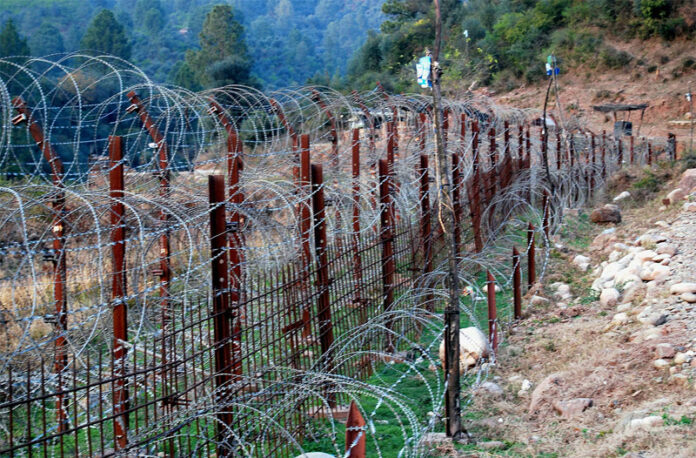
JAMMU, June 6: The Anti-Infiltration Grid has been further strengthen along the Line of Control (LoC) in Poonch and Rajouri districts in the Jammu region and Baramulla and Kupwara in the Kashmir division amid reports that Pakistan was trying to push terrorists into Jammu and Kashmir to increase their dwindling strength to cause subversive activities.
“Unmanned Aerial Systems (UAS), drones, surveillance cameras and many other sophisticated equipments have been installed along the LoC and manual patrolling has been further intensified all along the LoC to ensure that the terrorists don’t manage to infiltrate from Pakistan,” officials told the Excelsior.
Army chief Gen Upendra Dwivedi is expected to visit the Northern Command Headquarters and the LoC to supervise the Anti-Infiltration Grid after few days, the sources said, adding Gen NS Raja Subramani, who recently took over as the new Chief of Defence Staff (CDS) may also pay a visit to Jammu and Kashmir shortly as the UT remains prime focus because of the infiltration attempts by Pakistan and ongoing anti-terror operations in the upper reaches.
Northern Command chief Lt Gen Pratik Sharma and General Officer Commanding (GOC) 16 Corps Lt Gen PK Mishra have regularly been visiting the LoC to review anti-infiltration measures taken by the troops and to further strengthen them to ensure zero intrusions from Pakistan.
Asserting that adequate measures are in place on the LoC, sources, however, said that the steps are constantly being reviewed, improved, enhanced and upgraded to thwart designs of Pakistan and the terrorists.
Pakistan, as per the sources, is worried about dwindling strength of the terrorists and inability of those who are present to cause any terror act due to stringent security measures in place across the Union Territory including the sensitive and vulnerable areas. The killing of Saifullah, top Jaish-e-Mohammed (JeM) commander and his three associates in upper reaches of Chatroo in Kishtwar district in encounters with security forces in February this year, has further dented the terrorists and their mentors sitting in Pakistan as he was operating in different areas for the last two years and was instrumental in several terror attacks.
“Some of the foreign terrorists present in Jammu division have fled to the upper reaches of Kishtwar, Udhampur and other districts as snow has already melted there in the summer,” the sources but added that the terrorists keep changing their hideouts from one hilly area to another depending on pressure of the security forces.
Sources said majority of the infiltration attempts made by the terrorists with backing of Pakistan army in the past on the LoC have been successfully thwarted by the troops this year in which number of terrorists have been neutralized and rest fled back under the cover of darkness or dense forest area.
In anticipation of fresh intrusion bids along the LoC, security forces have been maintaining high alert along the LoC. Sources said sophisticated gadgetry has also been playing significant role in early detection of movement on the LoC leading to immediate action by the troops to neutralize the terrorists.
Security forces have trapped a group of three terrorists in Dorimal area of Gambhir Mugalan in Rajouri district for past about a fortnight. Contacts have been established by the security forces with the terrorists twice.
Security forces expressed confidence that the terrorists will be eliminated sooner or later.
Action linked to sexual exploitation of cognitively disabled minor boy
Excelsior Correspondent
SAMBA, June 6: Senior Superintendent of Police (SSP) Samba, Anuj Kumar, has suspended four police personnel, including the Station House Officer (SHO) of Ramgarh Police Station, and ordered an inquiry into allegations that they facilitated a compromise in a case involving the sexual exploitation of a cognitively disabled minor boy.
Official sources said Inspector Bhupinder Singh, SHO Ramgarh Police Station, Probationary Sub-Inspector Bilas Kotwal, and Assistant Sub-Inspectors Sansar Singh and Nek Ram have been placed under suspension and attached to the District Police Lines pending the outcome of the inquiry.
Special Police Officer (SPO) Rakesh Kumar, who was associated with the investigation, has also been transferred from Ramgarh Police Station to Police Post Goran, they said.
Meanwhile, Inspector Ajay Singh Chib has been posted as the new SHO of Ramgarh Police Station.
Sources said the case pertains to the alleged sexual exploitation of a cognitively disabled minor boy from Ramgarh area last week by three youths.
After the incident came to light, they said the victim’s family approached the police. However, instead of immediate registration of a case, efforts were allegedly made to settle the matter through a compromise.
Upset over the handling of the complaint, sources said the family approached senior authorities, including the Child Welfare Committee chairperson Namisha Rajput, DC Samba Ayushi Sudan, and SSP Samba Anuj Kumar.
Following their intervention, a case under the Protection of Children from Sexual Offences (POCSO) Act was registered on the night of May 30 and three accused youths were arrested.
Chairperson of the Child Welfare Committee, Namisha Rajput, said she took cognizance of the matter on May 30 itself after being informed about the incident.
The victim was later admitted to AIIMS Vijaypur for treatment and discharged after his condition improved after 3-4 days.
SSP Samba Anuj Kumar said action was taken immediately after the matter came to his notice.
He said an internal inquiry found that police personnel had attempted to hush up the matter instead of ensuring prompt registration of the case.
The police officer assured that further investigation into the case is underway and strict action will be taken against anyone else found responsible.
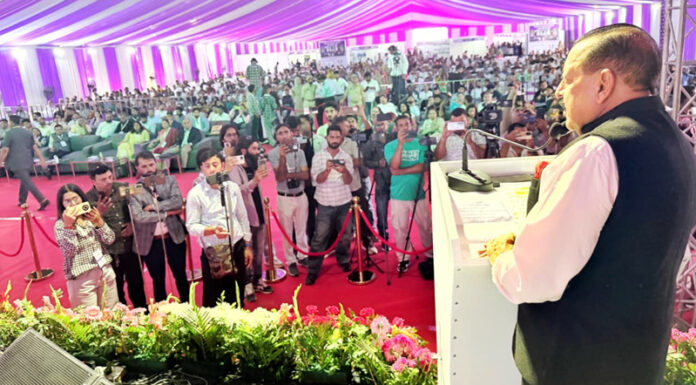
Union Minister Dr Jitendra Singh addressing a gathering at Bhaderwah. —Excelsior/Tilak Raj
2-day Lavender Festival at Bhaderwah
*Azad lauds Union Minister’s efforts
Avtar Bhat
BHADERWAH, June 6: Union Minister of State in PMO with Independent charge of Science & Technology and Earth Sciences Ministries, Dr Jitendra Singh today said highlight of 12 years of Narendra Modi Government is prioritizing unexplored sectors including Himalayas.
Talking to reporters on the sidelines of inauguration of 4th two-day Lavender Festival 2026 under the theme “Lavender goes Global’’ in Bhaderwah today organised by CSIR Indian Institute of Integrative Medicines (IIIM), Dr Jitendra Singh said exploring of Himalayas has emerged as new avenue of economic generation and transformation particularly in Agriculture and rural sectors.
CLICK HERE TO WATCH VIDEO
The Union Minister said “The value addition will come from unexplored sectors and we have to explore them tremendously for economic transformation both in Agriculture and rural sectors’’.
Dr Jitendra Singh said though the Bhaderwah has emerged as hub of Aroma Mission and Lavender cultivation, there is need of increasing quantity to export its products to other countries.
Meanwhile, former Chief Minister of J&K Ghulam Nabi Azad, who hails from Bhaderwah, has congratulated Union Minister Dr Jitendra Singh and farmers for Lavender Festival and making it an annual feature. He urged the Central Government to take steps for marketing of Lavender. He said when he was the Chief Minister of J&K in 2007, he too had taken steps to this effect and added that Dr Jitendra Singh has taken keen interest and campaigned for Lavender.
He said the CSIR has 37 branches in the country and every branch has one success story to tell during last 12 years. “Modi gave an impetus to this mission by making the mention of Remote area of Bhaderwah and this mission in his Mann Ki Baat. He said CSIR Lucknow has grown 108 leaves of Lotus and Modi gifted it to the visiting President of Vietnam at Ayodhya.
He said likewise IIIM Jammu gave birth to purple revolution and Lavender cultivation. He said 6000 youth are involved in Lavender cultivation and Aroma Mission in J&K and earlier a farmer earning Rs 15,000 to 20,000 from agriculture is earning in lakhs from Aroma Mission and Lavender cultivation.
He said the startups are not only linked to IT Sector but other fields also. The distillation is done in fields and Government provides market support also. “The Lavender Oil produced by us is better in quality than other nations’’, he added.
Earlier addressing the function, he said “Lavender has given the small town of Bhaderwah a national identity and a national role in India’s economic growth, he said,. What was once considered a remote hill town has today emerged as a beacon of India’s rural StartUp movement”.
BCCI President, Mithun Manhas, who also happens to be a son of the soil, was guest of honour on the occasion. The festival was held to celebrate the remarkable transformation of Bhaderwah from a traditional agrarian region into India’s leading Lavender cultivation and Aroma entrepreneurship hub.
Dr Jitendra Singh described Bhaderwah as one of the most successful examples of technology-led rural transformation in the country. He said the Purple Revolution has demonstrated how scientific research can be translated into sustainable livelihoods and entrepreneurship in remote mountainous regions.
The Union Minister credited Prime Minister, Narendra Modi’s vision of Startup India and science-driven development for the success of the Lavender Mission. He recalled that Modi had dedicated a significant portion of the 99th episode of Mann Ki Baat to Bhaderwah’s lavender success story.
Highlighting the economic impact of the mission, he noted that several young entrepreneurs associated with Lavender cultivation are earning substantial incomes through cultivation, processing and marketing of value-added products. He said Bhaderwah’s model is now being studied and replicated in other Himalayan and Northeastern states.
Dr Jitendra Singh said that Bhaderwah and the entire Doda region have witnessed remarkable developmental progress over the last 12 years. He highlighted the ongoing work on National Highway-244, stating that improved connectivity is transforming the socio-economic landscape of the region and opening new avenues for growth and opportunities.
Dr. Jitendra Singh attributed the success of the Lavender Mission to the active involvement of scientific institutions, industry experts and capacity-building initiatives. He said that sustained handholding, technology support and global-level conferences helped expand the model to other parts of the country.
Emphasising the vision of Viksit Bharat, he said that while the nation celebrates 12 years of transformative governance, planning is already underway for the next two decades. He stressed the need to unlock the potential of unexplored regions, particularly the Himalayan belt, and said that the Aroma Mission is inherently linked to the Himalayan ecosystem and will continue to play an important role in the region’s sustainable development.
In her address, Director General CSIR Dr. N. Kalaiselvi said the Purple Revolution represents one of the most impactful examples of science reaching grassroots communities. She noted that the initiative has successfully linked laboratory research with rural livelihoods and has emerged as a model for sustainable agricultural development across the country.
Professor V.K. Singh of IIT Lucknow highlighted the role of science and innovation in driving rural transformation and praised the CSIR Aroma Mission for successfully translating research into livelihood opportunities for farmers.
Earlier, welcoming the guests, Director CSIR-IIIM Dr. Zabeer Ahmed highlighted the achievements of the CSIR Aroma Mission and its transformative impact on rural communities across the country. Dr. Ahmed said that Lavender cultivation under the Aroma Mission has emerged as one of the most successful examples of science-led rural development in India.
“Over the last three phases of implementation, lavender cultivation has expanded to nearly 1,500 hectares, benefiting more than 4,500 farmers and farming families,” he said. “The initiative has led to the extraction of over 4,000 kilograms of high-value lavender oil and generated cumulative revenues exceeding Rs 18 crore, significantly enhancing rural incomes and creating sustainable livelihood opportunities,” he added.
The venue of the festival witnessed a display of innovation and entrepreneurship with dozens of stalls showcasing lavender oil, perfumes, cosmetics, soaps, incense products, herbal formulations, value-added aroma products, agri-technologies and startup innovations developed under the CSIR Aroma Mission.
The event also featured institutional presentations on the progress of the Purple Revolution, signing of Memorandums of Understanding (MoUs), launch of new lavender-based products, and felicitation of progressive farmers and successful startups who have contributed significantly to the growth of the aroma industry in Jammu and Kashmir.
Among those present on the occasion were MLA Bhaderwah Daleep Singh Parihar, MLA Doda West Shakti Raj Parihar, Prof. Vinod K. Singh, Institute Chair Professor, Department of Chemistry, IIT Kanpur, Chairman, CSIR-Research Advisory Board (RAB) and Mentor, CSIR-IIIM, Director of CSIR-Indian Institute of Chemical Technology (IICT) Dr. D. Srinivasa Reddy, Director CSIR-National Botanical Research Institute (NBRI) Lucknow Dr. Ajit Kumar Shasany, Deputy Commissioner Doda, Krishan Lal, senior scientists, officials, and representatives of startups and farmer groups.
Senior scientists Dr Suphla Gupta, Senior Principal Scientist and Nodal Officer, CSIR Aroma Mission, and Dr Saurabh Saran, Senior Principal Scientist CSIR-IIIM, were also present during the programme along with scientists, researchers, startup founders and representatives from the aroma industry.
‘Accuracy of orders is judge’s responsibility, not digital tools’
*UT-wide directions issued for strict compliance
Mohinder Verma
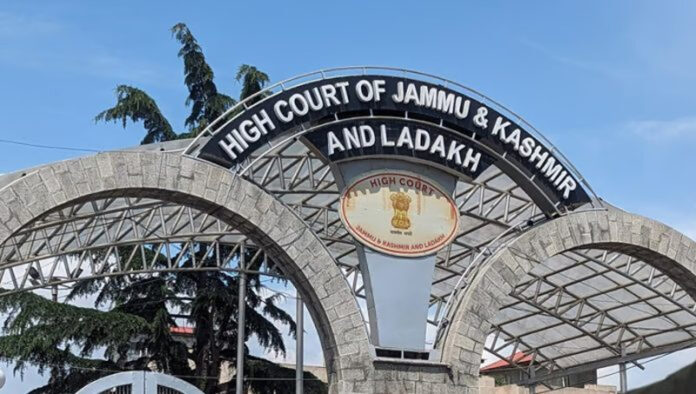
JAMMU, June 6: In a significant judgment with far-reaching implications for the judicial system, the High Court of Jammu & Kashmir and Ladakh has cautioned Judicial Officers against relying on unverified judicial precedents and Artificial Intelligence-generated legal research, emphasizing that the ultimate responsibility for the correctness, accuracy and authenticity of judicial orders rests solely upon the authoring judge.
Delivering judgment in Principal, Woodland House School, Srinagar & Others Versus Shakeel Ahmad Malik case, Justice Wasim Sadiq Nargal devoted an extensive postscript to concerns arising from the record regarding the quality and reliability of judicial reasoning and citation practices.
The High Court noted that counsel for the petitioners had argued that the impugned order substantially relied upon certain judicial precedents without furnishing complete and accurate citations, without identifying the legal principles emerging from those decisions and without examining their applicability to the facts of the case.
Acting on the submission, the High Court undertook an independent verification of the judgments relied upon by the trial court. Upon examination, the High Court found that the citations attributed to the two principal judgments forming the basis of the impugned order were incorrect.
According to the judgment, in one instance, not only was the citation erroneous, but the title of the decision recorded in the impugned order could not be traced despite diligent search and verification. The High Court observed that the judgment does not appear to exist in the form in which it has been referred to by the trial court. In the second instance, although a decision bearing a similar title could be located, the citation assigned to it did not correspond with the decision and was found to be patently incorrect.
While clarifying that these defects did not warrant interference with the impugned order on merits, the High Court said the issue nevertheless raised concerns touching upon the quality and reliability of judicial reasoning.
“Reliance upon judicial precedents constitutes an integral component of the adjudicatory process and, therefore, the authorities cited in support of a conclusion must be accurate, authentic and capable of verification”, the High Court observed.
Justice Nargal further expressed concern over what the court described as a tendency in some cases to refer to the ratio of judgments by paraphrasing the perceived principle in the words of the author of the order rather than reproducing the relevant extracts from the judgments themselves.
The High Court observed that the ratio decidendi (the reason for the decision) of a judgment must be gathered from what has actually been held by the court and not from an individual understanding of the decision. Reproduction of relevant extracts, the High Court said, ensures fidelity to the precedent relied upon and minimizes the possibility of unintended distortion of legal principles.
The High Court directly addressed the growing use of Artificial Intelligence-based tools and digital research platforms in legal and judicial work. The High Court acknowledged that such tools may serve as useful aids for research but categorically held that they cannot substitute judicial scrutiny and verification.
“Any proposition of law, citation, extract or precedent generated or suggested by an Artificial Intelligence tool must be independently verified from authentic and authoritative sources before being relied upon in a judicial order”, the High Court said, adding “Judicial Officers must remain mindful that the ultimate responsibility for the correctness, accuracy and authenticity of the contents of a judicial order rests solely upon the authoring judge”.
Emphasizing the need for caution, the High Court said that the use of technological tools must be accompanied by rigorous verification to ensure that judicial determinations are founded only upon genuine and verifiable legal authorities.
The High Court consequently issued a caution to Judicial Officers across the Union Territory to exercise greater care and circumspection while citing judicial precedents in future. It directed that judgments relied upon must be correctly cited, capable of verification and must faithfully reflect the proposition of law sought to be applied.
For the guidance of all Judicial Officers, the High Court laid down four specific directions. It emphasized that any citation, precedent, extract, factual assertion or proposition of law obtained through Artificial Intelligence platforms or similar technological tools must be independently verified from authentic and authoritative sources before being relied upon or incorporated in any judicial order.
Further, every precedent relied upon in a judicial order shall be accompanied by a complete and accurate citation; wherever a precedent constitutes the foundation of a finding or conclusion, the relevant extract of the judgment should, as far as practicable, be reproduced verbatim rather than paraphrased and citations obtained from unofficial compilations, secondary sources or electronic databases should be cross-verified with authentic sources before being incorporated into judicial orders.
The High Court directed that a copy of the judgment be forwarded to the Registrar Judicial of both wings of the High Court for circulation among all Judicial Officers in the Union Territory for information and compliance.
The observations came while dismissing a petition filed by the Principal of Woodland House School and two academic supervisors challenging an order directing implementation of an earlier interim direction requiring payment of 50 percent salary to respondent Shakeel Ahmad Malik for a specified period.
The High Court rejected the petitioners’ argument that an interim order passed under Order XXXIX Rules 1 and 2 CPC could not be executed. Relying on Section 36 CPC and Supreme Court precedent, the High Court held that judicial orders, including interim orders, are executable and that proceedings under Order XXXIX Rule 2-A CPC are not the exclusive remedy for non-compliance.
The High Court found that the interim order dated June 14, 2022 had already been upheld by the appellate court as well as by the High Court in earlier proceedings and that the petitioners had repeatedly sought to resist its implementation.
Describing the petition as devoid of merit and a continuation of efforts to delay compliance with binding judicial directions, the High Court upheld the impugned order dated October 15, 2025, dismissed the petition and imposed costs of Rs 25,000 on the petitioners. The High Court further directed compliance with the original interim order and permitted the executing court to adopt all permissible measures in law to secure its enforcement.
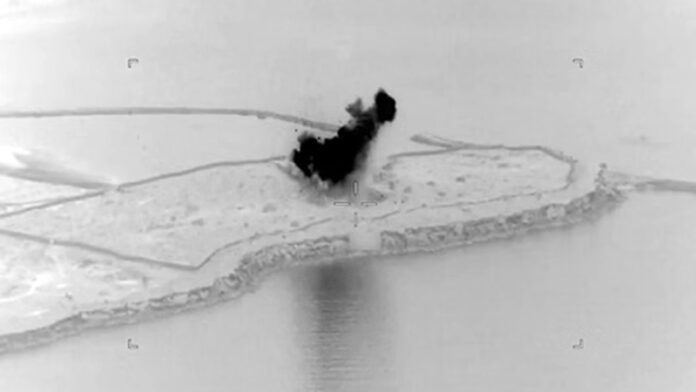
The US military said it shot down Iranian ballistic missiles and drones launched toward the Strait of Hormuz and Gulf Arab allies on Friday, while striking some of the Islamic Republic’s coastal surveillance radar sites in response, an exchange of fire that further frayed a shaky ceasefire with Tehran.
CLICK HERE TO WATCH VIDEO
The exchange of strikes comes as the Trump administration ramps up pressure on Iran to make a deal to end the conflict.
US Central Command said on social media Friday night that Iran fired seven ballistic missiles toward Kuwait and Bahrain, with US forces intercepting six of the missiles and a seventh failing to reach its target. The military said there were no reports of harm to US personnel.
The ballistic missiles were fired after the US earlier in the day shot down four Iranian drones that were launched toward Strait of Hormuz.
“The attack drones posed an immediate threat to regional maritime traffic,” US Central Command said on social media.
Kuwaiti’s military said forces were intercepting missiles and drones attacking the country, while Bahrain activated air raid sirens and told residents to move to the nearest safe location and follow official instructions.
Iran’s Revolutionary Guard said it targeted the Ali Al Salem airbase, which hosts US forces in Kuwait, and the US Navy’s 5th Fleet in the tiny Gulf island nation of Bahrain, according to the state-run IRNA news agency.
The US military is enforcing a blockade on Iranian ports in response to Tehran’s chokehold on the crucial corridor for global oil and natural gas shipments, which has sent energy prices spiking and posed political problems for President Donald Trump’s Republican Party ahead of the midterm congressional elections.
US Central Command said it hit the radar sites, including an island in the strait, “to defend against further attacks.”
It was the latest in back-and-forth attacks that have strained the tenuous ceasefire in the war and efforts to reach a deal to extend that truce. Earlier this week, Iranian drones heavily damaged a passenger terminal at Kuwait’s main airport, killing one person, wounding dozens and briefly closing the airfield.
Despite the attacks raising new concerns that the ceasefire could collapse, Trump told reporters Friday that “the situation with Iran seems to be going quite well.”
“We’re going to come out of Iran very quickly and it’s going to be very strong one way or the other, whether it’s a piece of paper or the very tough way,” Trump said at an event with farmers in Wisconsin. “The very tough way is maybe the easier way, but we’re going to come out, and your fertilizer prices are going to go way down, just like they were four months ago.”
Trump increasingly appears to be boxed in on a conflict that has settled into a holding pattern. U.S. and Iranian negotiators reached a tentative agreement a week ago to extend the ceasefire by 60 days and start a new round of talks on Iran’s nuclear program. But Trump has called for unspecified changes and Iranian officials have shown no public signs of signing off on the deal.
Asked on Friday why it was taking so long, Trump told NBC’s “Meet the Press” it was because “it’s a very hard thing for them,” citing their “great independence” and the fact that “they’re strong, they’re proud.”
“There are things they never thought they’d be doing that they’re going to have to do. They’ve got no choice, and it takes a little while,” he said in the interview.
Trump said the Iranians still have 21 per cent to 22 per cent of their missiles. (AP)
OSLO, June 6: Grandmaster R Praggnanandhaa etched his name in the history books as he became the first Indian to win the prestigious Norway Chess title with a final-round victory over Germany’s Vincent Keymer here, capping off a brilliant campaign in style.
Praggnanandhaa, who began the final day in third place with 15 points, delivered when it mattered the most, securing a classical win worth three full points to finish on 18 points and clinch one of the most coveted trophies in elite chess.
In doing so, the 20-year-old Chennai player achieved a feat that had eluded even Indian chess legend Viswanathan Anand and reigning world champion D Gukesh among others, since the tournament’s inception in 2013.
Competing in Norway Chess for only the second time, Praggnanandhaa endured a slow start in the elite six-player field before gathering momentum in the second half of the event to secure four wins on the trot.
His campaign was highlighted by a remarkable achievement — defeating seven-time Norway Chess champion and World No. 1 Magnus Carlsen twice in classical chess — a rare accomplishment that underlined his determination to bounce back from the disappointment of an underwhelming Candidates Tournament in Paphos earlier this year.
As reigning world champion Gukesh fell out of contention in the closing stages, Praggnanandhaa ensured that India’s challenge remained alive, ultimately carrying it all the way to the title.
The result was made possible after American Grandmaster Wesley So, who led the standings with 15.5 points heading into the final round, was held to a draw in his classical game against Alireza Firouzja, sending their contest into an Armageddon tie-break.
That outcome opened the door for Praggnanandhaa, who knew that a classical victory over Keymer would propel him to the top of the standings and secure a landmark title.
Although Wesley So went on to win the Armageddon tie-break, the victory was worth only 1.5 points, taking his tally to 17 points — one short of Praggnanandhaa’s winning total of 18.
Alireza, who had also entered the final round with title hopes, finished third with 15.5 points.
Meanwhile, Gukesh’s disappointing campaign continued as his third appearance in the tournament ended without the breakthrough he had hoped for in a year when he is set to defend his world title against challenger Javokhir Sindarov.
In the final round, Carlsen, playing with the white pieces, defeated the 20-year-old Indian in a classical game to collect three full points. However, the victory was not enough to propel the Norwegian great into title contention, as he finished fifth in the standings with 13 points. (PTI)
Excelsior Correspondent
JAMMU, June 6: An army officer died after slipping in a mountainous area and falling into a deep gorge during an anti-terror operation in Rajouri district this evening.
The officer, a Lieutenant, was part of the security forces engaged in Operation Sheruwali, which entered its 15th day.
Operation Sheruwali is underway in the Dorimaal and Gambhir Mughalan belt to track down two to three Pakistani terrorists believed to be hiding in the forests of Rajouri district.
During the search operation, the lieutenant reportedly slipped and fell into a 30-metre-deep gorge in the Dorimaal area, the officials said, adding that he succumbed to his injuries.
The body has been recovered, and further details are awaited.
Excelsior Correspondent
DEHRADUN, June 6: The Jammu and Kashmir police has arrested another woman from Haridwar in much talked about suspected financial transactions linked to Pakistan few days back.
Sources said that a team of Kathua police which is investigating the suspected financial transaction case arrested Puja from Dhanauri in Haridwar. Earlier police had arrested Sonam from Asafnagar village of Haridwar’s Kalyari Kotwali area.
The arrest of two women from Haridwar by Jammu and Kashmir Police for suspected financial transactions linked to Pakistan, has created a flutter among Uttarakhand security forces.
Sources said after the arrest of the first woman, Sonam, from Asafnagar village of Haridwar’s Kaliyar Kotwali area, relating to her alleged financial transaction linked to Pakistan on May 26, Jammu and Kashmir police on June 4 took her friend Pooja along with them for investigation.
The women were arrested following an input received from a man named Rahul Khan of Kathua district in Jammu and Kashmir who was arrested by Lakhanpur police last month along with his wife for suspected bank transactions from across the border.
Khan confided to police about his Pakistan connection and links with Sonam and Puja in Haridwar.
Khan, who is accused of being involved in financial transactions worth crores of rupees from Pakistan, revealed the involvement of Sonam.
According Haridwar police, Rahul Khan informed J&K Police he was operating a bank account in the name of Sonam for conducting illegal financial transactions worth crores.
According to Haridwar police, Sonam used to transfer the money to other states on behalf of Rahul Khan for a fixed commission in return.
A police official from Haridwar shared on condition of anonymity that Puja, a resident of Dhanauri in Haridwar, had introduced Sonam to a man identified as Umar, following which the latter got Sonam in touch with Rahul Khan.
Haridwar police stated that earlier Jammu and Kashmir police arrested Sonam and took her away with them.
After this talk of the involvement of another woman working with Sonam in the illegal transactions from Pakistan surfaced. On Wednesday, Jammu and Kashmir Police arrived in Dhanauri and took Puja into custody who was evading arrest till then.
On Thursday, Jammu and Kashmir police sought her transit remand for further probe. Following this, her transit remand was secured on Thursday and late in the evening Jammu and Kashmir police left with Pooja for further probe.
Haridwar Police confirmed that Jammu and Kashmir Police team questioned Puja and took her with them for more investigation.
Sources said police is also investigating the role of one Umar in the case.
Excelsior Correspondent
SRINAGAR, June 6: Government College for Women (GCW), M.A. Road, Srinagar, has been conferred the Gold Award for Green Campus and Sustainable Initiatives by the Climate Reality Project: India & South Asia, recognising its efforts to promote environmental sustainability and climate action.
The award was announced during the valedictory function of the college’s week-long Environmental Week celebrations held from June 1 to 6.
College authorities said the recognition was awarded for a range of sustainability measures implemented on the campus, including air quality monitoring, solar energy adoption, waste segregation and composting, rainwater harvesting, biodiversity conservation, plantation drives and environmental awareness programmes.
Principal Prof. Yasmeen Farooq termed the award a significant achievement for the institution and credited students, faculty members and staff for contributing to the college’s environmental initiatives.
She said the recognition would encourage the institution to further strengthen sustainable practices and continue its efforts towards environmental protection and climate resilience.
The Environmental Week celebrations were organised by the Eco Club in collaboration with the NSS units under the theme “Inspired by Nature: For Climate, For Our Future.”
Activities conducted during the week included cleanliness drives, waste audits, awareness programmes, biodiversity competitions, renewable energy presentations and plantation campaigns.
The concluding function at the college’s Lalla Ded Auditorium was attended by Prof. Azra Nahid Kamili, Director and Head of the Centre of Research for Development, University of Kashmir, and Aadil Bhat, Climate Reality Leader and Programme Officer of The Climate Reality Project J&K.
UNITED NATIONS, June 6:
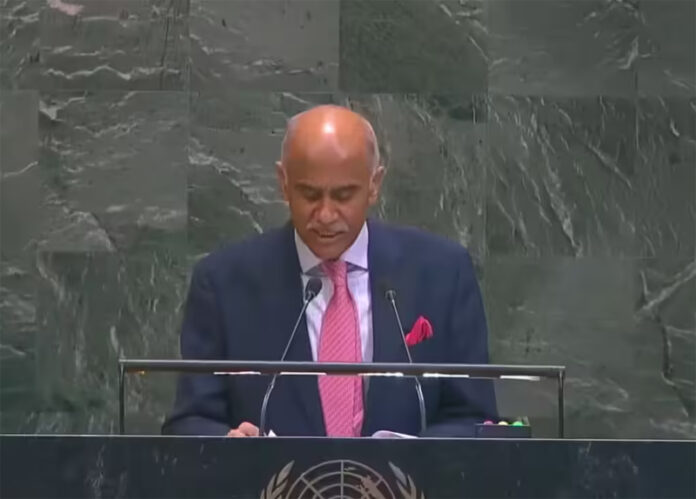
India has slammed Pakistan for its “unwarranted reference” to Jammu and Kashmir at the UN, telling the current non-permanent member of the global body that it was a huge responsibility and not a forum for peddling “biased and false narratives”.
“The unwarranted reference by Pakistan to a matter strictly internal to India, the Union Territory of Jammu and Kashmir, has compelled me to respond,” India’s Permanent Representative to the UN Ambassador Parvathaneni Harish said on Friday.
The strong retort by Harish came after Pakistan’s Permanent Representative to the UN Ambassador Asim Iftikhar Ahmad raised the issue of Jammu and Kashmir in his remarks in the UN General Assembly on Friday on the ‘Annual Report of the Security Council’.
Pakistan, which constantly raises the issue of Jammu and Kashmir as well as other topics internal to India at various UN platforms, currently sits in the Security Council as a non-permanent member and its tenure will end this year.
Harish said in the UNGA hall that Pakistan has decided not to spare this forum either from their characteristic misuse of august UN platforms for their divisive political interests.
“Abuse of its presence on the Security Council by Pakistan, including through the circulation of several misinformed and misleading communications also testifies to this counter-productive approach. I would like to remind Pakistan that being a member of the UN Security Council is a huge responsibility. It is not a forum for peddling biased and false narratives,” Harish said.
Making it clear that Jammu and Kashmir was, is and will always remain an integral and inalienable part of India, Harish emphasised that any assertions to the contrary are baseless, devoid of and inconsistent with historical facts.
“Empty rhetoric and hollow claims by Pakistan would not change this fundamental reality. In the interest of time of the wider UN membership, I would not delve any further into this,” he said.
The Indian envoy also pointed out that the international community recognises the importance of reform of the Security Council to make it fit-for-purpose to handle contemporary and future challenges we face.
“The current structure reflects geopolitical realities of 1945. Retaining the staus quo has so far not enabled effective functioning of the Security Council and cannot do so in future,” he said.
He noted that the “marginal” reform in the 1960s that expanded only the non-permanent category has not changed the fundamental mode of functioning of the Security Council in any impactful manner.
“Expansion of both permanent and non-permanent categories is central to implementing real and meaningful reform,” he said. (PTI)