

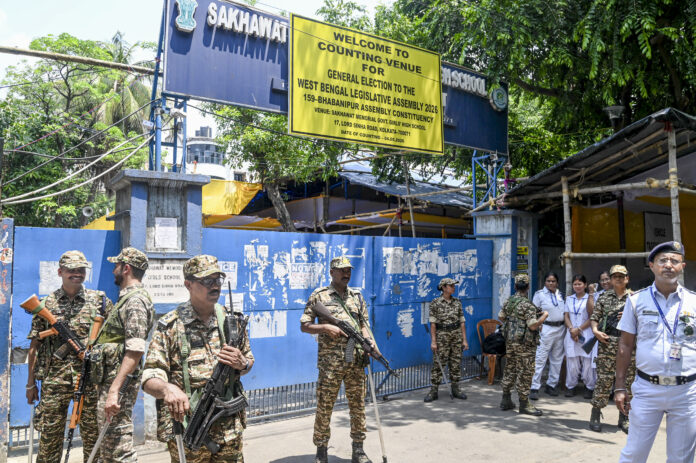
KOLKATA, May 4: Counting of votes for the high-stakes assembly elections in West Bengal began at 8 am on Monday, with the verdict set to decide whether the Mamata Banerjee-led TMC returns to power for a fourth consecutive term or the BJP scripts history by forming its first government in the state.
The counting is being held for 293 of 294 assembly segments in 77 centres across 23 districts of the state under a multi-layered security cordon, deciding the fate of 2,926 candidates.
The elections were held under the shadow of the SIR exercise, in which the names of around 91 lakh people were removed from the electoral rolls, which shrank to around 6.82 crore.
The polling was held in two phases — on April 23 for 152 seats and on April 29 for 142 seats, recording a voter turnout of 92.47 per cent — the highest since Independence, according to the Election Commission.
While repolling was held in 11 booths of Magrahat Paschim and four in Diamond Harbour assembly segment on May 2, the EC countermanded polls in the adjacent Falta constituency, citing “severe electoral offences and subversion of democratic process during polling in a large number of polling stations”.
The fresh poll in that seat will take place on May 21, and counting on May 24.
The postal ballots, through which those engaged in poll duty vote, are being counted first, followed by the EVMs. Several rounds of counting will be held in every seat, with early trends expected shortly.
The elections have been keenly contested, with the ruling TMC aiming to retain power for a fourth consecutive term, while the BJP is seeking a historic breakthrough in the state. The CPI(M)-led Left Front and the Congress are looking to regain lost ground after their rout in the 2021 elections.
More than 2.5 lakh personnel of the Central Armed Police Forces (CAPFs), along with state police, have been deployed, with the TMC and BJP engaging in a showdown outside several strongrooms, where EVMs were stored, in the run-up to the counting.
In state capital Kolkata, counting for 11 assembly constituencies is being conducted across five locations — Ballygunge Govt High School, Baba Saheb Ambedkar Education University, Sakhawat Memorial Govt Girls’ High School, Netaji Indoor Stadium and St Thomas Boys’ School.
TMC contested 291 seats, while its ally Bharatiya Gorkha Prajatantrik Morcha (BGPM), led by Anit Thapa, fielded candidates in three seats in the Darjeeling Hills. The BJP fielded candidates in all 294 seats, while the Congress contested 292 seats.
The four-party Left Front contested 246 seats, and lent support to CPIM(L) Liberation on 10 assembly segments, ISF and SDPI on 29 seats, and an Independent and other Left-wing outfits on the remaining seats.
The campaign witnessed a high-decibel contest, with senior BJP leaders, including Prime Minister Narendra Modi, Union Home Minister Amit Shah and Defence Minister Rajnath Singh, targeting the TMC on issues such as corruption, law and order, infiltration, women’s safety and unemployment.
The TMC, led by Chief Minister Banerjee and her nephew Abhishek Banerjee — the party’s national general secretary, countered with a campaign focused on alleged harassment of people during the Special Intensive Revision (SIR) of electoral rolls and Bengali pride.
In the 2021 elections, the TMC had won 215 seats, while the BJP bagged 77, and the Gorkha Janmukti Morcha and ISF one seat each.
Among the prominent TMC candidates are CM Banerjee, who is being challenged by Leader of the Opposition Suvendu Adhikari in Bhabanipur, state ministers Sujit Bose in Bidhannagar, Firhad Hakim in Kolkata Port, Jyoti Priya Mallick in Habra, Bratya Basu in Dum Dum, Sovandeb Chattopadhyay in Ballygunge, Aroop Biswas in Tollygunge, Manas Bhuniya in Sabang, Moloy Ghatak in Asansol Uttar, Udayan Guha in Dinhata, Shashi Panja in Shyampukur and Chandrima Bhattacharya in Dum Dum Uttar.
The BJP’s heavyweight candidates include ex-MP Nisith Pramanik in Mathabhanga, Sankar Ghosh in Siliguri, Gouri Shankar Ghosh in Murshidabad, Subrata Thakur in Gaighata, ex-MP Dilip Ghosh in Kharagpur Sadar, Koustav Bagchi in Barrackpur, Ratna Debnath in Panihati, Sajal Ghosh in Baranagar, Rekha Patra in Hingalganj, Roopa Ganguly in Sonarpur Dakshin, Arjun Singh in Noapara, Swapan Dasgupta in Rashbehari and Rudranil Ghosh in Shibpur.
Also in the fray are CPI(M)’s Minakshi Mukherjee in Uttarpara, Dipsita Dhar in Dum Dum Uttar, Kalatan Dasgupta in Panihati, ex-MP Bikash Ranjan Bhattacharya in Jadavpur, ISF MLA Nawsad Siddiqui in Bhangar, ex-MP Adhir Ranjan Chowdhury and state Congress president Subhankar Sarkar in Sreerampur.
Counting Of Votes For Bengal Polls Begins As TMC Eyes Fourth Straight Term, BJP To Script History
‘Extremely heartbreaking’: President Murmu on loss of lives in Delhi building fire

NEW DELHI, May 3 : President Droupadi Murmu on Sunday said that the loss of lives in Delhi fire accident is extremely heartbreaking and offered deepest condolences to the bereaved families.
A massive fire ripped through a residential building in east Delhi’s Vivek Vihar early Sunday, leaving nine people from two families, including a toddler, dead, officials said.
“The news of the loss of lives due to a fire in Shahdara, Delhi is extremely heartbreaking. I express my deepest condolences to the bereaved families. I pray for the swift recovery of those who have been injured,” Murmu said in a post on X in Hindi.
The fire broke out around 3:50 am in a four-storey building in Vivek Vihar Phase-I under Shahdara district, and rapidly spread from the rear portion, engulfing flats from the first to the fourth floors and trapping residents inside as thick smoke filled the structure.
A preliminary inquiry suggests that the blaze may have originated due to an air-conditioner blast on a lower floor, with strong winds intensifying the flames, a police officer said. (PTI)
GT beat PBKS by four wickets
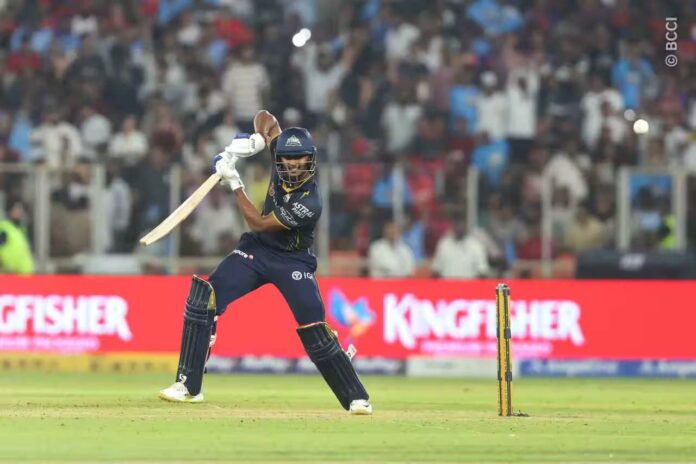
AHMEDABAD, May 3: Sai Sudharsan’s cool-headed 57 alongside the storm kicked up by pacers Mohammed Siraj, Jason Holder and Kagiso Rabada carried Gujarat Titans to a last over four-wicket victory over Punjab Kings in their IPL match here on Sunday.
On a slightly slow pitch, the Titans needed a level-headed chase of 164, and Sudharsan did precisely during his 41-ball knock.
A similar innings from debutant Suryansh Shedge’s energetic 57 had helped PBKS to post 163 for nine despite Siraj (2/28) and Holder (4/24) reducing them to 47 for five in 8.4 overs.
But it was Sudharsans’ turn to stand on the winners’ podium in the battle of half-centurions on the night. The result meant that GT stayed at five in the table but their points tally swelled to 12, while PBKS also maintained their top spot with 13 points for now.
After skipper Shubman Gill fell early to Arshdeep Singh, Sudharsan took control of the chase and added 53 runs for the second wicket with Jos Buttler.
Buttler (25) was the more dominant partner, dismissing Marco Jansen and Xavier Bartlett for a six each, the second one being an audacious scoop over the wicketkeeper.
But the England batter could not clear the infield off Vyshak Vijayakumar, giving a catch to Shreyas Iyer.
But Sudharsan continued undeterred and reached his third fifty of this IPL season off 37 balls.
The left-hander celebrated that with a couple of fours off Yuzvendra Chahal but could not impart distance to a pull off Vysakh, getting caught on the ropes by Bartlett.
The dismissal of Rahul Tewatia added some more drama to the close contest, with GT needing 11 runs off the final over.
But Washington Sundar (40 not out, 23b) stayed long enough to finish the match with a scooped six off Marcus Stoinis.
Earlier, Shedge made a well-made fifty but GT could not progress beyond 163 for nine.
But even that total looked distant once the Gujarat pacers found their wares early in the innings.
However, Shedge’s 29 ball innings, instrumental in a 79-run alliance for the sixth wicket with Stoinis (40) helped Punjab to recover from that precarious place to some extent.
Shedge, who often does the firefighting job for Mumbai in domestic cricket, used that experience here for Punjab.
The right-hander never looked to force the shots, and accepted the superiority of GT bowlers on this pitch and the lines they bowled.
But he was not reluctant to flex his muscles when the opportunity presented itself, such as the 14th over bowled by Manav Suthar.
Shedge hammered him for 6, 6, 4, 4, 6 to take 26 runs from that over and fetched his fifty in just 24 balls.
But he did not last long after that, edging Rabada (2/22) to Jos Buttler behind the stumps, as PBKS lost their way once again.
However, Siraj, who has been outstanding throughout this tournament, started the Titans’ slide early, dismissing Priyansh Arya and Cooper Connolly off successive balls in the very first over.
Arya cut Siraj straight to GT debutant Nishant Sandhu in the deep, while Connolly snicked one back to Buttler.
Prabhsimran Singh could not negate Rabada’s 152 kmph rocket and scooped it to Suthar inside the circle.
Holder took over from there, giving marching order to Nehal Wadhera and PBKS skipper Shreyas Iyer, excellent examples of his stifling line.
Wadhera edged one to stumper Buttler, and Shreyas did not have enough space to guide it to third man, and chopped Holder back onto his stumps as PBKS fell to complete disarray.
Marco Jansen made a couple of beefy blows in the final over off Rashid Khan to take them past the 160-run mark.
Brief Score:
PBKS: 162 for 9 in 20 overs (Suryansh Shedge 57; Jason Holder 4/24).
GT: 167 for 9 in 19.5 overs (Sai Sudharsan 57; Arshdeep Singh 2/24, Vijaykumar Vyshak 2/31). (PTI)
Arunachal CM lauds MIMC for promoting Buddhist values
Intl Conference on Himalayan Buddhism
Excelsior Correspondent
LEH, May 3: The Chief Minister of Arunachal Pradesh, Pema Khandu lauded the role of institutions like- MIMC in preserving and promoting Buddhist values. He described the event as a historic after decades, and appreciated the efforts of IBC in connecting Buddhist communities globally.
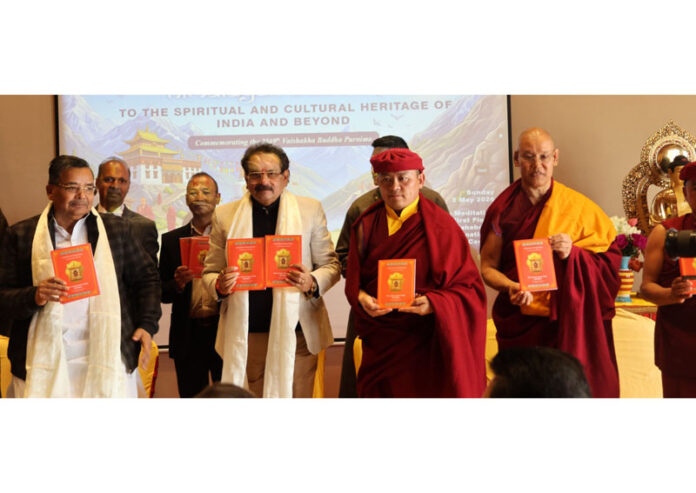
Addressing International Conference on Himalayan Buddhism, organized by the International Buddhist Confederation (IBC) at Mahabodhi International Meditation Centre (MIMC) , Leh in collaboration with the Ministry of Culture, the Chief Minister Pema Khandu highlighted the shared cultural bond across Himalayan states, and noted that regions like Arunachal Pradesh, Sikkim, Himachal Pradesh, and Ladakh are linked not only geographically but spiritually through Buddhist traditions.
He underscored the cultural and spiritual inter-connectedness of Himalayan regions and stressed that the teachings of Gautama Buddha-particularly compassion and non-violence, remain essential in shaping a peaceful global future.
Referring to the vision of Narendra Modi, he remarked that the 21st century can truly become an Asian century only if guided by these principles.
The Chief Minister highlighted Arunachal Pradesh’s unique position as a state practicing both Mahayana and Theravada traditions and stressed the role of Buddhism in strengthening cultural identity as well as national security in border regions.
Drukpa Thuksey Rinpoche, the guest of honour, while addressing the conference said while Buddhist teachings remain deeply relevant in addressing modern mental and emotional challenges, there is an urgent need to preserve Himalayan Buddhist traditions.
Rinpoche called for greater unity among Himalayan regions such as Ladakh, Bhutan, Nepal, and Arunachal Pradesh and active engagement of youth in preserving spiritual heritage besides use of modern platforms like digital media to communicate Buddhist values. He warned that many traditions are already fading and urged collective responsibility to safeguard them for future generations.
A significant highlight of the ceremony was the release of the book “The Living Legacy of the Tathagata,” reflecting Ladakh’s deep-rooted spiritual heritage and its commitment to preserving Buddhist teachings.
The conference, organized by the IBC and supported by the Union Territory Administration of Ladakh, is being held alongside the sacred exposition of the holy relics of Gautama Buddha.
Set against the serene spiritual landscape of MIMC, the session brought together eminent spiritual leaders, scholars, policymakers and delegates from across India and abroad, transforming the meditation centre into a vibrant hub of philosophical exchange and cultural reflection.
Among the special guests were SP Singh Baghel, Union Minister of State for Fisheries, Animal Husbandry and Dairy; Jaiveer Singh, Minister for Culture and Tourism, Uttar Pradesh; Ven. Shartse Kehnsur; Jangchup Choeden Rinpoche, the secretary general of the International Buddhist Confederation; Chering Dorjey Lakruk, president Ladakh Buddhist Association; Dorjey Stanzin, President Ladakh Gonpa Association; and Bhikkhu Sanghasena, founder and Spiritual Director of Mahabodhi International Meditation Centre.
BJP growing with time
Satish Singh Manhas
manhas444@gmail.com
Ever since India attained independence-or even before that-the country has witnessed many popular leaders, from Mahatma Gandhi, Sardar Patel, and Jawaharlal Nehru in the early decades, to Lal Bahadur Shastri, Indira Gandhi, and Bharat Ratna Atal Bihari Vajpayee in later years. Each of them enjoyed popularity during their tenure. However, only a few leaders, such as Indira Gandhi and Atal Bihari Vajpayee, managed to retain widespread influence across political, social, and ideological divides for extended periods.
Every Prime Minister contributed significantly to the nation, though each also faced failures. Jawaharlal Nehru streamlined India’s political and economic systems after independence but failed to secure the nation’s borders effectively and did not succeed in securing a permanent seat for India in the United Nations. Sardar Patel, with his iron will, unified the country and created history. Lal Bahadur Shastri led India effectively during the 1965 war. Indira Gandhi played a decisive role in the creation of Bangladesh, helping people escape atrocities by the Pakistani army.
Rajiv Gandhi promoted modernization through initiatives like Maruti and the introduction of computers. Vishwanath Pratap Singh focused on OBC welfare, though his tenure also saw unrest. P.V. Narasimha Rao introduced major economic reforms. Atal Bihari Vajpayee made India a nuclear power despite international pressure and set an example of corruption-free governance while successfully managing a coalition of more than 20 parties.
Despite these achievements, almost every government faced corruption allegations-from the Jeep scandal to 2G, Commonwealth Games, and Rafale controversies. Rajiv Gandhi once admitted that only a fraction of development funds reached the grassroots level, highlighting the deep-rooted issue of corruption in the country.
After independence, Congress dominated Indian politics, winning elections almost unchallenged. Indira Gandhi returned to power riding on the Bangladesh victory, while Rajiv Gandhi’s massive mandate followed a sympathy wave after his mother’s assassination. BJP’s initial rise was linked to issues like the Ram Janmabhoomi movement, Article 370, and Advani’s Rath Yatra, which brought it into national prominence.
However, what explains the current popularity of Prime Minister Narendra Modi and the BJP? It is not based on grand promises, emotional waves, or symbolic campaigns like in the past. Instead, it appears rooted in practicality and delivery.
BJP’s governance record in states like Gujarat under Narendra Modi and Madhya Pradesh under Shivraj Singh Chouhan built credibility. Public dissatisfaction with Congress-due to perceived poor governance, a soft stance on terrorism, and ambiguous positions on key issues-also contributed to BJP’s rise.
The BJP’s bold decisions, such as the abrogation of Article 370, the ban on triple talaq, and the construction of the Ram temple, significantly impacted public perception. Welfare schemes like free LPG connections, rural electrification, bank account inclusion, Mudra loans, housing under PMAY, and sanitation drives addressed real grassroots needs.
This shift attracted voters across communities. Many women, including Muslim women, supported the BJP due to tangible benefits like gas connections and social reforms. The party’s appeal grew not through rhetoric but through perceived delivery and trust.
For instance, in a small village like Bagh in Doda district, all 20 households received housing under PMAY. Such examples reflect the government’s outreach at the grassroots level.
Interestingly, many voters express that even if they personally do not receive benefits, they trust that corruption is being reduced and resources are less likely to be misappropriated. This perception has strengthened BJP’s image as a party of accountability.
During the COVID-19 pandemic, many citizens believed that the government would guide the country through the crisis, reinforcing trust further.
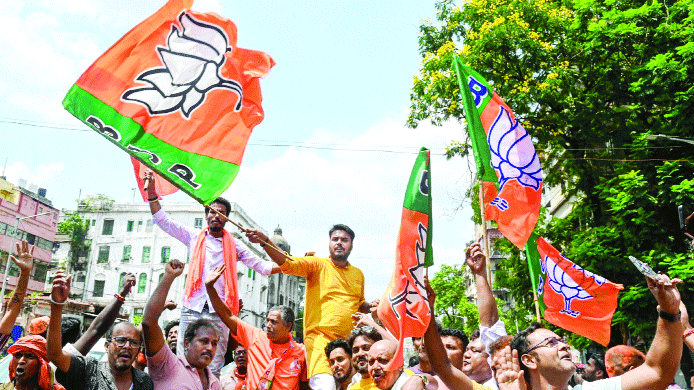
Today, BJP is not just seen as a political party but increasingly as a national belief system. It is viewed by supporters as a reform-oriented, nationalist force committed to delivering across social and economic segments.
Its repeated electoral successes at the central and state levels-including victories in Uttar Pradesh, Bihar, Madhya Pradesh, Maharashtra, and others-along with strong performance in local body elections, indicate its growing influence.
In conclusion, BJP appears to have shifted India’s political narrative-from dynasty-driven politics to one centered on development and diplomacy. Whether this transformation is permanent or evolving remains to be seen, but its impact on India’s political landscape is undeniable.
(The Author is serving as Assistant Director in Forest Department.)
BJP to intensify fight against drug menace, expose NC Govt’s ‘anti-people policies’
Excelsior Correspondent
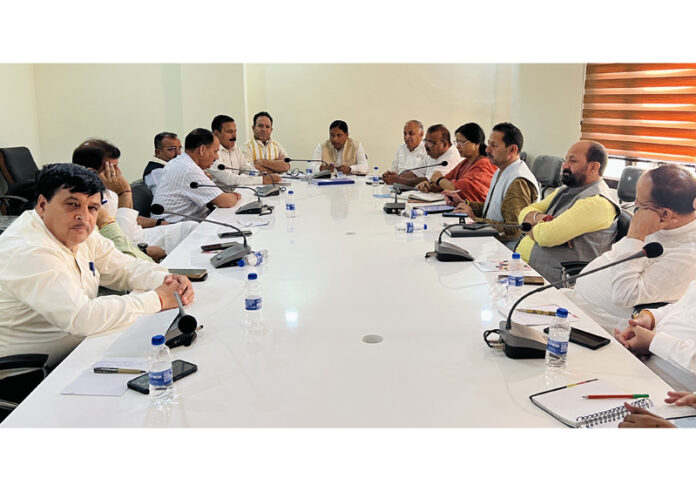
JAMMU, May 3: Bharatiya Janata Party (BJP), Jammu & Kashmir held a meeting of its MLAs at party headquarters, Trikuta Nagar,here, today.
Party president and Rajya Sabha MP, Sat Sharma and Leader of Opposition in the J&K Assembly (LoP) in J&K Assembly Sunil Sharma addressed the meeting. Party general secretaries, Sanjita Dogra, and Baldev Singh Baldev Singh Billawaria were also present in the meeting.
Sat Sharma, while addressing the meeting, said that the BJP remains fully committed to safeguarding the youth of Jammu & Kashmir from the growing menace of drugs and will actively contribute to the de-addiction movement being carried out across the Union Territory. He appreciated the visionary leadership of Union Home Minister, Amit Shah in launching a determined campaign against narcotics and lauded the extensive work being undertaken by Lieutenant Governor, Manoj Sinha and the administration to dismantle drug networks and spread awareness against substance abuse.
Sat Sharma said that every BJP MLA will work at the grassroots level to support awareness drives, rehabilitation efforts, and strict enforcement measures to save the younger generation from falling prey to narcotics. He said that drug addiction is not merely a social issue but a direct assault on the future of Jammu & Kashmir, and BJP Legislators will fully contribute to the mission of making society drug-free.
The BJP president also expressed gratitude to Prime Minister, Narendra Modi and the Central Government for bringing unprecedented development to Jammu & Kashmir. He particularly hailed the historic railway extension connecting Jammu to Kashmir and the massive expansion of connectivity under the Pradhan Mantri Gram Sadak Yojana (PMGSY), stating that these landmark projects have transformed infrastructure, improved accessibility, and strengthened economic opportunities in far-flung regions.
Sunil Sharma launched a scathing attack on the National Conference (NC) Government over its “anti-people and deceptive policies.” He alleged that the NC administration is attempting to make nearly 24,000 backdoor appointments through outsourcing agencies, which he termed a betrayal of the educated unemployed youth of Jammu & Kashmir. He asserted that BJP MLAs will strongly corner the Government both inside and outside the Assembly on the issue and expose every attempt to bypass transparency and merit.
Sunil Sharma further condemned the steep increase in transport fares imposed by the NC Government, terming the move “anti-poor, anti-middle class, and insensitive towards the hardships of the common people.” He said that the arbitrary hike will negatively affect every resident of Jammu & Kashmir, including daily commuters, students, traders, employees, and families already burdened by inflation and economic stress.
He said that the NC had sought votes by making lofty promises before the elections, but after assuming power, it has failed to deliver on its commitments and instead imposed additional financial burdens on the people through increased tariffs and fare hikes.
“The NC Government has committed a fraud with the people of Jammu & Kashmir by betraying the trust reposed in it,” Sunil Sharma said, adding that the BJP will continue to raise the voice of the masses against every anti-public decision of the Government.
Digital Media Reshapes War Perception

Ashok Ogra
ashokogra@gmail.com
Today, a meme can travel faster than a missile-and sometimes leave a stronger impression. During the recent Iran-US conflict, a short clip spread widely on Instagram and X. It showed a cartoon-style version of Donald Trump pressing buttons that caused big, exaggerated explosions, while an Iranian figure appeared calm.
Similarly, posts that joke about the Strait of Hormuz with Iranian diplomatic accounts saying they had “lost the keys” to the strait, as if it were a locked gate.
The United States also uses social media, often through stylised videos and popular culture references, mainly aimed at its own domestic audience. In one controversial case, official US content mixed real strike footage with clips from video games and films, presenting war almost like entertainment. This showed how even formal communication has begun adopting the language of social media to reach wider audiences.
The difference in approach, however, is clear. Iran tries to reach a global audience, while the US focusses more on its domestic constituency. Still, both understand that how a story is told is as important as the events themselves.
Across all these examples, some common patterns can be seen. Content that is short, simple and easy to understand gains public acceptance more easily.
However, what looks like simple online content is often part of a larger effort to influence public opinion. Governments and people use social media to present their side of a conflict. Memes, short videos and edited visuals are made to attract attention and encourage sharing. Social media have become a space where ideas about a war are created and debated. In essence, war is no longer only fought on the ground.
This development is relatively recent, coinciding with the rapid growth and deeper penetration of social media platforms.
Take the case of the Ukraine war: the country uses platforms like X, Telegram and Instagram to share updates, videos and messages asking for global support. The “Saint Javelin” image has become one of the most powerful symbols of the war. It shows a saint-like figure in the style of a traditional religious icon, but instead of holding a child, she holds an anti-tank weapon. This unusual mix of faith and modern warfare made it visually striking and easy to remember. It spread rapidly online, boosted morale, and even raised over a million dollars for humanitarian aid-showing how a meme can move from symbolism to real-world impact.
Similarly, the “Ghost of Kyiv,” – a viral story about a heroic Ukrainian pilot who allegedly shot down several Russian aircraft in a single day. Though later acknowledged as a myth, it played a powerful role in the early days of the war.
Russia, on the other hand, uses social media in a more controlled way, focusing on its own explanation of the conflict. They use more controlled messaging. Symbols like the “Z” sign became widely visible. Influencers and online personalities amplify pro-war messaging, sometimes under pressure or guidance, creating a digital environment of patriotism and support while limiting dissent.
Both sides-Russia and Ukraine-have seen viral posts that later turned out to be misleading or false. Claims about war crimes, battlefield victories, or leadership actions spread rapidly online, often before verification. Unfortunately, such content influences how people think, rather than giving full details.
New technologies have added another layer. Edited or AI-created visuals can make events look more dramatic or different from reality. For instance, Iran has increasingly used cartoon-style and AI-generated videos on social media to depict the US as confused or weak.
This does not mean everything is false, but it does make it harder to clearly tell what is real and what is changed. While social media have become a major source of information, they also raise questions about accuracy. Because of this, most well-informed people often check more than one source before forming an opinion.
This is why newspapers and established media still matter- though their influence has dramatically diminished in recent years. It continues to provide more complete reporting and context, and present a fuller picture. However, their coverage differs across countries and regions.
Take the case of the Iran conflict. In the United States, newspapers like The Washington Post and The New York Times, when covering the Iran conflict focus on security, policy and risks. In the United Kingdom, The London-based Guardian gives more attention to humanitarian issues and civilian impact.
In Iran, newspapers such as The Tehran Times present a national viewpoint, focusing on unity and response. In the Gulf region, papers like Gulf Times and Khaleej Times focus on stability, oil markets and the risk of conflict spreading.
Indian newspapers such as Daily Excelsior, The Hindu, The Indian Express and The Times of India take a practical approach. They look at oil prices, the safety of Indian citizens and the global impact. They usually call for calm and dialogue.
The fact remains that today, traditional media and social media are closely connected. Viral posts can influence what news organisations cover, while detailed reporting helps people understand what they see online. In short, there is no single way to understand a conflict.
The main point is simple. War today is not only about what happens on the battlefield. It is also about how those events are shown and understood. In this situation, public opinion is not separate from the conflict-it is part of it.
So, the challenge today is not only to follow the war, but also to understand how it is being shown. Remember, in today’s conflicts, what travels fastest is not always the truth, but the story-and often, that story shapes reality as much as the battlefield itself.
(The author works for reputed Apeejay Education, New Delhi)
FICCI FLO launches art collaboration with Arzaani
Excelsior Correspondent
JAMMU, May 3: FICCI FLO launched a year-long national collaboration with Arzaani under its visual arts initiative, beginning May 2026 and continuing till May 2027.
The initiative was spearheaded by Puja Garg, National president of FICCI FLO, along with Raseel Gujral of RGAL, Dr Ritu Singh, National Lead and Day Chair, and co-led by Sonia Singla.
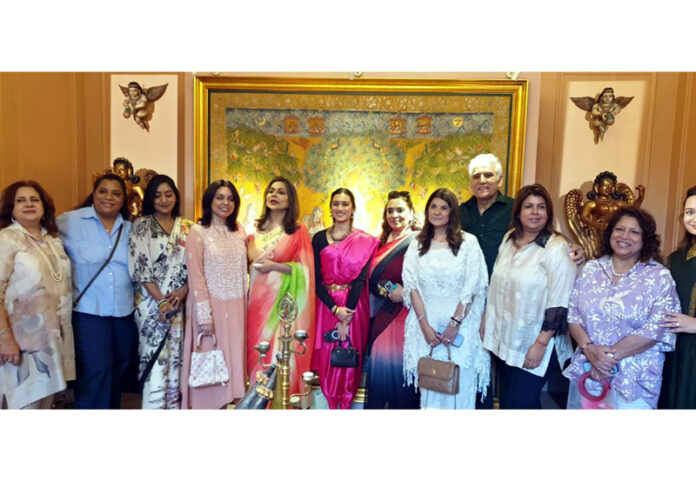
The collaboration commenced with a grand event titled “Sacred Movements: An Artistic and Spiritual Dialogue” at the Arzaani Atelier Prive, Bikaner House, New Delhi. The event was conceptualized and presented by Raseel Gujral under the banner of Raseel Gujral Art Legacy and witnessed participation of more than 140 FLO members from across the country.
The evening celebrated India’s rich artistic heritage through an exceptional display of Tanjore paintings, antique Pichwais, Raja Ravi Varma oleographs and finely crafted sculptures. A major attraction of the programme was an evocative Bharatanatyam performance by acclaimed dancer Shreyasi Gopinath.
Another key highlight was the launch of the exclusive “FLO x Arzaani Prive Membership Card”, aimed at encouraging women entrepreneurship and creative collaboration. The card offers members privileged benefits including a 10 per cent benefit at Arzaani, early previews of curated collections and access to exclusive festive offerings.
The event also featured an engaging interactive session and question-answer round, followed by a specially curated high tea showcasing culinary traditions from North and South India.
Prominent dignitaries present on the occasion included Puja Garg, National president, FICCI FLO; Raseel Gujral, accompanied by Naveen Ansal; past president Namita Gautam; governing body members, initiative leads and FLO members from different regions. The initiative was efficiently co-led by Sonia Singla.
Speaking on the occasion, Puja Garg, Raseel Gujral and Dr Ritu Singh highlighted the need to preserve India’s artistic heritage while empowering women artisans and creators. They reaffirmed FLO’s commitment to promoting cultural legacy and generating opportunities for women across sectors.
The exhibition will remain open to the public from 11 am to 8 pm till May 30, 2026, at Arzaani, Bikaner House, New Delhi.
50,000 appear in NEET in J&K amid strict security
Irfan Tramboo
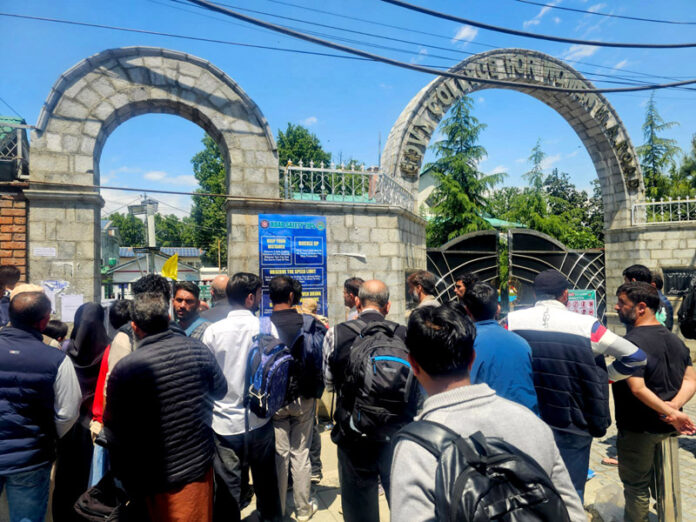
SRINAGAR, May 3: The National Eligibility-cum-Entrance Test Undergraduate (NEET-UG) 2026 was held today across Jammu and Kashmir, with nearly 50,000 candidates estimated to have appeared for the examination.
No official figures, however, were released on the exact number of candidates registered or those who took the test in the Union Territory. Overall, an estimated 47,000 to 51,000 aspirants from J&K are believed to have registered.
Click here to watch video
On the ground, authorities enforced strict security and logistical arrangements at multiple examination centres across the Valley.
Officials said foolproof measures were put in place to ensure the smooth and fair conduct of the examination, with strict adherence to guidelines issued by the National Testing Agency (NTA) and close coordination among stakeholders.
Keeping in view the sensitivity of the examination, adequate deployment of magistrates and security personnel was ensured at all centres.
Elaborate arrangements, including the deployment of invigilators, observers, and security personnel, were made to facilitate the process.
The examination was conducted from 2:00 PM to 5:00 PM in pen-and-paper mode, with entry to centres permitted between 11:00 AM and 1:30 PM.
Candidates eligible for compensatory time, including persons with disabilities (PwD/PwBD), were allowed to write until 6:00 PM.
Candidates are competing for around 1,676 MBBS seats in the Union Territory, in addition to admissions to BDS, BVSc, AYUSH, and nursing courses.
At the national level, the NTA conducted the exam across 551 cities in India and 14 cities abroad at more than 5,432 centres, for approximately 22.79 lakh registered candidates.
Officials said the scale of coordination was massive, with 674 city coordinators and over 6,000 observers deployed.
In Srinagar, several candidates, seen making their way to examination centres or waiting outside with their parents, expressed a mix of anxiety and optimism before entering the halls.
“I am nervous, but I will give my best-let’s hope for the best,” said Nafeesa, a candidate.
Tabiya, appearing for the first time, said she felt well prepared. “I have prepared well and will give it my best,” she said.
Another aspirant, Wahid from Anantnag, appearing for the second time, said he was hopeful of improving his performance. “I have studied the entire year, and I am hopeful it will go well,” he said.
LG chairs high-level review meeting on Nasha Mukt J&K Abhiyan
Excelsior Correspondent
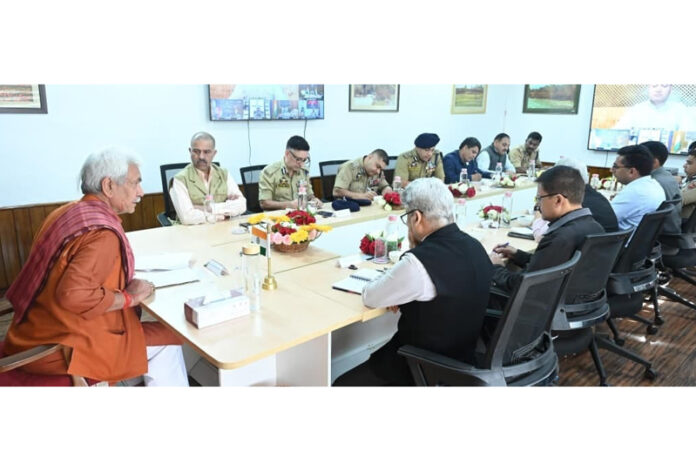
SRINAGAR, May 3: Lieutenant Governor, Manoj Sinha, today chaired a high-level meeting at Lok Bhavan to review the progress of the ongoing Nasha Mukt Jammu Kashmir Abhiyaan and assessed the district-wise action plans aimed at eliminating drug- abuse and narco-terrorism.
The meeting was attended by Atal Dullo, Chief Secretary; Nalin Prabhat, DGP; Chandraker Bharti, Principal Secretary Home Department; S.J.M.Gillani, Spl DG Coordination PHQ; Nitish Kumar, ADGP, CID; Dr. Mandeep K Bhandari, Principal Secretary to Lieutenant Governor; Shri Sujit Kumar, IGP Security; Sarmad Hafeez, Commissioner/ Secretary, Social Welfare Department; Ram Niwas Sharma, Commissioner/ Secretary School Education Department; Anshul Garg, Divisional Commissioner Kashmir; VK Birdi, IGP Kashmir; senior officials of civil and police administration, Deputy Commissioners and SSPs from Kashmir Division.
Reviewing the progress, the Lieutenant Governor underscored the need for a focused, time-bound and result-oriented strategy by all district administrations in the next 78-days. He directed the officers to ensure effective implementation of the action at all levels with measurable outcomes in curbing drug abuse and dismantling narcotics networks.
The Lieutenant Governor called for intensified grassroots-level engagement at the Panchayat and Ward levels. He emphasized active participation of community stakeholders, including religious leaders, educationists, traders, youth groups, and social and political activists to transform the campaign into a sustained mass movement.
The Lieutenant Governor laid special emphasis on youth engagement through sports and recreational activities. He instructed the Deputy Commissioners to ensure the development of playfields in all panchayats and strengthening of sports infrastructure across districts.
He also directed to regularly organize sports competitions and youth engagement activities under the banner of the Nasha Mukt J&K Abhiyaan, enabling young people to channel their energy and talent into positive pursuits and stay away from substance abuse.
Reiterating the administration’s zero-tolerance policy towards narcotics, the Lieutenant Governor called for strict and visible enforcement actions against those involved in drug trafficking.
The Lieutenant Governor emphasized swift implementation of Standard Operating Procedures (SoPs) for cancellation or suspension of driving licenses and passport and other documents of drug peddlers. He also called for prompt identification and seizure of properties linked to narcoterrorists and drug smugglers. He further stressed intensified inspection of pharmaceutical shops to prevent misuse of prescription drugs and also enhanced vigilance in and around educational institutions and vulnerable areas.
The Lieutenant Governor also directed Deputy Commissioners to identify and take appropriate action against the fake or unauthorized drug de-addiction and rehabilitation centres, ensuring that only certified institutions operate within the established regulatory framework.
The Lieutenant Governor highlighted the importance of strengthening Mahila Samitis and Youth Clubs as vital community institutions in the fight against drug abuse. He called for their effective functioning and active involvement in awareness campaigns, early identification of vulnerable individuals, and community-based monitoring mechanisms.
He also directed for utilizing Block Diwas and Thana Diwas as platforms for addressing public grievances and strengthening trust between citizens and the administration.
The Lieutenant Governor further directed the officers to take advance and comprehensive measures for the smooth conduct of upcoming major religious events, including the annual Shri Amarnathji Yatra and Muharram. He emphasized the need to ensure adequate arrangements to facilitate the convenience and safety of the people.