

Satish Singh Manhas
manhas444@gmail.com
Ever since India attained independence-or even before that-the country has witnessed many popular leaders, from Mahatma Gandhi, Sardar Patel, and Jawaharlal Nehru in the early decades, to Lal Bahadur Shastri, Indira Gandhi, and Bharat Ratna Atal Bihari Vajpayee in later years. Each of them enjoyed popularity during their tenure. However, only a few leaders, such as Indira Gandhi and Atal Bihari Vajpayee, managed to retain widespread influence across political, social, and ideological divides for extended periods.
Every Prime Minister contributed significantly to the nation, though each also faced failures. Jawaharlal Nehru streamlined India’s political and economic systems after independence but failed to secure the nation’s borders effectively and did not succeed in securing a permanent seat for India in the United Nations. Sardar Patel, with his iron will, unified the country and created history. Lal Bahadur Shastri led India effectively during the 1965 war. Indira Gandhi played a decisive role in the creation of Bangladesh, helping people escape atrocities by the Pakistani army.
Rajiv Gandhi promoted modernization through initiatives like Maruti and the introduction of computers. Vishwanath Pratap Singh focused on OBC welfare, though his tenure also saw unrest. P.V. Narasimha Rao introduced major economic reforms. Atal Bihari Vajpayee made India a nuclear power despite international pressure and set an example of corruption-free governance while successfully managing a coalition of more than 20 parties.
Despite these achievements, almost every government faced corruption allegations-from the Jeep scandal to 2G, Commonwealth Games, and Rafale controversies. Rajiv Gandhi once admitted that only a fraction of development funds reached the grassroots level, highlighting the deep-rooted issue of corruption in the country.
After independence, Congress dominated Indian politics, winning elections almost unchallenged. Indira Gandhi returned to power riding on the Bangladesh victory, while Rajiv Gandhi’s massive mandate followed a sympathy wave after his mother’s assassination. BJP’s initial rise was linked to issues like the Ram Janmabhoomi movement, Article 370, and Advani’s Rath Yatra, which brought it into national prominence.
However, what explains the current popularity of Prime Minister Narendra Modi and the BJP? It is not based on grand promises, emotional waves, or symbolic campaigns like in the past. Instead, it appears rooted in practicality and delivery.
BJP’s governance record in states like Gujarat under Narendra Modi and Madhya Pradesh under Shivraj Singh Chouhan built credibility. Public dissatisfaction with Congress-due to perceived poor governance, a soft stance on terrorism, and ambiguous positions on key issues-also contributed to BJP’s rise.
The BJP’s bold decisions, such as the abrogation of Article 370, the ban on triple talaq, and the construction of the Ram temple, significantly impacted public perception. Welfare schemes like free LPG connections, rural electrification, bank account inclusion, Mudra loans, housing under PMAY, and sanitation drives addressed real grassroots needs.
This shift attracted voters across communities. Many women, including Muslim women, supported the BJP due to tangible benefits like gas connections and social reforms. The party’s appeal grew not through rhetoric but through perceived delivery and trust.
For instance, in a small village like Bagh in Doda district, all 20 households received housing under PMAY. Such examples reflect the government’s outreach at the grassroots level.
Interestingly, many voters express that even if they personally do not receive benefits, they trust that corruption is being reduced and resources are less likely to be misappropriated. This perception has strengthened BJP’s image as a party of accountability.
During the COVID-19 pandemic, many citizens believed that the government would guide the country through the crisis, reinforcing trust further.
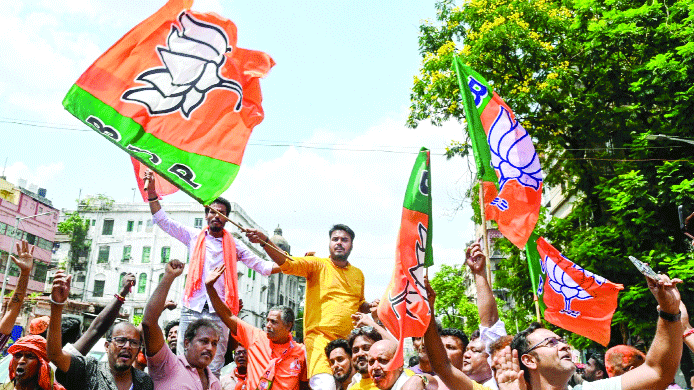
Today, BJP is not just seen as a political party but increasingly as a national belief system. It is viewed by supporters as a reform-oriented, nationalist force committed to delivering across social and economic segments.
Its repeated electoral successes at the central and state levels-including victories in Uttar Pradesh, Bihar, Madhya Pradesh, Maharashtra, and others-along with strong performance in local body elections, indicate its growing influence.
In conclusion, BJP appears to have shifted India’s political narrative-from dynasty-driven politics to one centered on development and diplomacy. Whether this transformation is permanent or evolving remains to be seen, but its impact on India’s political landscape is undeniable.
(The Author is serving as Assistant Director in Forest Department.)
 Follow our WhatsApp channel
