Saturday, April 25, 2026
E-Paper
Home Blog Page 11

No plan to raise fuel price: Govt

NEW DELHI, Apr 23:  State-owned fuel retailers are incurring losses of about Rs 20 per litre on petrol and roughly Rs 100 per litre on diesel as pump prices remain frozen for nearly four years despite a surge in global oil prices, the government said on Thursday, signalling there is no immediate plan to raise retail fuel rates.
Dismissing reports of a potential Rs 25-28 per litre increase in petrol and diesel prices after assembly elections, the Ministry of Petroleum and Natural Gas (MoPNG) said in a post on X that “there is no such proposal under consideration by the government”.
At a news briefing on developments in West Asia, Sujata Sharma, Joint Secretary in MoPNG, said international prices of crude oil (raw material used to make fuel like petrol and diesel) and LPG rates have been very volatile, yet the government has not increased prices.
Crude which was USD 70 per barrel last year, averaged over USD 113 this month, she said. “There is a huge increase… inspite of that the government has not increased prices and the effort of the government has been to keep the prices stable.”
Retail petrol and diesel prices have remained frozen since early April 2022 — a period during which oil prices rose in some months and fell in other times. When prices fell, state-owned oil firms made handsome profits, which they used to set off losses when rates rose.
Sharma said despite the increase in oil prices after war in West Asia, the government has not increased retail pump rates. “The effort of the government has been to keep the price stable.”
The sharp increase in prices in international markets, on which India is 88 per cent dependent to meet its oil needs, has led to PSUs incurring under-recoveries on petrol and diesel, she said.
Under-recoveries — the difference between retail price and the desired rate if domestic prices were aligned with import parity — vary on daily basis.
“(Under-recovery) may be around Rs 20 (per litre) on petrol and around Rs 100 (a litre) on diesel,” she said.
She, however, hastened to add that government interventions so far have been to provide stability in terms of price and it will continue to do that.
The government last month cut tax on petrol and diesel by Rs 10 a litre each so as to ensure that “the burden of high oil prices are not transferred to consumers,” she said.
Alongside, the government also imposed a tax on fuel export so as to “motivate” refiners to prioritise domestic sales, she said.
On cooking gas LPG, she said while the Saudi CP — the benchmark for LPG pricing — has increased 102 per cent between July 2023 and April 2026, rates in the country have fallen 17 per cent.
“Data is speaking for itself and the effort of the government is also visible,” she added.
The clarification came after a report by Kotak Institutional Equities hinted of a steep increase in petrol and diesel prices once the polling for assembly elections in states like West Bengal ends on April 29. Kotak projected a Rs 25-28 a litre increase in price based on crude oil staying close to USD 120 per barrel.
The ministry said such reports are “designed to create fear and panic amongst the citizens and are mischievous and misleading”.
“In fact, India is the only country where petrol and diesel prices haven’t increased in the last four years,” it said. “Government of India and oil PSUs have taken relentless steps in order to insulate the Indian citizens from steep increases in international prices.”
International oil prices spiked after the US and Israel attacked Iran on February 28, and Tehran’s sweeping retaliation that effectively shut the Strait of Hormuz — one of the world’s most critical energy arteries, linking the Persian Gulf to global markets and handling roughly a fifth of global oil trade along with significant volumes of liquefied natural gas.
After the Iran war, oil prices spiked from around USD 70 per barrel to USD 119 before seeing some correction. Renewed tensions have pushed Brent — the world’s most known crude oil benchmark — to USD 103-106 per barrel.
Despite a more than 50 per cent rise in input crude oil prices, petrol and diesel rates have remained unchanged in India. Petrol is priced at Rs 94.77 a litre in the national capital and diesel comes for Rs 87.67. (PTI)
Gujarat pilgrim dies of heart attack in Kedarnath; body stranded for 5 hrs before free airlift

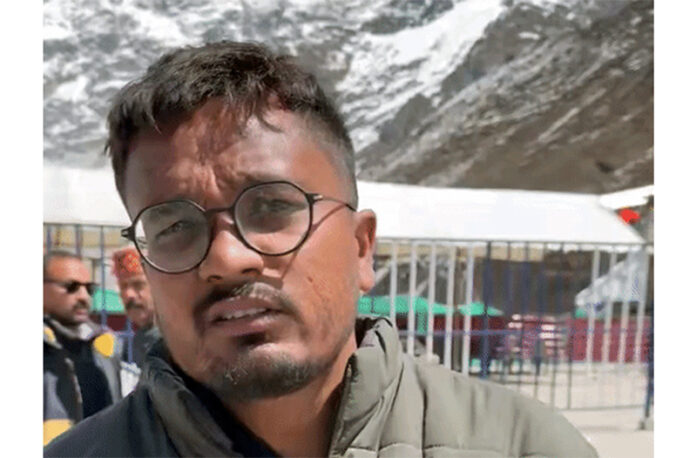
RUDRAPRAYAG, Apr 23: A 69-year-old pilgrim from Gujarat died of cardiac arrest in Kedarnath, but his body remained stranded for over five hours before the administration arranged a free airlift to the base while the family paid Rs 53,000 for a private ambulance home.
Dilip Bhai Mannu Mali from Vadodara’s Gorwa collapsed near the White House area at 6.30 am Wednesday, just moments before the temple gates opened. Yatra Management Force (YMF) personnel shifted him to the Kedarnath Primary Health Centre, where doctors declared him dead at 7.30 pm.
The victim’s son, Hemant Bhai Mali, alleged that despite pleas, no transport was arranged until 1 pm. Following the delay, the deceased’s body and Hemant were airlifted for free to the Jamu helipad. Four other members of the group were forced to travel down to the base on horses, paying Rs 3,000 each.
“We requested the district magistrate for a helicopter, but no arrangement was made for hours despite assurances. I eventually had to pay Rs 53,000 for a private ambulance from Rudraprayag to take my father’s body home to Vadodara,” Hemant told PTI.
The district administration denied allegations of negligence, stating that relief efforts began immediately despite a temporary suspension of helicopter services.
Refuting claims of administrative apathy, Nodal Officer for Kedarnath Yatra and SDM Ukhimath, Anil Singh Rawat, told PTI that the delay was because helicopter services were halted temporarily because of safety inspection protocols by the Directorate General of Civil Aviation (DGCA).
Several helicopter companies were conducting test flights at the time. Operations to Kedarnath resumed after the NoC was granted, Rawat said.
The administration maintained that officials acted with “sensitivity and quick decision-making”. The body was shifted to the Kedarnath helipad and airlifted to Jamu as soon as flight operations resumed following DGCA clearance.
From Jamu, the body was transported to the district hospital in Rudraprayag. The family left for Gujarat by ambulance late Wednesday night after completing formalities.
The incident occurred despite a Standard Operating Procedure (SoP) by the Uttarakhand Civil Aviation Development Authority (UCADA) that prioritises the air transportation of deceased pilgrims.
Officials noted that while medical emergencies get priority, body transport depends on resource availability and technical clearances.
While the administration maintains that a special plan is in place for pilgrim safety, the victim’s son expressed deep anguish. “I do not wish to blame anyone now, but we felt helpless for several hours during the ordeal,” Hemant said.
Health data released on Wednesday evening showed that of the 38,000 pilgrims at the shrine, only 424 underwent medical fitness tests. Only five devotees were flagged as unfit to continue the high-altitude trek. (PTI)

CGPWA, BSS organize Bhajan Sandhya

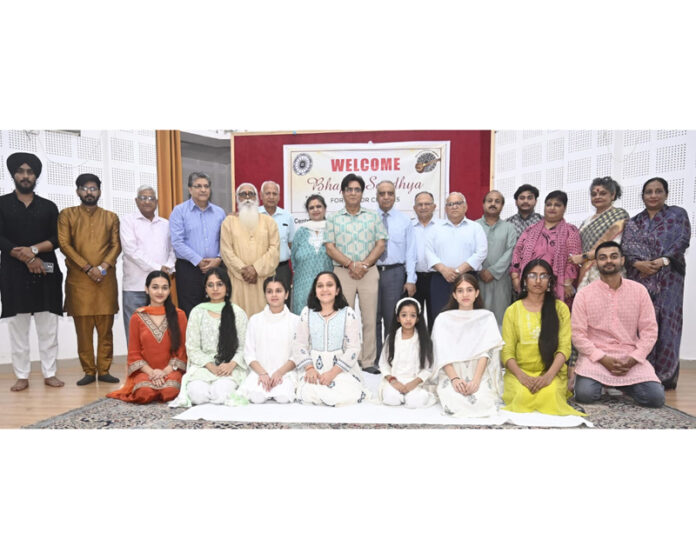
Kuldeep Khoda, president of CGPWA posing along with others during a function in Jammu.

Excelsior Correspondent
JAMMU, April 23: A ‘Bhajan Sandhya’ for senior citizens organized by the Central Government Pensioners’ Welfare Association (CGPWA) in collaboration with the Bharatiya Sangeet Sansthan (BSS) was held here today.
The evening featured 14 budding artists trained under the prestigious Guru-Shishya Parampara by renowned Hindustani classical maestro Vijay Kumar Sambyal, popularly known as ‘Rangeeley Thakur.’
The performance mesmerised the jampacked hall, blending melodious bhajans with deep classical foundations.
The president of CGPWA, Kuldeep Khoda presided, while Padam Shree awardee Dr Nirmal Vinod, Ashok Angurana, Dr Ashok Bhan, B R Sharma, Dr Sudarshan Kumar, K B Jandial, V K Sambyal, Prem Gupta, S S Bijral, Yoginder Kaul, Hemant Sharma and V K Padha were also present during the event.
The musical evening took off with the serene invocation “Vartaman Sundar Kar Lo, Prabhu May Jeevan Kar Nirbhaya Ho” presented by Vanshika, Asmi, Anika, Banat and Ragnya, setting a deeply devotional tone for the evening.
It was followed by two poignant bhajans by Tahyra and Tejasvi—“Bol Sachidanand Om Om” and “Yeh Khel Anokha Saara, Koi Samjhe Samjhan Haara”—which were appreciated for their depth and expression.
Uday and Davinder continued the musical journey with their engaging performances.
Ridhima Bajpai presented a soulful Dogri bhajan-“Mannua Neyi Kar Mera Mera, Ae Nagri Maya Nagri Ae, Itthe Rain Basera”, penned by Dr. Nirmal Vinod and composed by ‘Rangeeley Thakur’.
She also presented another heart touching bhajan “Jamuna Kinare Hove Gram, Braj Mein Ho Bisram”.
V K Sambyal ‘Rangeeley Thakur’ accompanied by Ridhima descended on the stage amidst huge applause and enthralled the audience through profound renditions, including “Sundar Samujhi Samujhi Pag Dhar Re, Uttam Raah Pakad Re” and “Panchhi Kai Din Ka Mehmaan, Soch Samajh Geh Gyaan”, written by noted lyricist of Rajasthan, late Kanh Singh.
A deeply philosophical bhajan encapsulating the essence of the Avdhoot Gita, “Jal Jaaye Jibhva Paap Ni Shri Raam Ke Bina” was a grand finale of the musical event resonating deep in the mind of the audience.
Kuldeep Khoda congratulated the young artists for their excellent performance.
Madhavi Sharma conducted the proceedings gracefully.

Situation grim, Govt failed to meet expectations despite strong mandate: Mufti

Excelsior Correspondent
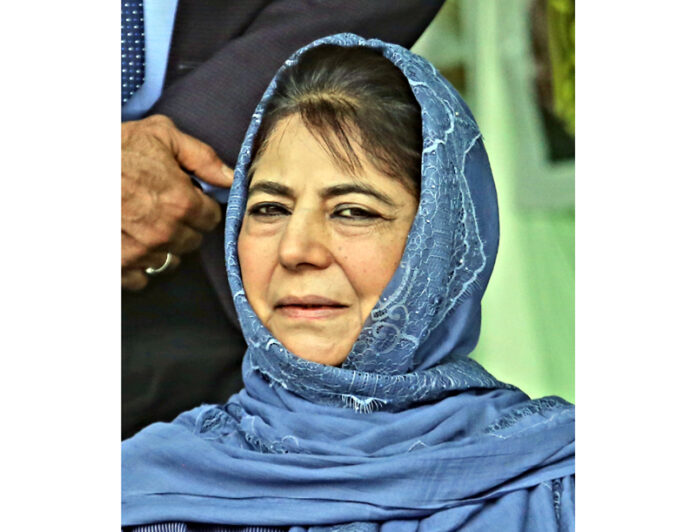
SRINAGAR, Apr 23: Peoples Democratic Party (PDP) president Mehbooba Mufti today criticised the Government, saying it has failed to meet public expectations despite receiving a strong electoral mandate.
Addressing a gathering in Baramulla district, in north Kashmir, Mufti described the present situation as “grim”, pointing to rising unemployment and increasing distress among both young people and older residents.

Click here to watch video

She also alleged interference in religious institutions and expressed concern over rising electricity tariffs. “The current situation in the region is grim,” she told supporters, adding that economic hardship was affecting large sections of society.
Mufti said the National Conference (NC) has failed to meet public expectations despite receiving a strong electoral mandate. She claimed that during its time in office, the PDP had implemented “ground-level initiatives” despite facing significant challenges, whereas the present administration had not achieved comparable progress.
She highlighted the opening of the cross-Line of Control trade route to Muzaffarabad, which she said was intended to boost economic activity and ease tensions. Mufti said the closure of the route had been a setback, “its continuation could have improved economic conditions, particularly for the fruit industry,” she said.
On tourism, she said destinations such as Pahalgam had faced closures, and urged Chief Minister Omar Abdullah to address broader regional concerns.
Highlighting her party’s record in Government, Mufti said that developments such as medical colleges and infrastructure projects had been delivered within a short period, something she claimed other administrations had taken decades to achieve.
Defending the PDP’s past alliance with the Bharatiya Janata Party (BJP), she said key regional interests had been protected and that there had been no compromise on power-related projects.
She also called for greater recognition of regional demands, including district status for Sopore and “hill district” status for Uri, which she described as a potential gateway to Kashmir. In addition, she appealed for a special package for the Sikh community and urged authorities to extend land lease benefits to labourers.

Pak should clamp down on terror groups: US lawmaker

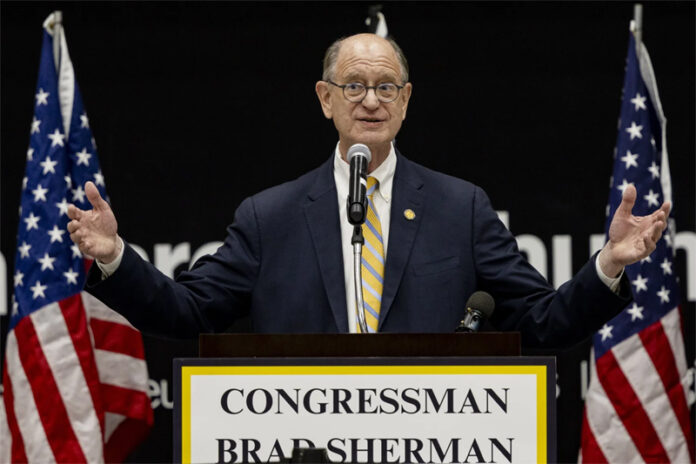
 WASHINGTON, Apr 23: US Congressman Brad Sherman has called on Pakistan to clamp down on terror groups such as Lashkar-e-Taiba (LeT), which has been linked to the 2025 Pahalgam terror attack.
 Speaking at an exhibition organised by the Indian Embassy here on the “Human Cost of Terrorism”, Sherman remembered the victims of the Pahalgam attack on the first anniversary of the incident in which 26 innocent lives were killed.
“The attackers, identified as The Resistance Front, targeted innocent people, reportedly separating victims by religion. The group is widely seen as linked to Lashkar-e-Taiba, which has found sanctuary in Pakistan,” Sherman said at the exhibition on Wednesday evening.
“We must use this moment to demand that the Pakistani government clamp down on Lashkar-e-Taiba, Jaish-e-Mohammed and other terrorist groups,” the Democrat leader said.
The exhibition, organised at Capitol Hill, comes at a time when Pakistan is projecting itself as a peacemaker by mediating efforts to end the seven-week US-Iran war.
The event was attended by lawmakers from both Democratic and Republican parties.
The digital exhibition also displays major terror attacks perpetrated across the world, including the 1993 Mumbai bomb blasts, the 2008 Mumbai terror attacks and the Pahalgam attack. It also identifies the terror outfits responsible for the attacks, including several Pakistan-based individuals and entities such as Lashkar-e-Taiba terror group.
“The special exhibition essentially serves to remind us of a few things. One, the scourge of terror upon humanity remains determined to destroy our societies. Countries around the world need to come together and remain resolute in defeating terrorism,” India’s Ambassador to the US Vinay Mohan Kwatra told reporters.
Kwatra said Prime Minister Narendra Modi has been clear about India’s unwavering resolve to deal with and defeat the scourge of terrorism.
Lawmakers who attended the exhibition included Michael Baumgartner, Bill Huizenga and Lisa McClain (all Republicans), and Julie Johnson, April Delaney, Ro Khanna, Raja Krishnamoorthi, Jamie Raskin, Shree Thanedar and Jonathan Jackson (all Democrats).
“We can share intelligence, ideas, policies and information to fight this threat jointly. When you work in silos, it is harder to coordinate and respond effectively. Through partnership, we can combine what each side is doing and build on what works,” McClain, chair of the House Republican Conference, said.
“That is the right way forward: working hand in hand, sharing information, learning from each other and acting together,” she added.
The images and visuals at the exhibition — each moment, memory, artefact and word — narrated stories of lives interrupted and altered by terrorism.
On May 7, 2025, India launched Operation Sindoor targeting terror infrastructure decimated multiple terror infrastructures in Pakistan and Pakistan-occupied Kashmir. The operation targeted nine sites, including the headquarters and training centres of LeT and another terrorist group, Jaish-e-Mohammed, from where terror attacks against India were planned and directed.
Pakistan later also launched offensives against India. The military conflict between the two nuclear-armed neighbours, lasting nearly 88 hours, halted after they reached an understanding on the evening of May 10.
“Leaders like Atal Bihari Vajpayee were warning about this threat back in the 1990s, but very few people took him seriously. After the September 11 attacks, the United States realised terrorism is not confined to one region; it spreads and threatens freedom around the world,” Khanna said.
“What Prime Minister Vajpayee said years ago was true: this is a global threat,” he added.
“I look forward to continuing to work as a co-chair of the caucus to support intelligence sharing, defence cooperation and the fight against terrorism, while standing up for freedom and democracy around the world,” Khanna said.
Congressman Richard McCormick described terrorism as a “unique evil” threatening both India and the US.
“We face extremist forces that seek to crush those who think differently and reject freedom, self-determination and unity. That is our common enemy,” McCormick said.
“Terrorism is everyone’s problem. Those who try to destroy our diversity through violence, and who do not accept us for who we are, are the true enemy. I stand with you, and I look forward to working together. We will have peace through strength,” he said. (PTI)

India’s First UNESCO Chair on Gender Inclusion and Skill Development to be launched by Jayant Chaudhary

PUNE, Apr 23: Symbiosis Skills and Professional University (SSPU), Pune, in association with UNESCO Paris, is set to mark a significant milestone in India’s education and skilling landscape with the launch of Asia’s first UNESCO Chair on Gender Inclusion and Skill Development for Women’s Empowerment.
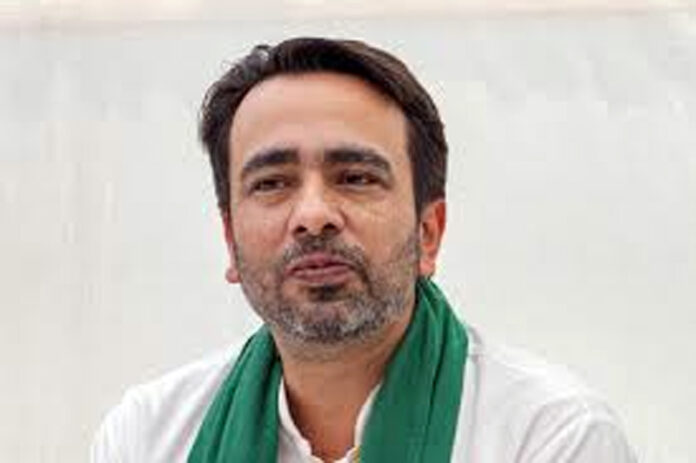
The UNESCO Chair will be formally launched by Jayant Chaudhary, union Minister of State (Independent Charge) for Skill Development & Entrepreneurship and Minister of State for Education on Friday at the International Conference on “Women Leading the Future of Work” organised in collaboration with UNESCO and being held at SSPU Campus, Kiwale, Pune, a release stated.
The initiative is spearheaded by Dr. Swati Mujumdar, Pro-Chancellor of SSPU and UNESCO Chairholder, who is a globally recognized Skill development policy expert, a member of the B20 Task Force, and recipient of the prestigious Fulbright-Nehru (FINEAS) Grant (2024-2025).
This landmark initiative positions India at the forefront of global efforts to strengthen skills ecosystems, technical education, and workforce readiness, in alignment with international standards and future workforce demands.
Established under the aegis of UNESCO Paris, the UNESCO Chair on Gender Inclusion and Skill Development at SSPU will act as a centre of excellence and global knowledge hub for advancing skill-based education and employability with a focus on increasing the participation of women in the workforce.
This International Conference on “Women Leading the Future of Work”, will reinforce the critical role of skills development in enabling women’s participation in sunrising sectors like AI, Semiconductor Technology and Defence Tech, the release added. (UNI)

Clean hands, clean mind, complete candour key to extraordinary relief: HC

*Dismisses petition for suppression, imposes costs

Excelsior Correspondent
JAMMU, Apr 23: Emphasising that a litigant must approach the court with clean hands, clean mind and complete candour and suppression of facts amounts to playing fraud upon the court, the High Court of Jammu & Kashmir and Ladakh has dismissed a writ petition as utterly misconceived and an abuse of the process of law, with Rs 50,000 costs.
Delivering judgment in a writ petition filed under Article 227 of the Constitution of India by three residents of Harnoo tehsil of Budgam district, Justice Wasim Sadiq Nargal came down heavily on the petitioners for concealing crucial facts and attempting to secure relief through parallel proceedings.
The case arose from a challenge to an order dated March 24, 2026, passed by the Court of Sub-Judge/Special Mobile Magistrate, Budgam, directing the Tehsildar to implement an earlier order. However, during the hearing, it was brought to the notice of the High Court that the petitioners had already approached the same court seeking suspension of the order.
The trial court, after hearing both sides, had passed an order on April 6, 2026, directing that the impugned order shall not be executed till further orders and restraining the respondents from proceeding with its execution. Despite this development, the petitioners failed to disclose the order before the High Court.
Taking serious note, Justice Wasim Sadiq Nargal observed, “once the execution of the impugned order already stood stayed by the court concerned, there was no occasion for the petitioners to invoke the supervisory jurisdiction of this court under Article 227 of the Constitution of India seeking quashment of the same order. The filing of the present petition, therefore, appears to be wholly unnecessary and misconceived”.
“The petitioners had not only suppressed the material fact of the stay order but had also concealed the filing and dismissal of an earlier writ petition on the same issue before a Coordinate Bench”, the High Court said and held that such suppression was deliberate and aimed at misleading the court to obtain interim relief.
Agreeing with the arguments of the respondents, the High Court ruled that the petition fell squarely within the realm of abuse of the process of the court as the grievance projected had already been redressed by the competent court.
“It is well settled that a litigant invoking the extraordinary jurisdiction of this court must come with clean hands, clean mind and complete candour and is under a bounden obligation to disclose all material facts which have a bearing on the adjudication of the case”, the High Court said, adding “suppression or concealment of material facts is not a mere irregularity, but amounts to playing fraud upon the court”.
It further held, “the duty to disclose is absolute and extends not only to facts which support the case of the party, but equally to those which are adverse to it. Any attempt to mislead the court strikes at the very root of the administration of justice and undermines the confidence reposed in judicial proceedings”.
The High Court also relied on the Supreme Court judgment in Auroville Foundation Vs Natasha Storey and earlier High Court rulings to reiterate that petitions involving suppression of facts are liable to be dismissed without going into merits.
Holding that the petitioners had indulged in concealment and attempted to overreach the judicial process, the High Court observed that a litigant who seeks to pollute the stream of justice is not entitled to any relief.
Declaring the petition as utterly misconceived and devoid of any merit, the High Court dismissed it and imposed costs of Rs 50,000, directing the petitioners to deposit the amount with the Registry within two weeks. The High Court further directed that the matter be listed on May 15, 2026, for compliance in case the costs are not deposited within the stipulated time.

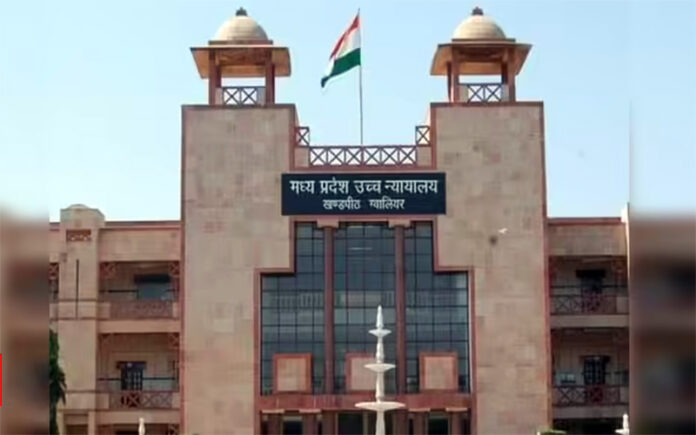
No evidence that temple was demolished and mosque built at Bhojshala: Muslim side tells HC

INDORE, Apr 23: A Muslim petitioner before the Madhya Pradesh High Court on Thursday claimed that there was no evidence that a specific temple was demolished at the present site of Bhojshala complex in Dhar district and a mosque was built there.

The high court is hearing petitions over the original religious nature of the structure at the site which Hindus claim to be a Saraswati temple built in 1034 by Raja Bhoj of the Parmar dynasty and the Muslims recognise as Kamal Maula Mosque.
Senior advocate Salman Khurshid, representing Maulana Kamaluddin Welfare Society of Dhar, presented detailed arguments before Justices Vijay Kumar Shukla and Alok Awasthi of the Indore bench which has been hearing four petitions and a writ appeal related to the dispute since April 6.

There was no evidence that any “specific temple” in Dhar was demolished during any “specific period” and a mosque was subsequently built on its site, said Khurshid.

Citing a 2003 letter purportedly sent by the British High Commission to the then chief minister of Madhya Pradesh, the senior lawyer claimed that a statue in the British Museum in London, which the Hindu petitioners claim to be of Vagdevi (Goddess Saraswati) from Bhojshala, is actually a statue of the Jain goddess Ambika.

He also cited the Supreme Court’s landmark judgment in the Ram Janmabhoomi-Babri Masjid case and argued that the ownership of the disputed complex should be determined on the basis of established principles of law and standards of evidence that govern the proceedings of a civil suit.

The authenticity of all documents, texts, and other materials presented before the high court should be thoroughly scrutinized, Khurshid said.

Citing Ramsevak Garg’s Hindi book “Hazrat Maulana Kamaluddin Chishti (Rahmatullah Alaih) and His Era,” he said that the city of Dhar, once the capital of the Parmar rulers of Malwa, witnessed numerous attacks, plunder, destruction and reconstruction during the princely era, including by Hindu kings.
Ain-ul-Mulk Multani had no need to plunder and conquer Dhar during his invasion of Malwa in 1305 and after conquering Mandu (another historic city in Malwa), he simply had to establish his rule in Dhar, Khurshid said, citing Garg’s book.

According to historians, Ain-ul-Mulk Multani was a general of Alauddin Khilji who played a key role in strengthening Khilji’s power in Malwa.
Khurshid also argued that the mosque associated with Maulana Kamaluddin, a Sufi saint of the Chishti order of Ajmer, was built within the disputed Dhar complex by the “then ruler”, and rejected the Hindu side’s claim that it was built by force.
Khurshid concluded his arguments on Thursday. The hearing would now resume on Monday. (PTI)

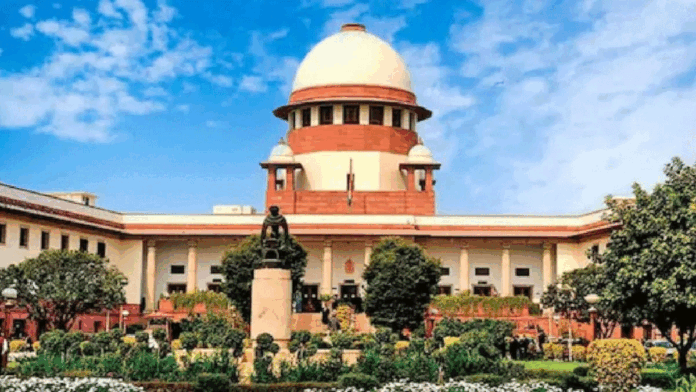
Dedicated Terror and Drugs Court

In a landmark intervention, the Supreme Court has taken decisive steps towards establishing dedicated, exclusive courts for cases pertaining to terrorism and narcotics. The directive seeks to end the backlog that has allowed some of the most dangerous criminals in the country to exploit procedural delays and languish in legal limbo for years. Terror and drug-related cases are not ordinary criminal matters. They are not disputes over property, contractual disagreements, or isolated acts of individual violence. They represent the calculated operations of dangerous syndicates – sophisticated criminal enterprises that conspire systematically against the nation, its people, and the very foundations of civil society. A single act of terrorism can shatter the economic equilibrium of an entire region within hours. Investment flees, tourism collapses, businesses shut, and the livelihoods of thousands are devastated. The ripple effect of one bomb blast or one targeted killing can set back a region by years, if not decades.
Beyond the economic damage lies something equally corrosive – the social fracturing that terrorism engineers. Terror incidents are frequently designed to inflame religious and communal tensions, to sow distrust amongst communities that have coexisted for generations, and to trigger political and social upheaval that weakens the democratic fabric of the nation. A society divided along religious lines is a society more easily manipulated and destabilised. This scenario is precisely the calculus of terror, and it must be met with the full, swift force of the law.
The narcotics menace is equally grave, and its consequences are equally far-reaching. Drug trafficking is a sinister, coordinated plot to destabilise regions and incapacitate the most vital resource a developing nation like India possesses – its youth. When an entire generation is rendered dependent, addicted, and incapacitated, the social and economic consequences are catastrophic. Human potential is extinguished, families are destroyed, and the workforce upon which India’s aspirations of development depend is steadily eroded. For those who orchestrate this trade, the suffering of millions is simply collateral damage in a ruthless enterprise driven by profit and geopolitical manipulation.
Nowhere is the deadly intersection of drugs and terror more evident – or more urgent – than in Jammu and Kashmir. The region has, for decades, grappled with a double onslaught that is unique in its viciousness. The same networks that smuggle narcotics are smuggling arms and ammunition. Drug money directly finances terror. The proceeds from heroin and contraband fund the purchase of weapons, the radicalisation of vulnerable young men, and the logistics of violence. In Jammu and Kashmir, the nexus is not a matter of conjecture – it is a documented, operational reality. Dismantling one without dismantling the other is an exercise in futility, and the judiciary’s decision to bring both within the ambit of dedicated special courts is therefore of particular and urgent significance for the region.
Yet for all the gravity of these offences, justice has been unconscionably slow. Courts across the country are burdened to the point of collapse, with judges simultaneously assigned non-NIA cases alongside UAPA trials, resulting in neither category receiving the focused attention it demands. Terror and drug cases have dragged on for years, in some instances for over a decade. When the guilty walk free or are left in prolonged pre-trial detention, neither the rights of the accused nor the rights of the victims are served. The Supreme Court has correctly identified that early disposal is the only mechanism that balances both.
The suo motu intervention by the Apex Court, directing that NIA courts exclusively handle UAPA and related trials without the encumbrance of other cases, is both timely and correct. The Ministry of Home Affairs framework – providing up to Rs 1 crore annually per court for operational expenses and a one-time infrastructure grant of the same amount – demonstrates that the financial scaffolding is in place. What is now required is speed and political will at the local level. State Governments must move swiftly to provide the space, infrastructure, and administrative support necessary to operationalise these courts without further delay. India’s message to those who deal in terror and narcotics must be unequivocal: justice will be swift, certain, and severe. The safety of the nation – and the future of its people – demands nothing less.

Water released in Kathua Canal after permanent restoration

Excelsior Correspondent
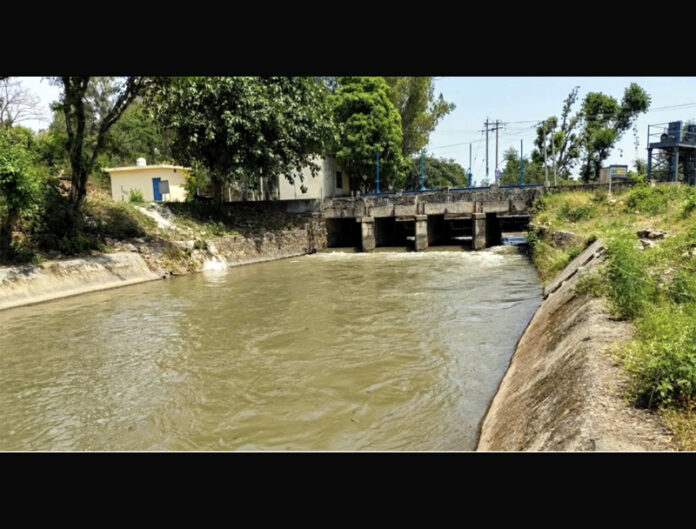
JAMMU, Apr 23: In a major relief to farmers, water has been released into the Kathua Canal following the successful completion of permanent restoration works, ensuring assured and uninterrupted irrigation supply across thousands of hectares.
The Kathua Canal, which originates from the Kashmir Canal at Chakunder Feeder in Jagatpur and irrigates a Culturable Command Area (CCA) of 8,463 hectares, had suffered extensive damage due to unprecedented floods in Sahar Khad and subsequent flooding in the River Ravi.
Following the damage, the authorities had carried out temporary restoration works, which were completed on October 7, 2025. This interim arrangement ensured irrigation for the last watering of standing Kharif crops and supported agricultural needs during the subsequent Rabi season, thereby providing immediate relief to the farming community.
Subsequently, the Jal Shakti (Irrigation & Flood Control) Department undertook sustained efforts to execute permanent restoration works. These included strengthening of damaged embankments and protection works of the siphon during the canal closure period to fully stabilise the canal system.
With the completion of these works, the canal is now fully operational and capable of functioning at its designed capacity. This will ensure reliable irrigation supply, particularly during the crucial Kharif season when water demand peaks.
The timely restoration has averted potential disruptions to agricultural activities and will enable farmers to plan their cropping operations with confidence and without uncertainty.
The achievement has been credited to the concerted efforts of the Jal Shakti (I&FC) Department, Jammu, under the guidance of Minister for Jal Shakti, Javed Ahmed Rana and Financial Commissioner (Additional Chief Secretary), Shaleen Kabra.