

‘No magic wand to make JK economically self-reliant’
Govt working with Centre to push for 2 key water projects
Excelsior Correspondent
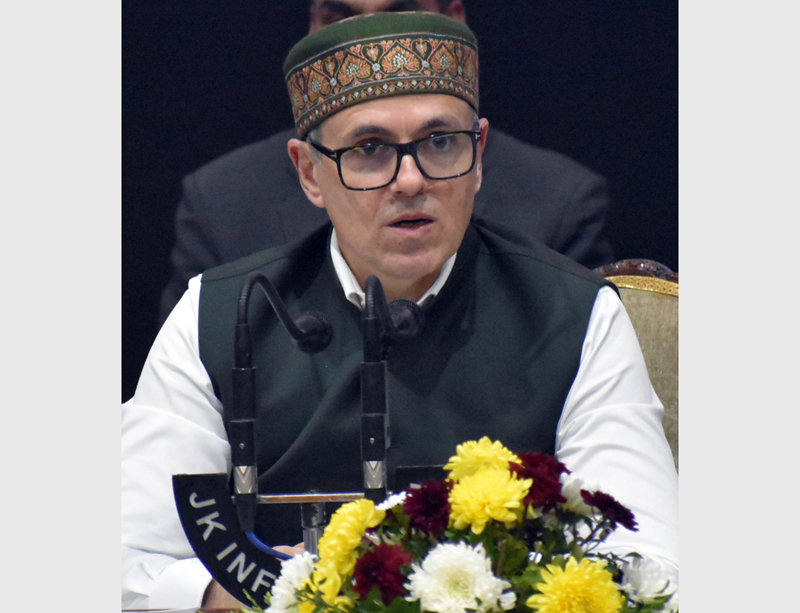
JAMMU, Feb 6: Chief Minister Omar Abdullah today defended his Government’s second budget, saying it was only natural for it to reflect the party’s priorities and manifesto commitments.
Follow the Daily Excelsior channel on WhatsApp
Dismissing the opposition’s criticism, Omar said they could not “have it both ways” by accusing the Government of failing to deliver on its promises and then objecting when those promises were implemented.
“…I am not apologetic at all about the allegation that this is a National Conference-centric budget. I would have been devastated if someone had said it was a BJP-centric budget. This is a National Conference Government. I’m sorry, but the opposition cannot have it both ways.
“They keep telling me that I am not fulfilling my manifesto or their manifesto. And then, when I actually begin fulfilling my manifesto promises, they turn around and say this is a National Conference-centric budget,” the Chief Minister told reporters at the post-budget press conference here.
He said the National Conference had a presence in every village and small habitation across Jammu and Kashmir and was the only political party capable of delivering balanced growth and representation.
Taking a swipe at the opposition, he said its role was to oppose, adding that even positive initiatives were criticised because the opposition aspired to occupy the seats of power but had so far failed to do so.
Omar said the opposition tended to ignore the Government’s achievements while exaggerating any lapse or shortcoming, a pattern he described as unsurprising.
He said the Government’s performance in just one year had exceeded what the opposition had expected, noting that critics had believed from the very first day that the NC-led Government would be unable to deliver.
He said the Government was steadily fulfilling its promises and would continue to do so, which was the reason behind the opposition’s discomfort and its tendency to blow issues out of proportion.
Omar said there is no “magic wand” to make the UT economically self-reliant, stressing that sustained multi-sector interventions are required to strengthen its financial position.
He said the Government is working to improve Jammu and Kashmir’s economic standing through targeted measures across sectors.
“If you are asking whether I have a magic wand to make Jammu and Kashmir self-reliant, the honest answer is no. These budgets have been directed towards improving our economic standing across sectors,” he said.
He expressed hope that the region would eventually reduce its dependence on Central assistance beyond its due share.
The Chief Minister said the Government is working under difficult economic realities but has still managed to present a realistic and operational budget for the Union territory (UT).
“This year has been particularly difficult for us. We were expecting a growth of around 5 to 10 per cent, but the Pahalgam incident and floods caused heavy losses. We hope to bring growth back on track,” he said, adding that despite the challenges, a “good and workable budget” has been placed before the people.
Replying to another question, Abdullah said that the UT is not presently a hydropower-driven economy, despite having significant potential in the sector.
“We have hydropower potential, but the economy gets almost nothing in terms of actual earnings from hydropower. Perhaps in the future, when all projects come on stream and the power is fully ours, hydropower could change the economic focus of Jammu and Kashmir. But it is extremely capital-intensive, with heavy upfront investment, so it is not easy,” he said.
“Hydropower is an important part of our infrastructure, but our economic focus remains on agriculture, horticulture, industry, tourism and handicraft,” Omar added.
The Chief Minister said the UT’s economy continues to be largely agrarian and dependent on agriculture, horticulture and allied sectors. “That is why this budget places special focus on agriculture, horticulture, productivity improvement and dairy development,” he said.
He further said there is a major push to expand dairy capacity in the region. “When you compare Jammu and Kashmir, which processes about 40 per cent of its milk, with a state like Gujarat, which processes nearly 90 per cent, the gap becomes clear,” he said.
On migration of youth for education and employment, the Chief Minister said the movement of people is natural and not necessarily a negative trend.
“If students go outside to study and come back, I don’t think it is a bad thing. I would be concerned if investments or productive assets were moving out, but people improving themselves and returning is not a bad development,” he said, adding that educational institutions in Jammu and Kashmir also attract students from outside the UT.
Replying to a question on providing six free LPG cylinders announced in the budget, Omar said, “The only concern of beneficiaries is whether they receive the cylinder free of cost. How we fund it is the government’s responsibility. We will not raise prices for others to fund it.”
On restoration of Statehood, Abdullah said he remains hopeful that the commitment made to Jammu and Kashmir would be fulfilled and declined to elaborate, saying the issue was not the subject of the press conference.
He further said the much-awaited Jammu Master Plan for urban development is in the final stages and will soon be placed before the Council of Ministers for approval.
“There is no order yet. The draft was put to public scrutiny, and several comments were received. Some changes were required. Such a comprehensive document, which includes a substantial portion of Jammu, cannot be prepared in a hurry,” he said.
Responding to concerns over shrinking agricultural and horticultural land, Abdullah said land-use change cannot be completely banned.
“People have the right to build houses and to use their land as they want. Our effort is to make conversion difficult, not impossible, and to protect productive agricultural land as far as possible,” he said.
Citing a recent example, the Chief Minister said the Government had requested the Centre to suspend proposed railway projects to Pahalgam and Shopian as their alignments were affecting fertile land. “I am grateful to Railway Minister Ashwini Vaishnaw for accepting our request,” he said.
On irrigation, Abdullah said strengthening the canal network is a priority. “Timely desilting is essential, not only in main canals but also in tail-end canals, because often water reaches the main canal but farmers at the tail end do not receive adequate supply,” he said.
Speaking on provisions related to Kashmiri Pandits, he said the budget includes measures for filling vacant posts, improving living arrangements and addressing welfare concerns but added that financial packages alone cannot ensure their return to the valley.
“They left because they felt unsafe. They will only return when a genuine sense of security is restored. Restoring that confidence is our collective responsibility,” he said.
On fiscal challenges, the Chief Minister blamed the previous PDP-BJP Government for artificially inflating the size of Jammu and Kashmir’s economy.
“That growth was unsustainable and unrealistic. It placed an enormous burden on the economy. We are undoing that damage,” he said.
Omar pointed out that the UT has not yet derived any benefits from the abeyance of the Indus Waters Treaty and said his Government is working with the Centre to push for two key water projects.
He was referring to the Tulbul Navigation Project (Wullar Barrage) on the Jhelum river and the diversion of water from Chenab to augment water supply in Jammu.
“Jammu and Kashmir should have got the benefit from the abeyance of the IWT, but no such benefit has accrued so far. As far as power projects are concerned, whether Ratle, Kiru, Kwar or Pakal Dul, all of these are ongoing projects, and there will be no change in their scope, design or water-holding capacity.
“In keeping with the provisions of the IWT, it has been ensured that there is no change in the generation capacity of these projects. Looking ahead, if new projects are taken up and the restrictions imposed under the IWT are not lifted, the region can certainly gain in the long run,” he said.
He noted, however, that this is “both our understanding and our effort”, as power projects typically take a long time to materialise.
At present, Abdullah said the UT can potentially derive benefits in two key areas. First, if the Tulbul Navigation Project (Wullar Barrage) is constructed on the Jhelum, it would enable the storage of additional water during normal flow periods.
“This would have multiple advantages — facilitating inland navigation, helping control sedimentation, and improving power generation at downstream hydroelectric projects such as Lower Jhelum, Uri and Uri-II,” he said, adding that secondly, diverting water from the Chenab river to supply to Jammu city would help address the region’s long-standing water scarcity.
Abdullah further said his Government is working under a special drive to strengthen the canal network to draw additional water from the Chenab for irrigation, with a focus on benefiting tail-end farmers.
“We are hopeful of receiving support from the Centre to draw more water from the Chenab for both irrigation and drinking purposes to overcome scarcity,” he said.
According to the Chief Minister, so far, the IWT abeyance has not had any significant impact on the overall power sector.
“If any benefit has been realised at present, it came through the Special Assistance to States for Capital Investment (SASCI) scheme. Arranging funds for the equity share contribution in power projects had posed challenges in the past but under the new financing arrangement, not only has Jammu and Kashmir’s equity contribution been avoided, but additional savings have also been achieved,” he said.
The Chief Minister, however, expressed hope that future changes related to the IWT will yield broader gains to the region.
He said the National Conference Government is awaiting the report of a panel before initiating the process of regularisation of daily wagers.
“Once the committee finalises its report and submits it to us, we will begin the process of regularisation in a phased, planned and transparent manner,” he said.
Omar said the return of Kashmiri Pandits to the Valley would be possible only when their sense of security is fully restored, asserting that no package, fund or scheme alone could ensure their return.
“I have always maintained that Kashmiri Pandits left the valley because their sense of security was taken away. They felt unsafe living in the Valley. They will be able to return only when that sense of security is restored,” Abdullah said.
He said restoring that confidence must be the collective responsibility of all to facilitate the return of not only the Pandits but all those who migrated from Kashmir in the late 1980s and early 1990s.
“I mentioned Kashmiri Pandits in the budget. We spoke about the steps we intend to take, the posts that need to be filled, and the arrangements for their stay. We discussed how these measures can be implemented.
“However, when it comes to the return of Kashmiri Pandits, no package, fund or scheme alone can fully make that possible,” he said, adding his Government is doing everything possible to make their lives more comfortable and to facilitate the return of as many people as possible.
 Follow our WhatsApp channel
