

Dr Jyoti Malhotra Kapoor
drjyoti0104@gmail.com
Ongoing Globalization and universal digitalization in the modern scenario, WHO, UNICEF/CBSE and UNESCO urge the significance of instilling 21ist century skills amongst youth of a country. The skills are required to move with the pace of ongoing developments and technical advancements. Educational sectors at state and national level are trying their best to inculcate these skills beginning at foundational level and continuing thereafter as prosperity of a nation is directly reflected by the youth of a nation. Various policies are developed year after year so as to bring improvisation rather revolution in education sector of a country as this is the sector from where all the sections of societies emerge and is a leading sector on which the development, evolution and wellbeing of a country leans on. Hence education should foster responsible, self-reliant and compassionate citizens. To achieve and imbibe such qualities, life skills play a significant role. Life skills are a group of psychosocial competencies and interpersonal skills that help people/citizens/educators/students, make informed decisions, solve problems, think critically and with creativity, communicate effectively, build healthy relationships, empathize with others and cope with and manage their lives in a healthy and productive manner. Also, according to WHO, Life Skills are “the abilities of adaptive and positive behavior that enable individuals to deal effectively with the demands and challenges of everyday life.”
Taking into consideration the challenges and imbibition of life skills in youth of a country, National Cadet Corps (NCC) plays a significant role. NCC, a youth organization has its beginning in the’ University Corps’ created in the Indian Defense Act 1917, with the objective to make up the shortage of Army. In 1920, University Corps was replaced by University Training Corps (UTC) and UTC was renamed as University Officers Training Corps (UOTC) in 1942. In 1946, a committee under Pandit HN Kunjru was set up and NCC came into existence on 16th July 1948 under the act, Act XXXI of 1948 under the ministry of defense (MOD). Since then, the NCC is contributing immensely in helping the youth in developing personality traits like physical strength, psychological, socio- emotional, intellectual values and morals necessary for a healthy lifestyle and character building. NCC has grown step by step and is open to both schools and universities but it cannot provide coverage to large number of educational institutions due to the sanctioned strength at each level. It is important to mention that NCC got an inter service image when air wing in 1950 and naval wing in 1952 were added to it. Elementary military training was given to school students, junior division(JD), college students, senior division (SD) being trained as potential officers of the army. In 1949, the girls division was introduced to give equal opportunity to school and college going girls. Due to popular demand and followed by Chinese aggression, NCC training was made compulsory in 1963. However, again NCC was made voluntary in 1968 in response to resistance by some students and suggestions of some vice chancellors.
Induction into NCC is on voluntary basis. Students, both boys and girls, in schools and colleges can join NCC with no distinction made on the basis of caste, creed, status, community and province, at the age of 13 years in junior division/Junior wing (boys/girls) class VIII to X, and senior division/senior wing from class XI onwards.
Keeping in mind four cardinal principles (obey with smile, be punctual, work hard without fuss and make no excuses and tell no lies) and NCC motto (unity and discipline),NCC students are always taken care of by their Associated NCC Officers (ANOs).ANOs undergo rigorous training for 3 months at OTA Gwalior (for women) and OTA Kamptee Nagpur(for men) and are appointed to train NCC cadets in their respective institutions and during camps in addition to JCOs (junior commissioned officers) & NCOs (non- commissioned officers).ANOs are regarded to be the most important and the only backbone of running institutionalized NCC.
First and foremost, effort has to build and boost the morale of NCC cadets and make them motivated and inclined to future trainings.NCC teaches respect for diverse religion, language, culture, ethnicity, lifestyle and habitat, instill a sense of national unity and social cohesion and sensitivity to the needs of poor and socially disadvantaged fellow citizens,understanding the values of honesty, truthfulness, sacrifice,perseverance and hard work.In NCC trainings, NCC camps are organized where importance of time, punctuality, discipline, collaboration with team, interpersonal relationships, communication, personal hygiene and cleanliness are of utmost importance. While in a camp, to be on time on ground, early in the morning (4-4.30 am) for running, body exercises, yoga by an instructor in a camp teaches NCC cadets the value of time and judicious use of same.
Time management is a set of skills, tools and systems that work together to help you to achieve outstanding results, both personally and professionally. The skill helps NCC cadets in reducing or eliminating wasted time and to make an effort to have more productive time each day thereby improving their performance to achieve long term goals. Another most important aspect of NCC training is to inculcate leadership traits in youth of our country aligned with character building, comradeship to mold them into a responsible citizens and leaders across various fields.NCC acts as an experimental laboratory, translating theoretical knowledge into behavioral competencies. During institutional trainings and in camps, cadets are placed in positions of command fostering team coordination, responsibility and thereby making the best of a problem solving skill with accountability. Certain camps like BLC (Basic leadership courses and ALC (Advanced leadership Courses) are designed to boost up their personality and soft skills.
Senior wing / senior division NCC cadets are given some adventurous activities like mountaineering, trekking and rock climbing which cultivate courage, teamwork and self-confidence. Regular drills and Parades in camps instill self-discipline and attention booster. Love for uniform and badges is automatically inculcated among NCC cadets and camps like Republic day camp (RD Camp) and Ek Bharat Shrestha Bharat (EBSB) camp promote national integration, patriotism, love for nation and people of country thereby promoting unity in diversity and teamwork with fellow NCC cadets of different regions and religions. Structured interactions in camps help NCC cadets improve verbal communication and interpersonal skills. During parades, NCC cadets are given a chance to command the squad and manage peers helping boost up their morale and self-confidence in a disciplined way. Trainings do develop ability to withstand tension, frustration and disagreement.
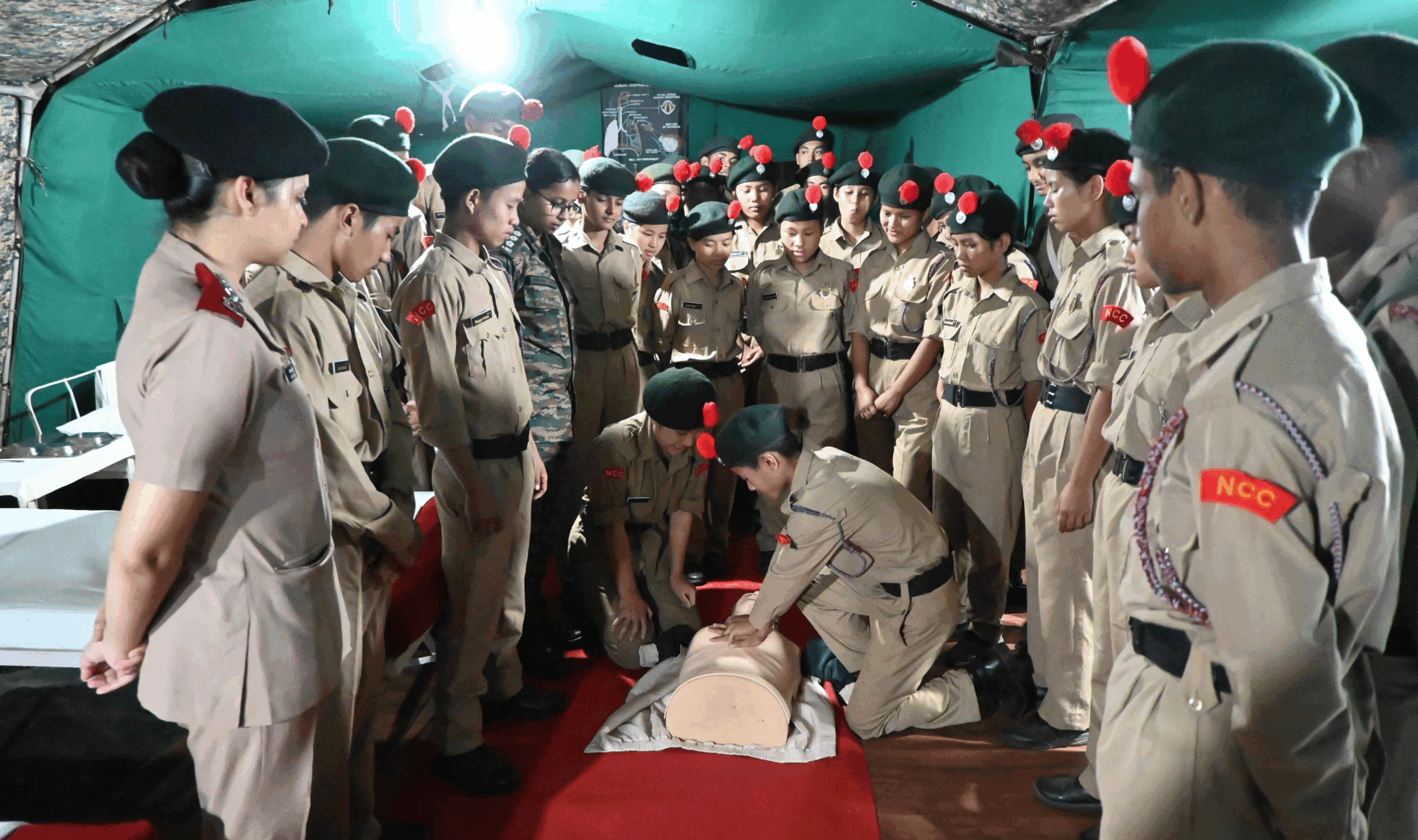
NCC cadets are wonderfully trained to manage disasters efficiently. Disasters can be because of earthquake, bomb blasts, short circuiting, and gas explosion. Fire emergencies can evoke havoc resulting in loss of life and property. Firefighting, a vital component of fire management, requires skills to handle fire extinguishers and different types of fires besides basic principles to control fires. Training includes practical demonstrations, rescue techniques and in routine classes by the experts and ANOs. Fire- fighting is frequently taught during combined annual training camps (CATC), annual training camps (ATC) or as a part of specialized disaster management trainings. Fire- fighting training fosters a sense of responsibility and bravery in cadets making them effective responders during crisis.
NCC plays a significant role in providing comprehensive basic military training to youth of a country studying in schools and colleges through weapon training, rifle drill, map reading and visa-viz. preparing cadets for ‘B’ and ‘C’ certificate examinations. In weapon training, cadets are made aware of different rifles (.22 Rifle NO 2 Mark IV, .22 Delux and .03 Rifle No. 1 Mark III bolt action Rifles). Till few years back Indian Army was using 7.62 mm SLR and 5.56 INSAS Rifles. Presently AK-203 (7.62×39mm) has replaced older 5.56mm INSAS rifles. Cadets are practically demonstrated stripping of Rifle, cleaning and assembling of rifle. Cadets are informed to take care of their rifles in different areas viz., humid, desert, and polar areas. Loading and unloading of rifles is taught and the cadets are made to practice personally in presence of an instructor / ANO/GCI (girl cadet instructor)/JCO or NCO. After theoretical knowledge cadets are taught principles of firing which lead to correct aiming and perfect alignment prior to operating trigger of rifle. Cadets are taught about four positions of firing, while lying is most accepted and being taught in NCC camps.
The culmination of all trainings in the NCC is the conduct of certificate examinations and passing of these examinations are mandatory for the cadets as these certificates help them getting certain benefits for job employability besides learning and achieving life skills. Certificate ‘A’ for .JW/JD NCC cadets (Class IX-X) after completion of 2 years of NCC training become eligible to appear for ‘A’ certificate exam while Senior wing/Senior Division (SW/SD) NCC cadets after completion of 2 years training became eligible for ‘B’ certificate exam. Such candidates after passing ‘B’ certificate exam appear for ‘C’ certificate exam at the end of 3rd year (1st year of college).
Though a balanced diet, regular exercise and sports play a significant role in overall development of a person but while keeping in mind inculcating of life skills in one’s life make a person ready to meet and handle diverse situations. NCC training of cadets through different camps and trainings teaches life skills as leadership traits with flexibility and responsibility, collaboration effective communication, maintaining interpersonal relationships, problem solving attitude, critical thinking, time management besides discipline, punctuality, initiative, civic sense like personal and societal norms including cleanliness, plantation drive, following traffic rules and compassionate behavior. Presently all the schools and colleges are not given NCC as of their specified limited strength, I do recommend NCC as an elective subject in all institutions and maximum students to be enrolled in NCC keeping in mind the holistic development and inculcating life skills as it in the need of hour.
 Follow our WhatsApp channel
