

Vijay Hashia
iamvhashia@gmail.com
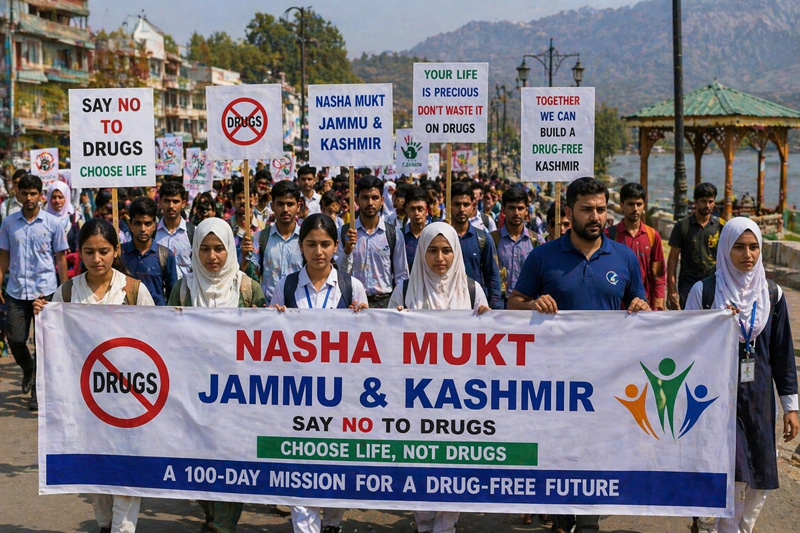
Lt Governor Manoj Sinha has launched a 100 day ” Nasha Mukt Jammu & Kashmir Abhiyaan” to combat drug menace in the region. The initiative reflects a comprehensive “whole-of-government” approach integrating the efforts of law enforcement agencies, health services, educational institutions, and civil societies. This strategy is aimed at safeguarding youth and restoring the social fabric of Jammu and Kashmir. The call for a ” Nasha Mukt Jammu & Kashmir” is not merely a policy slogan; it is a moral and civilizational imperative.
The drug menace in Jammu and Kashmir cannot be understood in isolation. It is the product of geopolitical vulnerabilities, socio-economic distress, and psychological fragility. The region’s proximity to the notorious Golden Crescent comprising Afghanistan, Iran, and Pakistan, places it perilously close to one of the world’s largest narcotics producing zones. This geographical reality has turned the region into a transit as well as a consumption hub.
Cross-border smuggling, often facilitated through covert networks, has injected a steady flow of drugs such as heroin, cannabis, and synthetic substances into the region. More disturbingly, the phenomenon of narco-terrorism, where drug trafficking finances, adds a dangerous dimension, transforming the issue from a public health concern into a national security threat. Yet, the supply side alone does not explain the crisis. The demand is equally rooted in the lived realities of the youth. Years of political instability, unemployment, and exposure to violence have engendered a deep sense of alienation and psychological stress. For many young individuals, drugs become an escape, a fleeting refuge from despair and disillusionment.
The Human Cost: A Generation at Risk
The most tragic aspect of this crisis is its disproportionate impact on the youth. A significant number of those affected are adolescents and young adults, many of whom fall easy prey to addiction during their formative years. The shift from relatively milder substances to highly addictive opioids like heroin has accelerated both dependency and devastation. Therefore, the consequences are manifold and deeply corrosive. Health complications, including the spread of infectious diseases such as Hepatitis C, are on the rise. Most of the families have disintegrated under the strain of addiction, their economic hardships have intensified. Crime, too, has become an inevitable byproduct, as the desperation has driven addicts toward theft and violence.
A Right Administrative Resolve Under LG Manoj Sinha
Recognizing the gravity of the situation, the administration under Lieutenant Governor Manoj Sinha has launched a series of decisive interventions. Central to these efforts is the vision of a “Nasha Mukt Jammu & Kashmir,” operationalized through targeted campaigns and stringent enforcement measures.
The “Nasha Mukt Jammu and Kashmir Abhiyaan,” a time-bound initiative, seeks to dismantle the ecosystem of drug abuse through a combination of supply reduction and demand mitigation strategies. Law enforcement agencies will intensify crackdowns on drug peddlers, with a clear emphasis on dismantling trafficking networks. The administration has also adopted a zero-tolerance policy, including the confiscation of properties and financial assets linked to drug trafficking. Moreover, efforts are afoot to expand rehabilitation infrastructure. De-addiction centers are being strengthened to ensure that those caught in the cycle of addiction are not merely punished but also rehabilitated and reintegrated. Public awareness campaigns, to educate communities about the perils of drug abuse and to foster a culture of vigilance and responsibility is on anvil.
Youth as Change Agent
A distinctive feature of the anti-drug campaign is the active involvement of youth themselves. Educational institutions, civil society groups, and volunteer organizations are being mobilized to transform young individuals from potential victims into proactive participants in the fight against drugs. Workshops, seminars, and awareness drives, cultivating a sense of responsibility among students will be conducted. Sports, cultural activities, and skill development programs are being promoted as constructive alternatives, channeling youthful energy into positive pursuits. This participatory approach will ensure that the battle against drugs will be fought both through enforcement and within the minds of the youth.
The Road Ahead: Toward a Sustainable Solution
While the current measures represent a strong beginning, the path to a drug-free Jammu and Kashmir demands further sustained and holistic action:
Firstly, the border management must be strengthened through advanced surveillance technologies and intelligence coordination to curb the inflow of narcotics. Secondly, education systems must be integrated to comprehensive anti-drug curricula, equipping young minds with knowledge and resilience. Thirdly, employment opportunities, entrepreneurship initiatives, and skill development programs must provide youth with a sense of purpose and direction, reducing their susceptibility to addiction. Fourthly, rehabilitation efforts must be expanded and humanized. Addiction should be treated not merely as a crime but as a health condition requiring compassion, medical care, and social support. Last but not least, community engagement is indispensable. Families, religious institutions, and local organizations must act as the first line of defense, fostering environments of support, vigilance, and moral guidance.
The vision of a “Nasha Mukt Jammu & Kashmir” is not an abstract ideal; it is a pressing necessity. The steps taken under the leadership of LG Manoj Sinha signal a determined administrative will. However, the ultimate success of this mission depends on a collective awakening. If Jammu and Kashmir is to preserve its legacy of resilience and cultural richness, it must confront this crisis with urgency and unity.
 Follow our WhatsApp channel
