

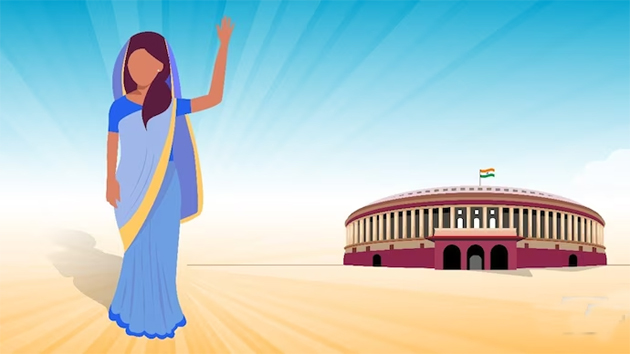
-A Historic Act, A National Resolve-
Tarun Chugh
Where women are honoured, there divinity resides. This ancient Sanskrit wisdom is no longer merely a verse from our scriptures – under the visionary leadership of Prime Minister Shri Narendra Modi, it has become the foundational governing principle of our nation. The Nari Shakti Vandan Adhiniyam – the Constitution’s 106th Amendment Act, also known as the Women’s Reservation Act, 2023 – is not merely a piece of legislation. It is the fulfilment of a promise that had been broken time and again by the Congress party, and which the Bharatiya Janata Party has now honoured with unwavering political courage and unshakeable conviction.
Thirty-three percent reservation for women in the Lok Sabha and State Legislative Assemblies – this is not an act of charity. It is a correction of a historical injustice that kept half of India’s population excluded from the halls of decision-making for decades. Every delay in advancing women’s representation was, in effect, a delay in strengthening the quality and inclusiveness of our democracy. Today, as this Act moves steadily towards implementation, it stands as irrefutable testimony to Prime Minister Modi’s extraordinary resolve and his commitment to the principle of ‘Sabka Saath, Sabka Vikas, Sabka Vishwas, aur Sabka Prayas’ – a commitment visible not in words alone, but powerfully in deeds.
India’s women have demonstrated time and again that they are more than ready for leadership. With over 47 crore women voters participating at 65.78% turnout in the 2024 general elections, Indian women have proven their democratic energy and engagement. Yet their representation in Parliament and state assemblies remained disproportionately low relative to their share of the population. Research and experience consistently demonstrate that where women lead – in governance, in panchayats, in institutions – there is better prioritisation of water, nutrition, health and education, and governance becomes more sensitive, more inclusive, and more effective. This structural imbalance is now being corrected, and it is being corrected by a government that genuinely believes in women-led development.
The story of women’s reservation in India is, at its core, the story of the Congress party’s systematic betrayal of Indian women. In 1996, when the United Front government first introduced the Women’s Reservation Bill in the Lok Sabha, Congress was providing outside support to that government – yet it made no active effort to build political consensus or use its considerable influence to push the Bill through. As a result, in the absence of political will, the Bill could not be passed. This was the first of many betrayals that Indian women would endure at the hands of the Nehru-Gandhi legacy.
When Shri Atal Bihari Vajpayee’s NDA government introduced the Bill repeatedly in 1998, 1999, and 2003, it was Congress’s own political allies who disrupted Parliament and blocked progress. On 13 July 1998, when the NDA government attempted to present the Bill, Surendra Prasad Yadav of the Rashtriya Janata Dal tore up the Bill’s copy on the floor of the Lok Sabha. This was the naked face of the Congress-led coalition’s anti-women mindset – and the Congress party, rather than disciplining its allies, continued to accommodate them for the sake of political survival. On 22 December 1999, when the then Law Minister Ram Jethmalani attempted to advance the Bill, fierce opposition from the Samajwadi Party, Bahujan Samaj Party, and RJD killed it once again.
In 2008, the UPA government introduced the Constitution (108th Amendment) Bill in the Rajya Sabha. The Bharatiya Janata Party welcomed this move and pledged its support. However, Congress’s own coalition partners – the RJD, SP, and BSP – mounted fierce political opposition. RJD chief Lalu Prasad declared that his party would push for ‘reservation within reservation’ for OBC and minority women and would continue to oppose the Bill. The Samajwadi Party’s members were explicit that they would block the Bill until separate quotas for OBC, Dalit, and Muslim women were guaranteed. The BSP demanded 50% reservation for women, further complicating the consensus. It is worth noting: in each of these cases, it was not the BJP standing in the way – it was Congress’s own partners, tolerated and protected by the Nehru-Gandhi establishment for purely electoral reasons.
On 4 June 2009, President Smt. Pratibha Patil addressed a joint session of Parliament and announced that the newly-elected UPA government would pass the Women’s Reservation Bill within 100 days. This announcement ignited hope in the hearts of crores of Indian women. What followed? Delay, hesitation, and ultimately, betrayal. In 2010, the Bill did pass the Rajya Sabha – but when the real test came in the Lok Sabha, the Manmohan Singh government backed away. Why? Because preserving power with SP and RJD allies mattered more than delivering justice to women. For five full years – with a comfortable majority and ample parliamentary time – the Congress-led UPA, under Sonia Gandhi’s leadership, chose silence over action. They had the numbers. They had the time. What they lacked was the will.
The Bill lapsed. Again. Crores of women who had waited decades were betrayed. Again. For the Nehru-Gandhi family, women’s empowerment was never a mission – it was a slogan, deployed with great fanfare when convenient, and abandoned quietly when it threatened political interests. This is the truth that no amount of press conferences or Twitter posts can obscure. And today? When this historic legislation was passed in September 2023, Rahul Gandhi demanded ‘immediate implementation.’ Mallikarjun Kharge called it a political gimmick. Yet when the law is now moving forward and a special session has been convened to accelerate its implementation, the same opposition is raising the question – why now? Mamata Banerjee, who was once a vocal supporter of women’s reservation, now dismisses it simply because it is the BJP government that has delivered it. This rank hypocrisy, this double standard, is Congress’s true and enduring identity.
The Bharatiya Janata Party has consistently stood for 33% reservation for women in Parliament and state legislatures since the 1990s. A resolution to this effect was passed at our National Executive in Vadodara in July 1994. In 2007, under the presidency of Shri Rajnath Singh, the BJP’s National Executive approved 33% reservation for women across all organisational posts, including national office-bearers. By 2008, this had been extended to all cadre positions. Our commitment to women’s representation is not something we discovered recently for electoral purposes – it is a founding conviction of our political philosophy.
The NDA fielded 58 women candidates in 2014, 73 in 2019, and 91 in the 2024 general elections – a steady and consistent increase that reflects genuine institutional commitment. The INDIA bloc’s constituent parties, on the other hand, fielded 208 women candidates in 2014 – a figure that had collapsed to just 97 by 2024. This is not a coincidence. It reveals the difference between a party that places women at the centre of its political vision and parties that invoke women’s empowerment as seasonal rhetoric. The difference is not merely statistical – it is the difference between conviction and tokenism, between governance and grandstanding.
Under BJP leadership, India received its first tribal woman President in Smt. Droupadi Murmu – a moment of profound social justice, where a woman from the most marginalised strata of society rose to occupy the highest constitutional office in the land. Smt. Sushma Swaraj transformed diplomacy into citizen-centred service as External Affairs Minister, especially for Indian women living abroad. Smt. Nirmala Sitharaman has led India’s economy as the country’s first full-time woman Finance Minister, steering the nation through the once-in-a-century challenge of a global pandemic. This is the empowered Nari Shakti that the BJP truly believes in – not as symbols, but as leaders.
Over the past eleven years, Prime Minister Modi’s government has achieved a comprehensive transformation in the lives of Indian women across every dimension – dignity, health, economic empowerment, education, and security. The Swachh Bharat Mission has built over 12 crore toilets, restoring the dignity and safety of crores of women; over 90% of women have reported improved feelings of safety and self-respect. The PM Ujjwala Yojana has delivered over 10.7 crore LPG connections to women in below-poverty-line households, liberating them from the toxic smoke of traditional chulhas and safeguarding their health. The Jal Jeevan Mission has provided tap water connections to over 15.8 crore households, saving women the hours of daily drudgery previously spent fetching water from distant sources.
The economic empowerment numbers are equally transformative. Over 35 crore women have received MUDRA loans – nearly 68% of all loans sanctioned under PM MUDRA Yojana’s 52.5 crore total disbursements have gone to women, enabling them to become job creators in their communities. Over 32 crore women have been brought into the formal financial system through Jan Dhan accounts. More than 3 crore women have become ‘Lakhpati Didis’, earning over one lakh rupees annually. Over 10 crore women are part of 90 lakh self-help groups, building economic independence from the ground up. The Stand-Up India scheme has extended 2.04 lakh loans – 83% of the total – to women entrepreneurs, with a cumulative value of ?47,704 crore. Women-owned MSMEs have grown from 17.4% to 26.2% of total MSMEs. Female workforce participation has surged from approximately 23% in 2017-18 to over 40% today – a historic leap.
In healthcare, the PM Matru Vandana Yojana has provided ?5,000 in financial support to over 4.8 crore women during pregnancy and lactation. The PM Surakshit Matritva Abhiyan has facilitated health check-ups for 6.9 crore pregnant women. The Maternal Mortality Rate has been reduced from 130 (2014) to 80 (recent data). Mission Poshan and Poshan 2.0, backed by ?1.81 lakh crore in investment, are improving the nutritional status of approximately 9 crore adolescent girls, pregnant women, and lactating mothers. Under Ayushman Bharat, over 43 crore people – a significant majority of them women – have been brought under health insurance coverage. The Janaushadhi scheme provides sanitary pads at just ?1 each; over 100 crore pads have been distributed, ensuring affordable hygiene for women across the country.
In education, girls’ enrolment in higher education rose from 1.57 crore in 2014-15 to 2.18 crore in 2022-23. The Beti Bachao Beti Padhao programme has pushed the secondary school enrolment rate for girls to 80.2%. The sex ratio at birth has improved from 918 (2014-15) to 937 (2020-21). In science and technology, nearly half of India’s STEM graduates are now women. Women scientists led landmark missions including Chandrayaan-3 and Aditya-L1. The Vigyan Jyoti programme has inspired over 80,000 girls from rural backgrounds to pursue STEM careers. The WISE-KIRAN scheme has supported nearly 2,000 women scientists with fellowships and research opportunities.
In the armed forces, the transformation has been historic. Women are now admitted to the National Defence Academy – 158 women cadets have been inducted since 2022. Women are deployed on warships, serving as pilots and Naval Air Operations Officers. The Indian Air Force inducted women fighter pilots on an experimental basis in 2015, making this permanent in 2022. Women officers are now present in command units, international deployments, and UN peacekeeping missions, with their total numbers reaching approximately 11,000. In Operation Sindoor, women played crucial roles in intelligence, logistics, and ground coordination – demonstrating once again that India’s security apparatus is stronger when women are at its centre.
Prime Minister Modi has written with admirable clarity: ‘This moment calls for collective action. It is not about any one government, party or individual. It is about the nation as a whole recognising the importance of this step and coming together to realise it.’ I echo this appeal with every conviction I hold. The Nari Shakti Vandan Adhiniyam represents the broadest possible national consensus – and I urge every Member of Parliament, across party lines, to rise above narrow electoral calculations and support this transformative step for the women of India. Such opportunities come rarely in the life of a democracy. Let us seize this one with a sense of responsibility and purpose.
History will judge us not by what we promised, but by what we delivered. The Bharatiya Janata Party – under the extraordinary leadership of Prime Minister Narendra Modi – chose to deliver. We chose action over agenda, conviction over convenience, and governance over politics. The passage of this Act is not merely the crowning achievement of eleven years of women-centric governance – it is the foundation stone of Viksit Bharat, where women are leaders, entrepreneurs, scientists, soldiers, and nation-builders in the truest sense. This is the India that our Constitution’s framers envisioned – where equality is not merely enshrined in text, but realised in practice.
Nari Shakti hi Rashtra Shakti hai – Women’s Power is the Nation’s Power. Let us advance it together, let us honour it together, and let us build with it the India that the women of this great civilisation have always deserved.
(The author is the National General Secretary of the BJP and Co-Convenor of the Beti Bachao Beti Padhao campaign)
 Follow our WhatsApp channel
