

PM proposes 4 initiatives at G20 summit
JOHANNESBURG, Nov 22:
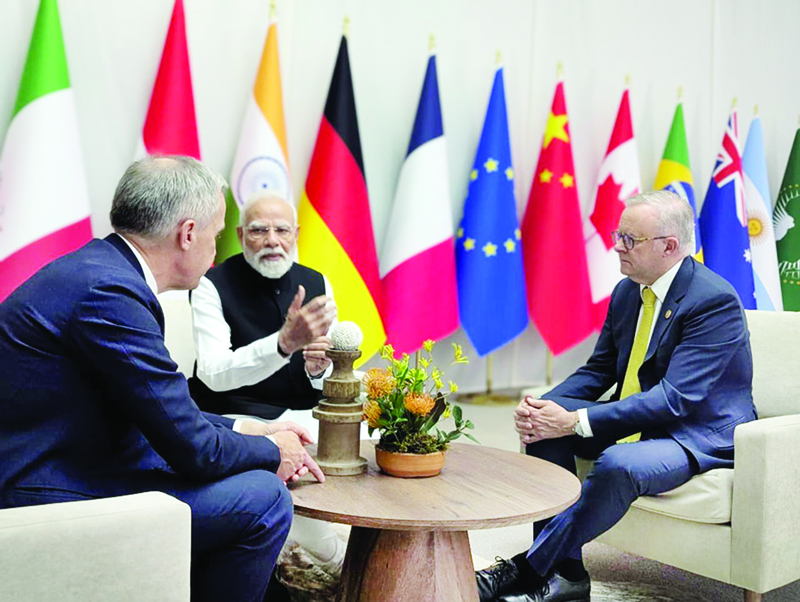
A new trilateral technology and innovation partnership was announced by Prime Minister Narendra Modi on Saturday after a meeting with his Australian and Canadian counterparts on the sidelines of the G20 Leaders’ Summit here.
Follow the Daily Excelsior channel on WhatsApp
“We are delighted to announce an Australia-Canada-India Technology and Innovation (ACITI) Partnership today,” Modi said in a social media post after meeting Australian Prime Minister Anthony Albanese and Canada’s Mark Carney.
“The initiative will deepen collaboration between democratic partners across three continents and three oceans in emerging technologies, support diversification of supply chains, clean energy and mass adoption of AI,” he said.
Separately, Modi on Saturday met his British counterpart Keir Starmer and UN Secretary-General António Guterres.
“It was wonderful meeting Prime Minister Keir Starmer in Johannesburg. This year has brought new energy to the India-UK partnership and we will keep driving it forward across many domains,” Modi said in a post on X.
The Prime Minister said he had a “very productive” conversation with UN chief Guterres.
Meanwhile, Prime Minister Narendra Modi on Saturday called for a profound rethink of the global development parameters and proposed setting up of a G20 initiative to counter the drug-terror nexus and a global healthcare response team.
Addressing the opening session of the G20 Leaders’ Meeting here, Modi said the G20 has long shaped global finance and growth, but prevailing models have deprived large populations of resources and driven the over-exploitation of nature – challenges felt acutely in Africa.
Modi also presented the principle of Integral Humanism — part of India’s civilisational values — which he said showed a way forward in striking a balance between development and nature.
The Prime Minister outlined four path-breaking new initiatives – the Global Traditional Knowledge Repository, the G20-Africa Skills Multiplier Initiative, the G20 Global Healthcare Response Team, and the G20 Initiative on Countering the Drug-Terror Nexus.
Acknowledging that the G20 Leaders Summit was being held in Africa for the first time, Modi said the focus on striking a balance between development and environment was more appropriate, given that the continent has been a victim of overexploitation of natural resources.
“Now is the right moment for us to revisit our development parameters and focus on growth that is inclusive and sustainable. India’s civilisational values, especially the principle of Integral Humanism offers a way forward,” Modi told the session on ‘Inclusive and sustainable economic growth leaving no one behind.’
Recognising that many communities across the world preserve eco-balanced, culturally rich, and socially cohesive ways of living, the prime minister proposed the creation of a Global Traditional Knowledge Repository under the G20.
India’s Indian Knowledge Systems initiative can form the base for this platform, he said.
The repository will document and share traditional wisdom that demonstrates time-tested models of sustainable living, ensuring that this knowledge is carried forward to future generations.
The Prime Minister proposed the G20-Africa Skills Multiplier with a train-the-trainers approach across sectors, supported and financed by all G20 partners.
“The collective target is to create one million certified trainers in Africa over the next decade, who will then help skill millions of young people,” he said.
Voicing concern over the rapid spread of lethal synthetic drugs such as fentanyl, the prime minister warned of their grave impact on public health, social stability, and global security.
Modi proposed a dedicated G20 Initiative on Countering the Drug-Terror Nexus, aimed at unifying financial, governance, and security tools.
“The initiative will help disrupt trafficking networks, choke illicit financial flows, and weaken a major funding source for terrorism,” Modi said.
He also proposed the setting up of a G20 Global Healthcare Response Team. “We are stronger when we work together in the face of health emergencies and natural disasters. Our effort should be to create teams of trained medical experts from fellow G20 nations who are ready for rapid deployment in case of any emergencies,” the prime minister said.
Earlier, South African President Cyril Ramaphosa welcomed Modi at the Summit venue with a ‘namaste’.
Modi was seen interacting informally with global leaders such as UK Prime Minister Keir Starmer, Italian Prime Minister Giorgia Meloni, and UN Secretary General Antonio Guterres among others.
Meanwhile, World leaders from the Group of 20 rich and developing economies broke with tradition and adopted a declaration at the start of their summit in South Africa on Saturday despite opposition from the United States, which is boycotting the two-day talks in a diplomatic rift with the host country.
Vincent Magwenya, the spokesperson for South African President Cyril Ramaphosa, said a leaders’ declaration was adopted unanimously by the other members at the start of the talks in Johannesburg.
“Normally the adoption of the declaration happens right at the end. But … there was a sense that we should actually move to have the summit declaration adopted first as the first order of the day,” Magwenya told reporters.(PTI)
 Follow our WhatsApp channel
