

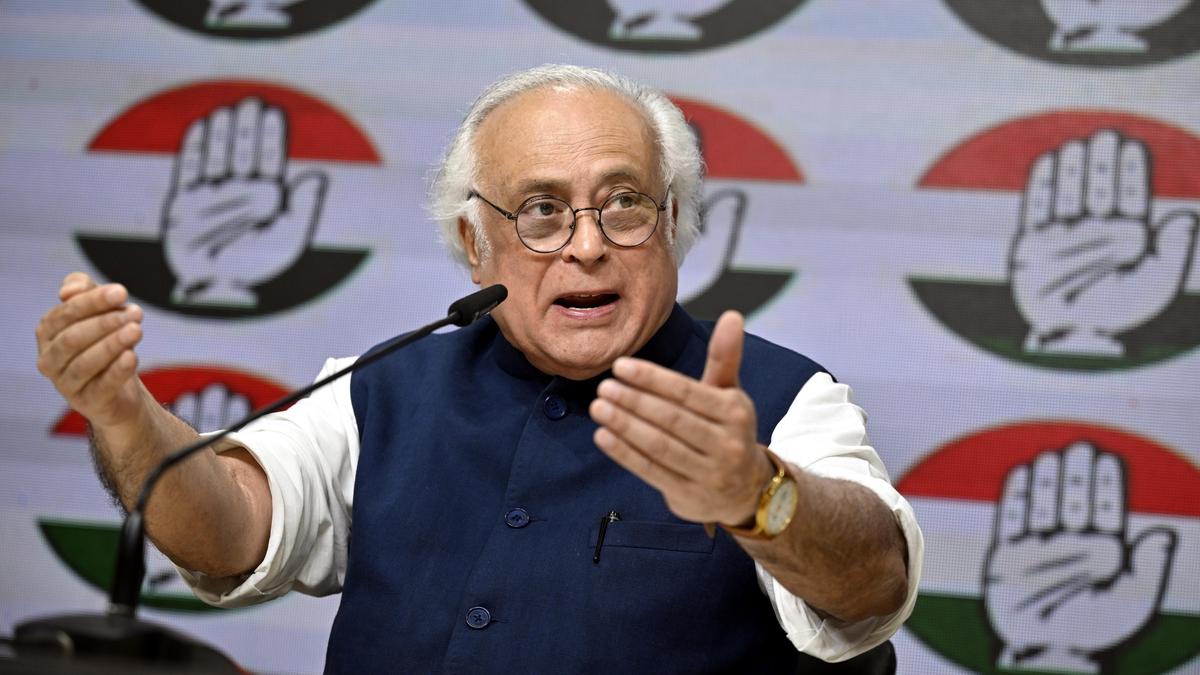
NEW DELHI, May 10: Congress leader Jairam Ramesh wrote to Environment Minister Bhupender Yadav on Sunday, claiming that the Great Nicobar Island development project would “destroy” the unique ecosystem there, and urging him to pause, reflect, and revisit the venture in its present design and detail.
In his letter to Yadav, Ramesh said the studies based on which environmental clearance has been granted to the project are “grossly inadequate” and there has been a “mockery of the Environmental Impact Assessment process”.
Ramesh highlighted that security experts have written that the country’s essential security needs can be met without inflicting such “ecological devastation”.
“I wish to reiterate that the Great Nicobar Island’s biodiversity is globally unique, and new discoveries are being made from time to time. It is this unique ecosystem that will be destroyed by the Great Nicobar Island development project,” the former environment minister said in his letter to Yadav.
Ramesh argued that the compensatory afforestation argument is completely bogus and the minister knows it.
“Security experts have themselves written that the country’s essential security needs can be met without inflicting such ecological devastation. I once again urge you to pause, reflect, and revisit the project in its present design and detail,” the Congress general secretary in-charge communications asserted.
Ramesh said it is evident that the studies based on which environmental clearance has been granted to the project are not even rapid environmental impact assessments (EIA) and are based on baseline data collection over a few days and weeks at best and are grossly inadequate.
“These reports are an insult to science and make a mockery of the EIA process. All my efforts to locate the ‘comprehensive studies, detailed assessments and robust EIA and Environmental Management Plan’ relied on in the FAQs have failed,” he said.
“The ‘Great Nicobar Project: FAQs’ published by the government on May 1, 2026 stated that ‘The potential ecological impacts of the project have been comprehensively identified, assessed, and are being effectively managed through a robust Environmental Impact Assessment (EIA) process and a detailed Environmental Management Plan (EMP).’ “I have already responded to these FAQs in considerable detail on May 3, 2026. I now wish to make a few additional points following the exchanges we ourselves had in writing in September 2024 on this matter of great (and grave) public importance,” Ramesh said in his letter.
The law mandates that port projects, especially those in the Andaman and Nicobar Islands are subjected to comprehensive EIA studies, he pointed out. Considering the unique biodiversity and ecology of the Great Nicobar Island, a robust and complete baseline study needs to cover at least three seasons, so that seasonal variations are adequately studied and assessed, he said.
The sector specific EIA Manual for ports and harbours issued by Ministry of Environment, Forest and Climate Change (MoEFCC) also requires the collection of at least two seasons physical, chemical and biological baseline data apart from oceanographic data, Ramesh pointed out.
In addition to the above requirement, clause 8(i) (c) of the ICRZ Notification,2019 also mandates a comprehensive EIA for projects located in low or medium eroding stretches of the coast, Ramesh said.
The importance of a Comprehensive EIA for port projects was reiterated by one of Yadav’s distinguished predecessors, Prakash Javadekar, on May 5, 2015, in the Lok Sabha, while rejecting a request from Gujarat government to consider clearance for ports based on Rapid EIA studies, the Congress leader said.
“I have also read the judgment of the NGT dated April 3, 2023 holding that there are ‘unanswered deficiencies’ in the clearance and directing the constitution of a High-Powered Committee (HPC) to re-visit the environmental clearance.
The MoEF&CC has filed affidavits before the NGT claiming that the deliberations and report of the HPC constituted pursuant to orders of the NGT are confidential,” Ramesh said in his letter. The subsequent judgment dated February 16, 2026, has relied only on the conclusions of the report of the High-Powered Committee, without the Report forming part of the record before the Court, he said.
“I am at a complete loss to understand the logic and legality behind the claim of the MoEF&CC that the HPC’s report is confidential. This goes against all basic principles of transparency and accountability to which you claim commitment,” Ramesh asserted.
When the original environmental clearance appraisal process was in public domain, is it legal to contend that the product of a court mandated reconsideration exercise is confidential, he asked.
“I would be glad to share the full extracts from your own Ministry’s documents from which I have quoted in this letter that clearly contradict the FAQs,” Ramesh said.
Ramesh said the final EIA report submitted in March 2022 clearly states at page C3-1 that “Environmental baseline studies were conducted during winter season (December 1, 2020 to February 28, 2021).
“Thus, the three-month, i.e., one season study is at best a rapid EIA which your predecessor has clearly stated is inadequate to assess the environmental and ecological impacts of a port. But even this claim that it is a rapid EIA is incorrect,” he said.
The Congress last week had flagged in detail concerns related to ecology, tribal rights, transparency and security, over the Great Nicobar project, and asserted that these considerations must be debated in a parliamentary forum.
The opposition party had claimed that the Modi government is “rattled” and in damage control mode after Leader of Opposition in the Lok Sabha Rahul Gandhi’s recent visit to Great Nicobar.
In a statement, Ramesh had said, “The Modi Government, clearly in damage control mode after the hugely impactful visit of the Leader of the Opposition in the Lok Sabha, Rahul Gandhi, to Great Nicobar on April 28 2026, issued a press note on the Great Nicobar Island Development Project three days later.” During his visit to Great Nicobar in the last week of April, Gandhi had alleged that the Great Nicobar project at Campbell Bay in Andaman and Nicobar Islands was “one of the biggest scams and gravest crimes against the natural and tribal heritage of the country”.
The government on May 1 released a detailed statement with answers to FAQs (frequently asked questions).
“The Great Nicobar Project is a strategic initiative to strengthen India’s presence in the Andaman Sea. It seeks to balance port-led growth with calibrated environmental safeguards. Protection of indigenous communities remains central to its planning,” the government statement had said.
“The project combines strategic, economic, and ecological priorities. This ensures that development is sustainable, inclusive, and aligned with national interests,” it had said. (Agencies)
 Follow our WhatsApp channel
