

Mohammad Ayaz Raina
ayazraina@gmail.com
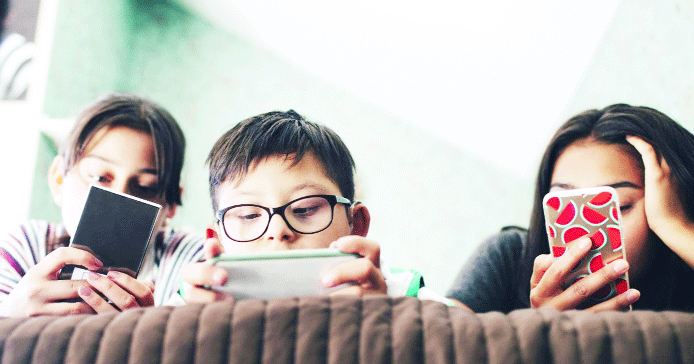
In today’s fast moving digital world, mobile phones have become an important part of our daily lives. They help us communicate, learn, and stay entertained. However, when their use crosses healthy limits, especially among children, they begin to harm more than they help. What starts as a convenience can slowly turn into dependency, affecting a child’s mind, behaviour, and overall development.
One important point every parent must remember is this, if a child spends four hours or more daily on a mobile phone, it is a clear warning sign of addiction. Parents should consciously observe and calculate their child’s daily screen time. When usage crosses this threshold, it is no longer just casual use, it is a growing concern that requires timely intervention.
One of the most worrying changes in recent years is the decline in reading habits among children. Books are slowly being replaced by screens, reducing children’s ability to think deeply and imagine creatively.
“The generation that distances itself from books will never be able to achieve its destination.”
This reminds us that reading is not just a habit, it is the foundation of learning and success.
In most households, children use mobile phones late into the night. They stay awake watching videos, playing games, or scrolling endlessly, and then wake up late in the morning. This unhealthy routine disturbs their sleep, reduces energy, and affects their concentration in school.
Many children now prefer to stay alone in their rooms. They spend hours glued to their screens, often with lights off and earphones or headphones in their ears, completely cut off from family interaction. This habit of isolation gradually affects their emotional and social development.
When parents try to take away the phone, some children become irritated, restless, or even aggressive. They may argue, speak harshly, or show disrespect. These are not just behavioural issues, they are warning signs of growing dependency.
The impact on physical health is also serious. Lack of physical activity can lead to weight gain, weak eyesight, poor posture, and constant tiredness. Eating habits become irregular, and sleep patterns are disturbed. All of this directly affects a child’s academic performance and overall well being.
A disciplined routine plays a key role in a child’s growth. When this routine is disturbed, children begin to lose valuable time and opportunities.
“Nations that sleep do not get a chance to move ahead.”
This highlights the importance of discipline and proper daily habits.
Excessive mobile use also affects the mind. It reduces attention span, weakens memory, and limits creativity. Children become used to instant entertainment and find it difficult to focus on studies or think deeply.
Another serious concern is exposure to inappropriate content and online risks. Without proper supervision, children may come across harmful material or unsafe interactions.
Recent expert opinions from Jammu and Kashmir also highlight the seriousness of this issue. Renowned neurologist Dr. Sushil Razdan has cautioned that excessive use of mobile phones at an early age can negatively affect brain development and may even lead to addictive patterns. He has emphasized that prolonged screen exposure can impact memory, concentration, and overall mental growth in children.
Similarly, child specialist Dr. Kaiser has pointed out that uncontrolled mobile use disturbs children’s sleep patterns, behavior, and emotional balance. According to experts, early and excessive exposure to screens can lead to irritability, poor academic performance, and reduced social interaction among children.
There have also been worrying reports where excessive mobile use, combined with emotional stress, has led some children to take extreme steps. Though such cases are not common, they are serious warning signs that must not be ignored.
This is the right time for parents to become aware and take action for their children’s better future.
“The nation that awakens today
will create history tomorrow…”
Timely action today can shape a healthier and brighter tomorrow for our children.
At this stage, the role of parents becomes crucial. Just as rules are necessary in society, clear rules are needed at home. Parents should set fixed time limits for mobile use and ensure consistency. At the same time, they must lead by example, as children learn more from actions than words.
Monitoring is not control, it is care. Parents should stay involved, especially when children use phones for studies. Open communication is very important. Instead of strict restrictions, parents should explain the reasons behind these rules and help children understand the importance of balance.
According to research, children under the age of 12 should ideally limit mobile usage to 1.5 to 2 hours per day, while those above 12 years should not exceed 2 to 3 hours. These limits are essential for maintaining a healthy balance between digital and real-life experiences.
Equally important is providing better alternatives. Encourage children to play outdoor games, read books, draw, or take part in creative activities. Family time, like going for walks, visiting parks, or eating together, helps reduce screen dependence and strengthens emotional bonds.
Keeping children engaged in meaningful activities prevents them from falling into idle habits.
“And the nation that gets trapped in idleness keeps creating excuses…”
This reminds us that without discipline and active engagement, children may develop unhealthy lifestyles.
Instead of harsh punishment, parents should guide children with constructive steps such as reducing screen time, assigning responsibilities, and encouraging positive habits. The goal is not punishment, but self discipline.
Schools and teachers also play an important role. Awareness programs, discussions on digital well being, and encouraging co-curricular activities can help children develop balanced lifestyles. A joint effort by parents and teachers can create a strong support system.
Childhood is a precious phase of life, meant for learning, play, laughter, and strong family bonds, not silent screens and isolation. As parents and teachers, it is our responsibility to protect this time and guide children in the right direction. A little care today can prevent bigger problems tomorrow.
Let us guide our children to use technology as a tool, not to become tools of technology.
(The author is Lecturer, National & State Awardee)
 Follow our WhatsApp channel
