

Prof. D. Mukherjee
mukhopadhyay.dinabandhu@gmail.com
The Middle East has long been a geopolitical crossroads where energy resources, global trade routes, and strategic rivalries intersect. When conflict erupts in this region, its consequences rarely remain local. The ongoing war has once again demonstrated how rapidly geopolitical instability can spread through the arteries of the global economy. Energy markets are particularly vulnerable. The Middle East accounts for roughly one-third of global crude oil production and remains the primary supplier for many energy-importing economies. Critical maritime routes-including the Strait of Hormuz and the Red Sea shipping corridor-serve as lifelines for international commerce. Any disruption to these passages can produce immediate price volatility and threaten the stability of supply chains across continents. Even limited military escalation can trigger global economic reactions. Oil markets tend to respond instantly to geopolitical risk, and investors often react by moving capital toward safer assets. Such shifts can raise borrowing costs for emerging economies while increasing inflationary pressure worldwide. But the economic consequences of the current war extend far beyond energy prices. The conflict has already disrupted transportation routes, damaged infrastructure, and forced businesses across the region to suspend operations. Tourism-an important sector for several Middle Eastern economies-has declined sharply due to security concerns. In an era defined by economic interdependence, war in one region reverberates globally. Supply chains stretch across continents, financial markets operate continuously, and investment flows react instantly to geopolitical developments. As a result, even distant economies are feeling the impact of instability in the Middle East. This reality underscores a fundamental truth of the twenty-first century: geopolitical stability is no longer merely a regional concern. It is a prerequisite for global economic sustainability.
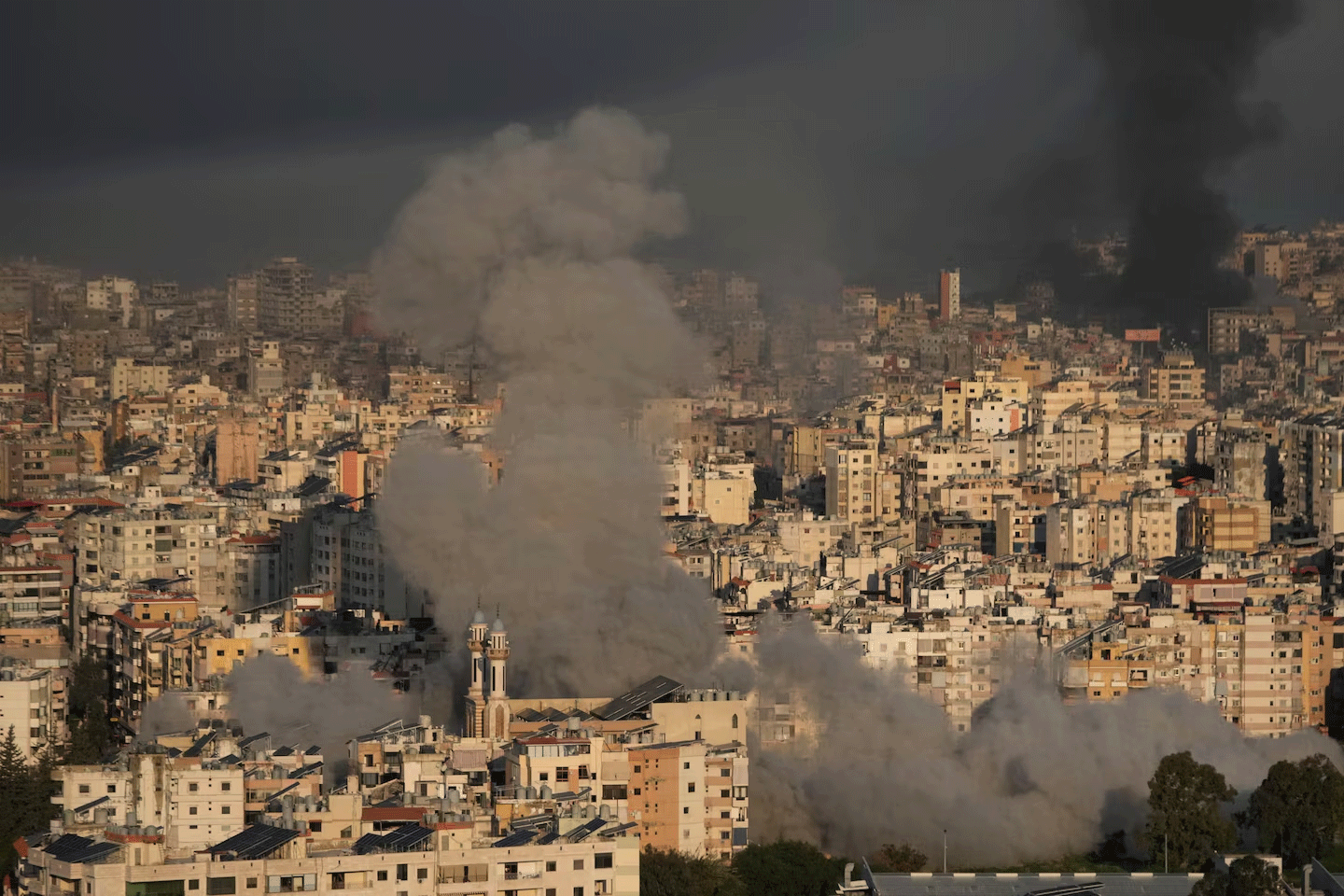
At the centre of the war lies a profound humanitarian and economic crisis. Entire communities have been uprooted, and vast portions of urban infrastructure have been reduced to rubble. The destruction of housing, hospitals, schools, and industrial facilities has crippled local economies and left millions struggling to survive. Economic activity in war-affected territories has nearly collapsed. Factories have stopped production, small businesses have been destroyed, and agricultural supply systems have been disrupted. With infrastructure damaged and transportation networks compromised, even basic commerce has become extremely difficult. The labour market has been particularly devastated. Large numbers of workers have lost employment due to the destruction of workplaces and the breakdown of economic institutions. Unemployment levels have surged dramatically, leaving many households dependent on international humanitarian assistance. Israel’s economy, though resilient and technologically advanced, has also experienced strain. Military mobilization, emergency spending, and security measures have imposed heavy fiscal costs. Wartime spending has required reallocating resources from development programs toward defence and security operations. Meanwhile, neighbouring countries have been drawn into the economic fallout. Tourism revenues in countries such as Jordan and Egypt have declined as travellers avoid the region. Refugee movements have placed additional pressure on public services and government budgets. Thus, the economic devastation of war is multidimensional. It encompasses not only the destruction of infrastructure but also the erosion of institutions, markets, and livelihoods.
The global economy has become increasingly reliant on complex supply chains that connect producers, manufacturers, and consumers across continents. When conflict disrupts key transport routes or production centres, the ripple effects can reach far beyond the region where the war occurs. Shipping disruptions in the Red Sea region have already forced several companies to reroute vessels around the Cape of Good Hope, significantly increasing transit times and transportation costs. Insurance premiums for ships operating near conflict zones have also risen sharply. These disruptions have serious implications for global commerce. Higher transportation costs eventually translate into higher prices for goods ranging from electronics to agricultural commodities. For developing economies already facing inflationary pressure, such increases can strain household budgets and slow economic growth. Manufacturing sectors that rely on imported intermediate goods are particularly vulnerable. Delays in components can halt production lines thousands of kilometres away from the conflict zone. This interconnectedness means that war-induced disruptions can affect industries in Asia, Europe, and the Americas. Financial markets respond to such uncertainty as well. Geopolitical tensions often cause fluctuations in stock markets and currency exchange rates. Investors typically seek stability during periods of conflict, which can reduce capital flows to emerging markets. In short, modern warfare does not only destroy cities-it destabilizes economic networks that span the entire globe.
The global diplomacy faces challenge in ending the ongoing middle east conflict. Ending the ongoing war needs extraordinary diplomatic channels and ceaseless efforts. History shows that prolonged conflicts rarely end through military victory alone. Sustainable peace typically emerges from negotiations supported by international mediation and political compromise. An immediate ceasefire would represent the first and most critical step. Such an agreement must be accompanied by credible monitoring mechanisms to ensure compliance and prevent renewed escalation. International organizations could play an important role in supervising these arrangements. Diplomatic engagement among major global powers is also essential. Countries with strategic interests in the region-including the United States, European nations, Russia, and China-must coordinate their efforts rather than pursue competing diplomatic initiatives. Confidence-building measures could further reduce tensions. These might include humanitarian corridors, prisoner exchanges, and agreements to restore essential services such as electricity and water supply. Ultimately, however, long-term peace will depend on addressing the underlying political disputes that have fuelled decades of conflict. Without confronting these fundamental issues, ceasefire agreements may only offer temporary relief.
Further, postwar economic recovery and the path to reconstruction and rehabilitation is a herculean if not a utopian task before the global leaders. When the war eventually ends, the scale of reconstruction required will be immense. Rebuilding destroyed infrastructure, restoring public services, and reviving economic activity will demand sustained international support. Reconstruction efforts must begin with housing and essential infrastructure. Millions of people have lost homes, and rebuilding residential areas will be crucial for enabling displaced populations to return and rebuild their lives. Healthcare systems and educational institutions must also be restored. War damages not only physical infrastructure but also human capital. Without functioning schools and hospitals, long-term economic recovery becomes extremely difficult. Investment in economic revitalization will be equally important. Programs designed to support small businesses, revive agricultural production, and rebuild manufacturing capacity can stimulate employment and restore livelihoods. Transparent governance and international oversight will be critical in managing reconstruction funds. Large financial commitments from international donors will require effective monitoring to ensure that resources reach affected communities. Reconstruction is not merely about rebuilding structures. It is about rebuilding societies, institutions, and economic systems.
India’s emerging role in global diplomacy is of significant visibility and its growing geopolitical influence gives it a potentially constructive position in promoting peace, harmony and economic stability. Maintaining diplomatic relations with both Israel and the Arab world allows India to engage with multiple stakeholders in the conflict. As a major emerging economy and a prominent voice of the Global South, India has increasingly participated in global discussions on conflict resolution and development. Its diplomatic approach-often emphasizing dialogue and strategic autonomy-could contribute to broader international mediation efforts. India’s role may not necessarily be that of a primary negotiator. However, it can facilitate dialogue, support humanitarian initiatives, and advocate peaceful solutions through international platforms. Furthermore, India’s historical experience in managing complex social and cultural diversity offers valuable lessons in coexistence and political negotiation.
The ongoing conflict poses particular economic challenges for India and protecting India’s economic interests is the topmost priority of government of India. The country relies heavily on energy imports from the Middle East, making it vulnerable to fluctuations in oil prices caused by geopolitical tensions. Higher energy costs can increase inflation and place pressure on government finances. To mitigate these risks, India has been expanding investments in renewable energy and strengthening strategic petroleum reserves. Trade diversification is another important strategy. By expanding economic partnerships with multiple regions, India can reduce dependence on any single trade route or supplier. Domestic economic resilience-supported by manufacturing growth, technological innovation, and infrastructure development-will also play a key role in protecting India’s economy from global shocks.
The responsibility for ending the conflict ultimately lies not only with the parties directly involved but also with the broader international community, the responsibility to resolve the military conflict lies with the global leaders who must recognize that prolonged conflict threatens economic stability far beyond regional borders. Diplomatic initiatives must therefore be sustained and coordinated. Humanitarian assistance should be expanded to alleviate suffering among civilians. Reconstruction plans should be prepared in advance to enable rapid economic recovery once hostilities cease. Perhaps most importantly, the international community must reaffirm its commitment to dialogue, international law, and peaceful conflict resolution. There is hardly any scope to deny that global peace is the foundation of economic stability of every country in the world. The lessons of the ongoing war are clear. In an interconnected global economy, conflict anywhere can have consequences everywhere. Economic sustainability depends not only on sound fiscal policies and technological innovation but also on geopolitical stability. Peace is therefore more than a moral aspiration-it is an economic necessity. The path toward stability will require patience, diplomacy, and cooperation among nations. But the alternative-prolonged conflict and economic disruption-is far more costly. For the world economy to thrive, the guns must eventually fall silent, and the work of rebuilding must begin.
(The author is a Bangalore based educationist, a management scientist and an independent researcher.)
 Follow our WhatsApp channel
