

Excelsior Correspondent
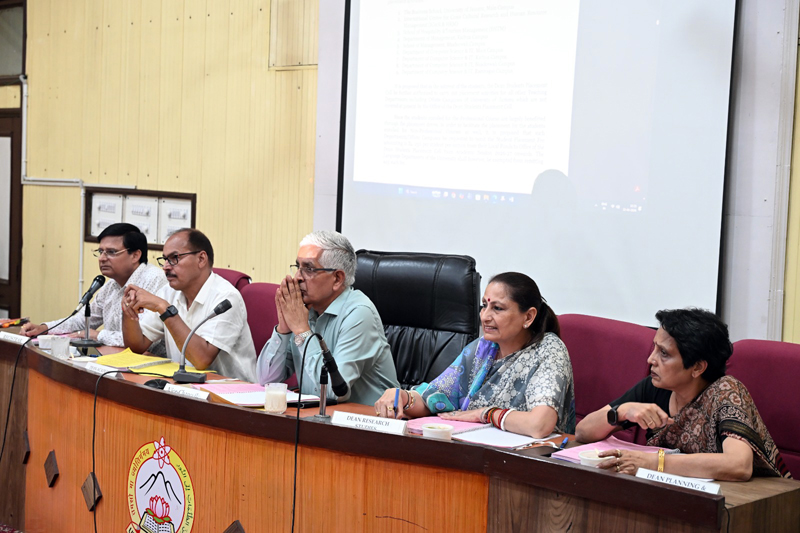
JAMMU, May 22: Jammu University Academic Council met today under the chairmanship of Vice Chancellor Prof Umesh Rai and endorsed several agenda items.
Among the major decision, the Council approved the creation of a Faculty of Trans-disciplinary Studies (FTS) in the University. Initially, the Faculty will comprise two units namely the School of Trans-disciplinary Studies (STS) and the Skill Incubation Innovation Entrepreneurship Development Centre (SIIEDC) with an objective to promote interdisciplinary learning, innovation and entrepreneurship.
The Council also endorsed the adoption of the Statutes and Scheme of the Integrated Teacher Education Programme (ITEP) in the Department of Education from the Academic Session 2026-27 as per the norms and framework prescribed by the National Council for Teacher Education (NCTE).
Further, the Council approved revised statutes for the two-year B.Ed. Programme from the academic session 2026-27 in accordance with NCTE guidelines and recommendations of the Board of Studies in Teacher Education.
Even as the Academic Council members also endorsed the matter regarding the introduction of Four-Year Undergraduate Programmes in Political Science and Sociology, along with One/Two-Year Postgraduate Programmes in Political Science and Sociology for Poonch Campus of the University, Dean Sciences, Prof Meena Sharma, who was also present in the meeting, is learnt to have raised her objection over the item. According to the sources, Prof Meena Sharma pointed out that the Poonch Campus block, in which the Social Sciences subjects are being introduced, was funded by the Science and Technology Department for Science subjects only.
Sources said that Prof Meena Sharma also registered her dissent over another agenda item, which proposed replacing the Mechanical Engineering course with Robotics and Automation in the University Institute of Engineering & Technology (UIET) at Kathua. She claimed that no such item was ever recommended by the Board of Studies, which was mandatory for the same, sources added.
The Council observed that possibilities should be explored for creating the required infrastructure and resources to introduce more self supporting courses in Science and Technology in Poonch Campus.
The Council also approved adoption of UGC Guidelines, 2023 relating to Internship and Research Internship for undergraduate students in the University. The meeting further endorsed revised Statutes governing the Four-Year Undergraduate Programme under “Design Your Degree” from the Academic Session 2026-27 onwards on the recommendations of the concerned Board of Studies.
The Academic Council also deliberated upon strengthening the Placement Cell of the University and stressed the need for creation of a dedicated Corpus Fund for long-term sustainability of the placement-related initiatives by the University.
Earlier, Registrar, Dr Neeraj Sharma presented various agenda items before the Academic Council which were deliberated upon in detail by the members.
At the outset, the Vice Chancellor Prof Umesh Rai shared details regarding several new academic initiatives proposed from the academic session 2026, including integrated programmes, Integrated Teacher Education Programme (ITEP), Integrated Master of Library and Information Science Programme and Ph D programmes in Journalism and Media Studies, Philosophy and Engineering and Technology. He called upon all stakeholders of the University to collectively work towards strengthening academic excellence, innovation, research and student development while preparing the University for future opportunities and challenges.
Prof J P Singh Joorel, Dean Academic Affairs; Prof Neelu Rohmetra, Dean Research Studies and Prof Sangita Gupta, Dean Planning and Development also shared their significant inputs. The meeting was attended by all the Academic Council members, Deans of various Faculties, Rectors, Directors, Heads of various Departments and other senior officers from the University.
 Follow our WhatsApp channel
