

Anoop Khajuria
anoopkhajuria@gmail.com
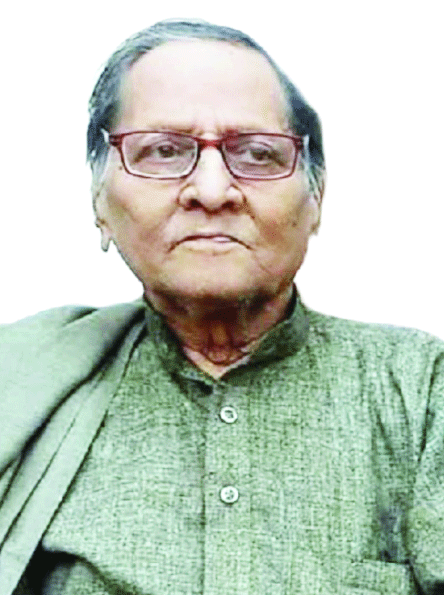
The reverberating voice of the beloved “Lambardar” from Des Suama-a farm radio programme broadcast on erstwhile Radio Kashmir Jammu-has fallen silent. With the passing of the legendary Shri J.S. Pardesi at the age of 85, we have lost not just a profound radio personality, but also an exceptional writer, lyricist, and poet.
I still remember watching him perform before the omnipresent microphones during my childhood, when I would visit the station to participate in children’s programmes. Though I hadn’t met him in person for many years, I was fortunate to speak with him over the phone a few times-each conversation reflecting his warmth and unmistakable charm. Pardesi Ji was simple, humble, low-profile, and an ardent, dependable support to younger colleagues and all who knew him.
His extraordinary ability to connect deeply with listeners made him more than just a broadcaster-he was a comforting presence, a trusted voice, and a communicator par excellence. He stood tall among the stalwarts of voice mimicry, alongside C. Parvana, Mehmood Ahmed, Baldev Ji, Kishan Ji, Pradhuman Singh, Bodh Raj Sharma, Vishnu Bhardwaj, and Yash Sharma-the pillars who defined the golden era of Radio Kashmir Jammu.
A unique facet of J.S. Pardesi was his unwavering commitment to bringing Bhakh folk singers from the remote valleys of the Shivalik ranges onto the airwaves of Radio Kashmir Jammu, introducing their talent to the wider world. Many groups who are now graded artists owe their first exposure to him. These artists-often construction or road workers from the upper Shivaliks-became known and celebrated largely because of Pardesi Ji’s efforts. He was deeply committed to preserving and promoting Dogra culture and traditions through radio, which was once the cultural heart of Jammu.
His recent collection of Dogri Geet and Geetru, “Gaanda Ja Banjara,” unveiled last year, beautifully reflects his personality. A master of the spoken word and an eminent character artist, this “Lambardar” of Des Suhama lived like a true Banjara-a cultural wanderer connecting with the remotest Duggar regions, reaching Gaddis, Gujjars, and Pahari Dogra families through the power of radio.
I fondly recall the recordings of “Dareeche”-a satirical short radio skit featuring artists like J.S. Pardesi, Mehmood Ahmed, C. Parvana, and Pradhuman Singh-which was immensely popular among Jammu’s radio listeners. Though they often held just a single page of script, much of the performance was extempore. Whenever the dialogues strayed left or right, Pradhuman Ji, playing the hard-of-hearing elder, would interject, “Kish migi aakhiya je?” (“Are you saying something to me?”), bringing the flow back on track. Such was their presence of mind and command over spontaneous humour. Pardesi Ji not only elevated this beloved segment but also contributed as a scriptwriter.
Another feather in his cap was his contribution to Dogri radio songs, especially those aired in the cherished 7:40 AM Dogri Sangeet slot. His meticulous memory-recalling which song had been played the previous month to avoid repetition-spoke volumes about his dedication. Ask him about a particular tape on any subject, and it would be in your hands the very next moment.
It is particularly poignant that Pardesi Ji passed away just a day before Baisakhi-his favourite festival. He would celebrate Basoa with great enthusiasm, inviting a dhol wala and performing spirited Dogri bhangra alongside colleagues near the library and newsroom. Though those heritage buildings are now gone, what remain are fond memories-and a lone tree with a chabutra that once served as a vibrant stage for cultural gatherings.
There was a time when radio defined the literary and cultural life of the city. It built subtle yet powerful bonds between unknown faces and familiar voices. The magic of tone, pitch, and inflection created vivid worlds in the listener’s imagination-seen through the mind’s eye. With the passing of J.S. Pardesi, one of the last bearers of that golden soundscape is gone.
His voice may now be silent, but his legacy will continue to echo in the hearts of listeners for generations to come.
(The author is a senior consultant with DD KISAN)
 Follow our WhatsApp channel
