

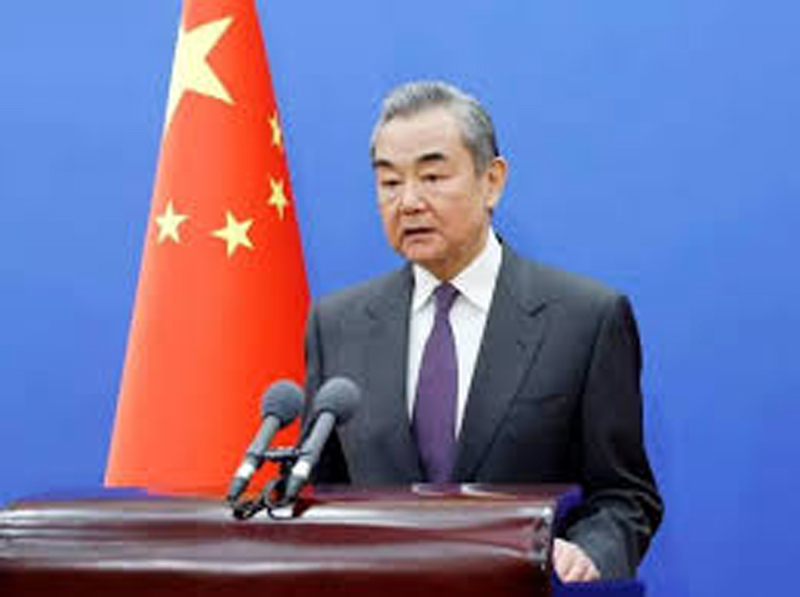
BEIJING, Apr 16: Chinese Foreign Minister Wang Yi on Thursday told his Iranian counterpart that reopening the Strait of Hormuz is a unanimous demand from the international community.
In a phone call with Iran’s Foreign Minister Abbas Araghchi, Wang emphasised that while Iran’s sovereignty, security, and legitimate rights as a littoral state must be respected, freedom of navigation and maritime safety through the strait should be guaranteed.
“Efforts to resume normal passage through the strait represent a unanimous call from the international community,” Wang said, according to a government statement released Wednesday.
Wang also highlighted that the current situation is at a critical point between war and peace, noting that a window for diplomatic resolution is opening.
The Iranian government has called for defining a “special regime” for the Strait of Hormuz, arguing that the waterway is a “special asset” for Tehran, the state news agency IRNA reported.
“Like all assets that serve as tools for the type of interaction and regulation of interactions with other countries, a special regime must be defined for this passage,” government spokeswoman Fatemeh Mohajerani told Russia’s RIA Novosti.
Shipping through Hormuz remains highly disrupted after Washington imposed a blockade on Iranian ports following failed US-Iran talks in Pakistan this weekend.
The Strait of Hormuz, which normally handles a major share of global seaborne oil flows, has remained at the centre of the latest energy shock triggered by the US-Israeli war against Iran that began on February 28.
In retaliation, Tehran launched missile and drone strikes targeting Israel and other regional countries hosting US assets.
As the US Central Command head Adm. Brad Cooper, stated that American forces have fully halted maritime trade to and from Iran. During the blockade’s first 48 hours, no vessels have passed through the area.
The command reported that 10 ships have complied with orders to turn back toward Iranian ports or coastal waters. The blockade applies equally to vessels of all nations entering or leaving Iran’s coastal areas, while ships avoiding Iranian ports remain unaffected.
The blockade is expected to exert significant pressure on Iran’s economy. Meanwhile, Tehran’s earlier restrictions on the vital waterway have contributed to rising global energy prices.
(UNI )
 Follow our WhatsApp channel
