

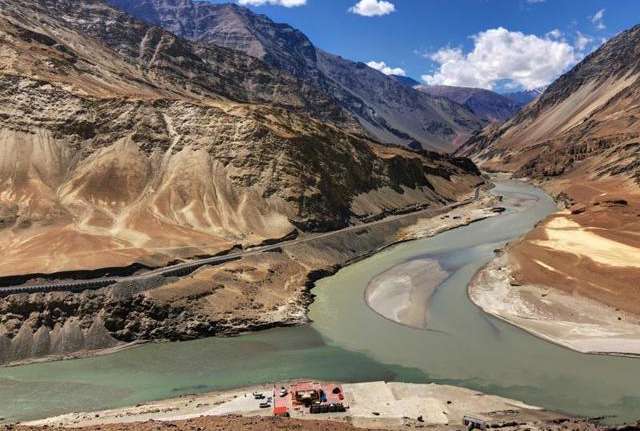
For decades, India’s relationship with the Indus Waters Treaty resembled that of a generous host who continues to lay out a feast even as the guest overturns the table. That era is decisively over. Since placing the Indus Waters Treaty in abeyance following the unconscionable Pahalgam terror attack, India has embarked upon one of the most consequential infrastructure campaigns in its post-independence history. The message is unambiguous: not a single drop of water to which India is entitled shall henceforth flow unused across its borders.
The abeyance of the IWT, far from merely a diplomatic signal, has become an extraordinary blessing for millions of Indians across Punjab, Haryana, Rajasthan, Himachal Pradesh, and Jammu & Kashmir. Where treaty constraints once shackled India to chronic under-utilisation of its own river waters, political will has now unlocked the gates – quite literally. The unprecedented temporary stoppage of the Chenab’s flow to Pakistan last year was not a theatrical gesture; it was a sovereign demonstration of capability, a moment that announced India’s arrival as a state that regards water as a strategic national asset.
The Chenab basin has emerged as the centrepiece of this ambitious national agenda. Two freshly approved infrastructure projects – the Rs 2,352 crore Chenab-Beas Link Tunnel in Himachal Pradesh and the Rs 268 crore sediment-bypass tunnel at the Salal Dam in Reasi – together represent an investment not merely in bricks and concrete but in India’s long-term water and energy security. The Chenab-Beas Link Tunnel, an 8.7-kilometre engineering marvel, will carry surplus water from the Chandra river – a tributary of the Chenab, historically known as the Chandrabhaga – into the Beas basin, directly irrigating fields in states that have long thirsted for this bounty. The Salal silt-bypass tunnel addresses a longstanding operational inefficiency: by automatically diverting silt-laden water away from the reservoir, it will sharply enhance power generation at one of India’s oldest hydroelectric stations. These are not routine projects; every rupee invested here will yield returns measured in irrigated fields, lit households, and thriving livelihoods.
The hydroelectric ambition on the Chenab runs deeper still. Mega projects, including Pakal Dul (1,000 MW), Kiru (624 MW), Kwar (540 MW), Ratle (850 MW), and Sawalkote (1,856 MW), are advancing with a velocity that would have seemed unimaginable under the shadow of the old treaty constraints. Together, these ventures will make Jammu & Kashmir a powerhouse of clean, renewable energy – transforming a region long defined by its challenges into an engine of India’s net-zero ambitions. The fast-tracking of these projects signals that delays, whether from bureaucratic inertia or external pressure, will no longer be tolerated.
The Jhelum River, too, is receiving its due attention. The revival of the Tulbul Navigation Project – the long-shelved Wular Barrage – is a milestone of immense significance. Pakistan stalled this project for four decades through specious claims of treaty violation, depriving Kashmir of a historic trade waterway that once carried 70 per cent of the Valley’s cargo. Reviving it will restore year-round navigability between Wular Lake and Baramulla, opening new arteries for Kashmir’s booming horticulture sector and providing essential flood-regulation benefits. Water storage on the Jhelum is no longer a pipedream; it is a scheduled reality.
On the Ravi, the Shahpur Kandi dam project is another pillar of this national water renaissance. Long delayed, it will now ensure that Ravi waters – India’s exclusive entitlement under the original treaty – are fully harnessed for irrigation and power in Punjab and J&K rather than draining unused into Pakistan as they have for years.
What binds all these endeavours together is a quality that India’s water policy has historically lacked: political will. Engineers have responded with ingenuity and speed. Project timelines are being compressed. Aerial inspections and ministerial oversight signal accountability at the highest level. The transformation will not happen overnight, but it is happening – and it is irreversible. India is writing a new chapter, one measured not in diplomatic courtesies extended to a hostile neighbour but in megawatts generated, hectares irrigated, and citizens whose lives are transformed by the waters that were always rightfully theirs.
 Follow our WhatsApp channel
