

Vijay Hashia
iamvhashia@gmail.com
The ramifications of West Asia war are manifold, impacting Indian households, industries, transport networks, and agricultural supply chains.
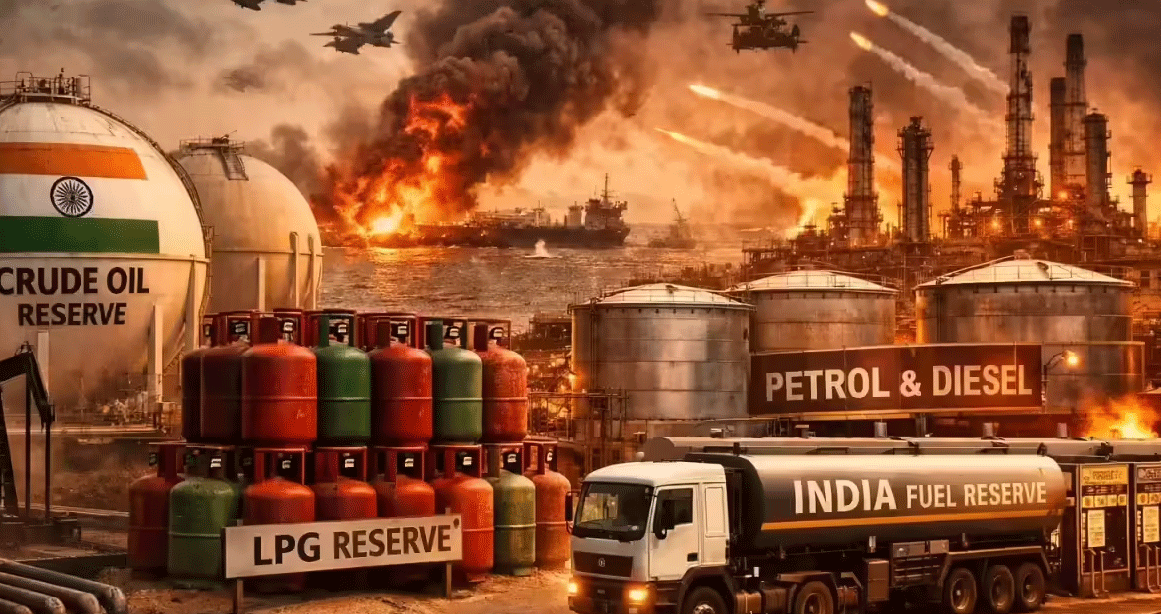
Much of India’s imported energy passes through the Strait of Hormuz, one of the world’s most vital maritime chokepoints. Around 40-45% of India’s crude oil, 80-85% of LPG and 50% LNG imports normally pass through the Strait of Hormuz. The war has disrupted the route and as such India’s economy feels the pressure. This has created a serious supply squeeze, especially for domestic cooking gas, petrol and diesel. Though the Indian government has increased domestic refinery output, diverted more hydrocarbon streams into LPG production, and prioritized household consumers over commercial users such as hotels and restaurants, the crisis has exposed how dependent India remains on imported crude oil and fuel supplies, LPG, petrol and diesel.
The second major impact has been the rise in crude oil prices. Even when physical supplies continue, war in West Asia has created uncertainty, insurance costs have risen, freight has become expensive, and global oil prices have soared up. For India, which is one of the world’s largest oil importers, this is a serious macroeconomic threat.
Higher crude prices increase the cost of petrol, diesel, aviation fuel, and transport, which in turn raise the prices of food, manufactured goods, and public services. Inflationary pressure then spreads across the economy. In a country where millions are already sensitive to fuel and food prices, such increases are not merely economic, they are social and political.
The impact on crude oil is serious. India has diversified crude sourcing and buys oil from a wider range of suppliers, including Russia, Venezuela and other non-Gulf exporters. Some estimates suggest that a significant portion of India’s crude imports can still be routed through alternative channels, which gives the country a partial buffer. That means the Iran conflict has not produced a total oil collapse in India, but it has certainly made energy procurement costlier, riskier, and more diplomatically complex.
The third major impact has been on Indian industry. Energy is not consumed only in homes; it is also a critical input for manufacturing, logistics, metals, chemicals, automobiles, and small-scale production units. As fuel and gas costs rise, production becomes more expensive. Reports already show supply delays in India’s automobile retail and manufacturing ecosystem have been alarming. While industrial belts in Maharashtra have reported significant losses due to shortages of gas and raw materials, Haryana and Telangana reported severe industrial and commercial losses due to LPG shortages and Kerala faced retail petrol rationing. When factories slow down, its effect is: output falls, transport costs rise, and employment becomes more vulnerable. Thus, the Iran conflict is not just an “oil issue,” it is a broader industrial disruption.
Agriculture and food security form another area of concern. India’s farming sector depends heavily on fertilizers, many of which are linked to global gas and ammonia supply chains. Since the Gulf region plays a key role in fertilizer and feedstock trade, any prolonged disruption in shipping can tighten supply and raise costs. India has already moved to secure additional urea imports in anticipation of shortages. If fertilizer availability becomes unstable during key agricultural cycles, the result could be lower productivity, higher farm costs, and eventually higher food prices. Therefore, the Iran conflict has moved from an energy crisis into an agricultural and food inflation crisis.
Another important effect is strategic and diplomatic. India has long tried to maintain balanced relations with competing powers in West Asia, including Iran, Israel, the Gulf monarchies, and the United States. The 2026 conflict places India in a delicate position. It must protect its citizens, secure shipping routes, maintain energy imports, and avoid alienating key regional partners. This is especially difficult because India’s interests in the region are not ideological; they are deeply practical, involving trade, remittances, energy, and diaspora security. The war therefore, increases the burden on Indian diplomacy and exposes how external conflicts can constrain India’s strategic autonomy.
At the same time, the crisis also offers India an important lesson. It reveals that national security today is not limited to borders and armies; it also includes supply chains, shipping lanes, fertilizer stocks, and household energy resilience. India is compelled to accelerate long-term reforms and austerity measures as appealed by the Prime Minister Narender Modi- reducing fuel consumption, carpooling, use of public transport and adopting to electric vehicles; cutting on non – essential foreign travels and destination weddings in abroad; austerity of consumer behaviour – ( gold purchases), adoption to swadeshi products, reducing chemical fertilizers, austerity in working methods similar to pandemic era ( WFH ) to save energy and travel costs.
That will not be enough if the war continues and the Strait of Hormuz remains disrupted. In such a situation, there would be further price hikes and greater hardship for consumers and that would be both a danger and a warning.
 Follow our WhatsApp channel
