

Jammu & Kashmir’s Urban Transformation Story
Ashish Anand
The urban transformation currently unfolding across Jammu & Kashmir is no longer limited to isolated infrastructure upgrades or cosmetic beautification exercises. What is emerging instead is a strategic, integrated, and future-oriented model of city development driven by strong institutional leadership, aggressive execution, and a long-term vision for sustainable urban growth. At the center of this transformation stand Jammu Smart City Limited (JSCL) and Srinagar Smart City Limited (SSCL); two agencies that are rapidly positioning themselves as among the most progressive urban development institutions in the region.
In recent years, Jammu & Kashmir has witnessed a visible shift in governance philosophy. Urban development is no longer being approached merely as a municipal responsibility; it is increasingly being treated as a strategic economic and social growth engine. The Union Territory administration has adopted a development-led governance model focused on mobility, public spaces, climate resilience, digital governance, tourism infrastructure, and citizen-centric urban services. This transition reflects a more assertive and progressive administrative mindset; one that seeks to build cities capable of supporting investment, tourism, employment, and improved quality of life simultaneously.
Beyond Conventional Smart Cities
Across India, many smart city initiatives have struggled with fragmented implementation, disconnected projects, or overemphasis on technology without corresponding improvements in urban livability. Jammu and Srinagar, however, are increasingly demonstrating a more grounded and integrated approach.
Rather than limiting themselves to standalone beautification works, JSCL and SSCL are focusing on large-scale urban regeneration, mobility transformation, ecological restoration, public realm improvement, and modern civic infrastructure.
This is particularly visible in the development of riverfront infrastructure, pedestrian-oriented urban spaces, electric mobility systems, smart governance initiatives, and modern public utility networks.
The approach being adopted reflects a mature understanding of urban development, that successful cities are not built merely through roads and buildings, but through interconnected systems that improve accessibility, sustainability, economic activity, and citizen experience.
Riverfront Development: Reclaiming Urban Identity
One of the most impactful dimensions of the ongoing urban transformation is the renewed focus on riverfront development.
For decades, rivers flowing through major urban centers in Jammu & Kashmir remained underutilized from an urban planning perspective despite their ecological, cultural, and tourism significance. The emerging riverfront initiatives now seek to transform these neglected urban edges into vibrant public spaces capable of supporting recreation, tourism, economic activity, and environmental restoration.
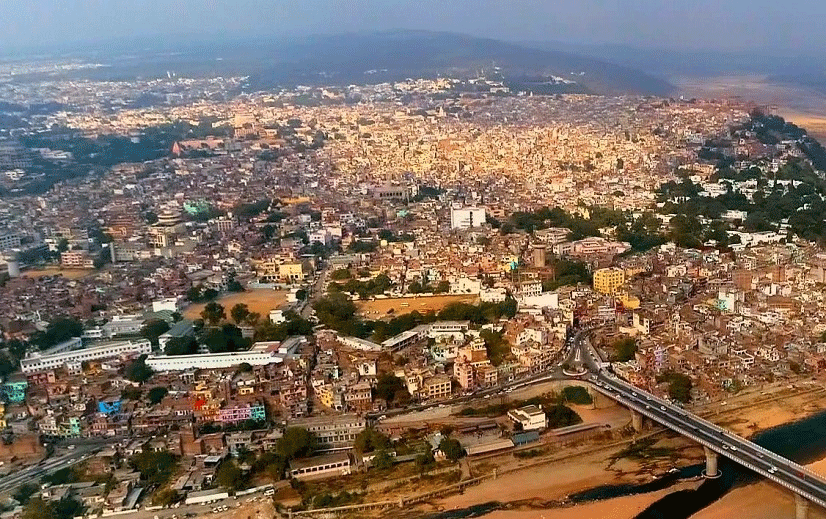
The Tawi Riverfront development in Jammu represents a particularly transformative urban intervention. Rather than being viewed merely as a beautification project, the initiative has the potential to reshape the city’s urban identity itself.
Integrated riverfront planning creates multiple layers of impact:
Such integrated riverfront planning enhances tourism potential, creates vibrant recreational spaces, improves environmental management, increases surrounding land and economic value, strengthens urban aesthetics, improves pedestrian and cycling connectivity, and opens up opportunities for cultural and event-oriented public spaces.
Globally, successful riverfronts have often become economic catalysts for urban renewal. The strategic importance of such initiatives in Jammu lies not only in physical transformation but also in repositioning the city as a modern urban destination.
The larger vision emerging from these projects indicates that the UT administration is increasingly embracing place-making as a core urban strategy rather than limiting development to engineering-focused infrastructure creation.
Electric Bus Projects: Transitioning Towards Sustainable Mobility
Another major indicator of progressive urban planning in Jammu & Kashmir is the accelerated push toward electric public transportation.
The introduction of electric bus systems under smart city initiatives represents far more than a fleet replacement exercise. It signifies a deliberate transition toward cleaner, technology-enabled, and citizen-friendly mobility ecosystems.
Modern electric bus systems contribute simultaneously to reduced urban pollution, lower carbon emissions, improved commuter experience, quieter public transport corridors, more efficient urban mobility, and long-term environmental sustainability.
For rapidly growing urban centers like Jammu and Srinagar, mobility planning has become critical. Rising vehicle density, increasing tourism flows, and expanding urban footprints require smarter transportation systems capable of balancing efficiency with sustainability.
The electric mobility initiatives being implemented by JSCL and SSCL indicate that Jammu & Kashmir is aligning itself with broader national and global transitions toward green urban transport.
Importantly, these projects also signal administrative willingness to invest in future-ready infrastructure rather than relying solely on conventional systems.
Citizen-Centric Urbanism
One of the most notable aspects of the current urban transformation agenda is its increasing focus on citizen experience.
Historically, urban development in many regions often prioritized administrative utility over citizen usability. The emerging model in Jammu & Kashmir appears significantly more people-centric. Urban spaces are increasingly being redesigned around walkability, public accessibility, inclusive infrastructure, smart public services, digital integration, public convenience, and safer streets and mobility corridors.
The development of pedestrian pathways, cycling infrastructure, smart traffic systems, public plazas, modern lighting systems, and improved streetscapes reflects a broader shift toward human-centered urban planning.
This transformation is particularly important because cities are ultimately judged not by the scale of expenditure, but by the quality of daily life they provide to citizens.
Institutional Leadership Emerging from Jammu & Kashmir
What distinguishes JSCL and SSCL today is not merely project execution, but the emergence of institutional capacity.
Urban development agencies across India often face challenges relating to inter-departmental coordination, funding constraints, delayed implementation, and fragmented project management. The recent pace and scale of execution in Jammu & Kashmir indicate growing administrative confidence and stronger institutional mechanisms.
JSCL and SSCL are increasingly functioning not merely as project implementation agencies, but as integrated urban transformation platforms capable of coordinating multi-sector urban projects, managing complex infrastructure ecosystems, integrating sustainability with development, leveraging technology for governance, driving public-space transformation, supporting tourism and economic growth, and building long-term urban resilience.
This institutional maturity is significant because sustainable urban transformation requires continuity, technical capability, and strategic planning far beyond isolated projects.
The broader implication is that Jammu & Kashmir is gradually developing a governance ecosystem capable of executing modern urban infrastructure at national standards.
Economic Development Through Urban Infrastructure
Urban infrastructure investment today is directly linked to economic competitiveness.
Modern cities increasingly compete on the quality of infrastructure, ease of mobility, tourism appeal, public safety, digital readiness, environmental sustainability, and the overall quality of public spaces. The current development trajectory in Jammu & Kashmir reflects recognition of this reality.
Projects relating to riverfront development, mobility systems, smart infrastructure, public space enhancement, and urban beautification are not merely civic works, they are economic enablers.
Improved urban infrastructure creates strong multiplier effects through tourism growth, employment generation, increased commercial activity, higher private investment confidence, improved real estate valuation, expansion of hospitality and service sectors, and enhanced investor perception.
As Jammu & Kashmir continues to position itself as a tourism and investment destination, high-quality urban infrastructure will increasingly become a competitive necessity rather than an optional enhancement.
Sustainability and Climate-Responsive Development
Another important shift visible in current projects is the growing integration of sustainability considerations.
Climate resilience is becoming a central challenge for urban regions globally. Flood management, ecological preservation, green mobility, urban heat mitigation, and sustainable infrastructure planning are now essential components of modern city governance.
The increasing focus on electric mobility, public transport systems, river ecology restoration, pedestrian infrastructure, and smart urban systems reflects movement toward more climate-responsive urban planning.
This is especially relevant for environmentally sensitive regions like Jammu & Kashmir, where urban growth must be carefully balanced with ecological preservation.
A New Urban Narrative for Jammu & Kashmir
The most significant outcome of these initiatives may ultimately be psychological and symbolic.
For decades, conversations around Jammu & Kashmir often remained dominated by security narratives and political discourse. The ongoing urban transformation is gradually creating a parallel narrative centered around infrastructure, modernization, economic development, tourism growth, and quality of life.
Modern public spaces, sustainable transport systems, vibrant riverfronts, digitally enabled services, and upgraded urban infrastructure contribute to a new civic identity, one that reflects aspiration, confidence, and forward-looking governance. The visible pace of development also reinforces public confidence in institutional delivery mechanisms.
The Road Ahead
The transformation journey, however, is only beginning. To sustain this momentum, the next phase of urban development in Jammu & Kashmir must focus on integrated metropolitan planning, transit-oriented development, climate-resilient infrastructure, smart parking and intelligent mobility systems, urban flood management, green and blue infrastructure networks, expansion of digital governance, revenue-generating urban infrastructure models, greater public-private investment participation, and long-term operation and maintenance sustainability.
The success of future urban transformation will depend not only on infrastructure creation, but on governance continuity, financial sustainability, and institutional innovation.
Conclusion
Jammu Smart City Limited and Srinagar Smart City Limited are increasingly emerging as flagship urban transformation agencies that symbolize the Union Territory’s ambitious and progressive development agenda.
Through initiatives such as riverfront regeneration, electric mobility systems, smart urban infrastructure, public-space transformation, and citizen-centric planning, the UT administration is signaling a decisive shift toward future-ready urban governance.
The development visible today is not merely about constructing assets. It is about reshaping urban identity, improving quality of life, strengthening economic potential, and building globally competitive cities for the future. As these projects continue to evolve, Jammu & Kashmir has the opportunity to emerge not only as a tourism destination, but also as a model for integrated, sustainable, and people-focused urban development in India.
The cities of Jammu and Srinagar are no longer simply expanding. They are being strategically reimagined.
 Follow our WhatsApp channel
