

Ashok Ogra
ashokogra@gmail.com
Neuroscience is a broad church and has long-drawn public interest. To treat the human brain requires exceptional patience, precision and judgment.
Most doctors’ memoirs or autobiographies tend to be too technical for the average reader. However, Healer in Exile: The Untold Story of Dr. Sushil Razdan deals with themes of resilience, service, and displacement. Presented as Dr. Razdan’s life story as narrated to his engineer son, Sachin, the book traces his journey through medicine, migration, and his continued association with patients and his homeland. Sachin also brings a personal dimension to the narrative.
In his detailed introduction, the author introduces Dr. Razdan by focusing less on his otherwise notable achievements and more on his interaction with patients. Dr. Razdan’s clinic is presented as a space marked by attentiveness and quiet reassurance.
The award-winning journalist, Rahul Pandita, in his foreword presents Dr. Razdan as a physician who sees illness as an off-shoot of terrorism and trauma that afflicted the valley in the1990s. The reference to Kashmir adds another layer, suggesting that personal histories are often shaped by larger circumstances.
Long-term family friend Sheikh Qayoom offers a deeply personal portrait of Dr. Razdan, tracing his upbringing, character, and lifelong friendships.
Noted physician, Dr. Abdul Wahid, who has enjoyed a close association with Dr. Razdan describes him as a distinguished neurologist known for holistic, compassionate care, humility, intellectual depth, and social engagement, earning widespread respect, leadership recognition, and deep patient trust.
Sachin effectively captures the Doctor’s early days in the valley -studying at Tyndale Biscoe school to watching Hindi films to their home in Jawahar Nagar. He adds that, for Dr.Razdan, Kashmir was identity itself.
The narrative later shifts to marriage, family responsibilities and medical training and aspects of professional life. “The medical school didn’t offer many festivals or grand events, but it gave something better: camaraderie, shared struggle, steady friendship, and the kind of memories that sit quietly in the heart for a lifetime.”
Vivid and absorbing details are provided about how the friendship developed between his parents. “My parents (Sushil and Rajni) were in the same medical college, in the same environment, surrounded by the same rhythms of student life.”
The author also refers to a period when the possibility of going abroad was considered. However, it was not pursued further in view of family commitments, professional responsibilities, and attachment to the Valley.
Meanwhile, the bureaucratic environment in the hospital led Dr. Razdan to leave government service and start private practice. Unfortunately, as his practice began to stabilise, militancy erupted in the Valley, forcing him to leave Kashmir along with his family and professional establishment. Referring to this period, Sachin laments, “History speaks in its own language. And sometimes that language is betrayal.”
The emotional impact becomes more visible in the account of what transpired in December 1989. Soon after the kidnapping of Rubaiya Sayeed, came bloodshed in broad daylight. “Tika Lal Taplu, a respected voice and Vice President of the BJP, was shot in a bustling market. Whatever illusion of normalcy remained shattered…. The news that reached Jammu was sharp enough to cut through the comfort of distance. Judge Neelkanth Ganjoo was assassinated. Soon after, journalist Prem Nath Bhat was murdered outside his home. Killings multiplied like a fever. Even though I wasn’t in Kashmir, I felt the tremors through grandpa’s tightening jaw, through Mummy’s strained silence when papa called, through relatives’ panicked whispers when the phone rang late.”
The narration turns poignant when the author recalls that ugly, unforgettable night of January 1990. The local newspaper Al-Safa carried a news item warning Kashmiri Pandits to leave the valley. The episode is portrayed not merely as a security threat but also as a crisis of identity for the community.
No wonder, the most telling chapter, ‘New Life in Jammu,’ covers the period after the family moved from the Valley to Jammu. It discusses housing, work, education, and everyday life after relocation. “Life in Jammu, especially in those early days, was harsh. The heat rose like a living thing, pressing down on us from the moment the sun came up. The valley’s chill had shaped our bones. Jammu’s summer seared them. The community dies twice. Once in their homeland, and again in the place they fled to.”
The unfamiliar and harsh summer conditions experienced by many migrants were also associated with health difficulties such as anxiety, insomnia, and memory-related problems. “Some forgot dates and some forgot themselves,” the author observes. It is in Jammu that survival took the shape of food and shared silence. Sachin also refers to the challenges his doctor mother faced when working in unfamiliar settings in Jammu.
Yet the biographer takes pains to inform us that Dr. Razdan showed no trace of revenge. His medical ethics defined his approach to life and to the unfolding situation. No bitterness edged his voice. No line divided his heart.
Sachin further adds: “home had changed, the city had changed, but responsibility had not.” Perhaps this is where Dr. Razdan’s tall stature as a physician emerges. In fact, a fellow doctor once referred to Dr. Razdan as the “Amitabh Bachchan of neurology,” reflecting his recognition and standing within the medical community. Given Dr. Razdan’s understated personality, he would perhaps be modest about such comparisons.
On reaching Jammu, Dr. Sushil Razdan gradually re-establishes his medical practice. His Bhagwati Nagar residence becomes a place where many patients come from the entire UT- not only for treatment, but also with hope. He spends as much time talking to caregivers as to patients.
seems the genes of serving society run deep into the family. Dr. Razdan’s daughter-in-law, Sunaina, has set up child development centres in Jammu, Kashmir and Bengaluru, supporting children and families who fail through the gaps of conventional schooling and healthcare. Neurodivergent children are described through experiences, observation, and medical care. Today it works across
The title ‘Healer in Exile’ refers to Dr. Sushil Razdan’s movement away from his original place of residence and subsequent life in a different difficult environment. In this context, the term “exile” is used in relation to displacement from one’s place of origin. Hannah Arendt also wrote about exile beyond territorial movement, observing, “We lost our home, which means the familiarity of daily life.” The title, therefore, relates to both Dr. Razdan’s relocation from the Valley and his continued medical service in the UT.
An interesting inclusion is references to the family patriarch, the late Sat Lal Razdan, father of Dr. Sushil Razdan- who distinguished himself as a headmaster of the reputed Tyndale Biscoe School, Srinagar. This chapter includes memories and incidents related to his long and satisfying innings at the school.
The closing sections include comments from different people who have observed Dr. Razdan from a close up.
Dr. K.K.Pandita pays tribute to his guru, describing as someone with a divine touch, and a holistic physician.
Jeelani Malik portrays him as a compassionate, pioneering neurologist whose humanity, mentorship, and lifelong service transcend medicine. The book is slim in size but not necessarily in insight. The author has resisted the temptation of excess. Photographs used in the book illuminate the subject’s life that words alone may not fully convey.
When the biographer is a son, a degree of emotional closeness to the subject is understandable. As a result, some sections come across more descriptive than analytical.
One aspect that could perhaps have been explored further is the inclusion of additional references to patients’ experiences. This would have added an additional warmth and personal dimension to the narrative.
Overall, the book remains readable, bringing together memory, observation, and lived experience in a balanced narrative style.
Brought out by BlueRose Publishers, the book is also reasonably priced.
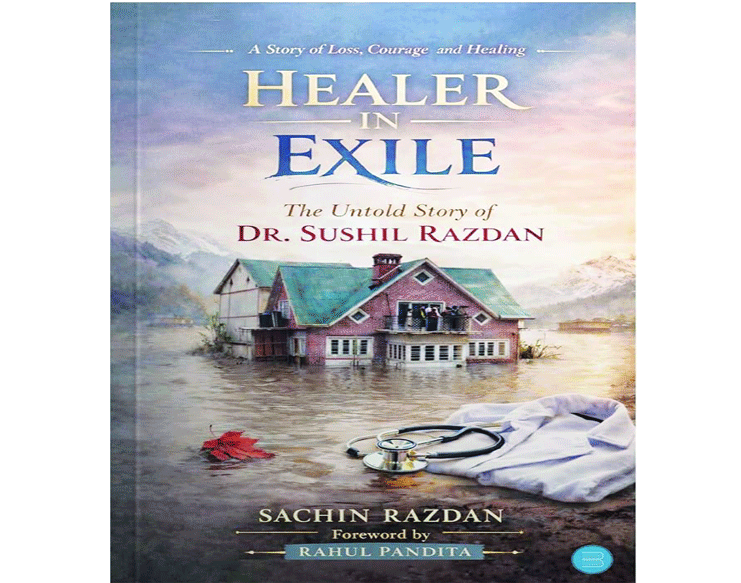
The cover of Healer in Exile reflects the background and themes of the biography. The flooded Srinagar house refers to disruption and displacement, while the Chinar leaf connects the narrative to Kashmir. The stethoscope and doctor’s apron indicate Dr. Razdan’s profession and medical journey.
The book’s central theme is reflected in these lines by Sachin: “And that is what Dr. Sushil Razdan has built- not just a life, but a way of living. One that continues. One that teaches. One that heals.”
(The author currently serves as Advisor at Apeejay Education)
 Follow our WhatsApp channel
