

Shyam Bijyal
A group of people or a community that speaks the same dialect/language, professes the same faith/religion, and demonstrates cultural cohesiveness by following the same traditions, festivals, customs, rituals, and practices constitutes a distinct ethnic group or ethnicity.
Saraz or Siraj, and Siraji or Sarazi, are interchangeable terms. While Siraj/Saraz refers to an area, Siraji/Sarazi represents both the dialect and the people who speak it as their first language.
The vast area of Siraj, marked by steep slopes and criss-cross ridges, lies in the mountainous erstwhile District Doda of Jammu & Kashmir. Its uniqueness also lies in the fact that the whole area is located exclusively along the right side of the River Chenab, traversing the landlocked districts of Kishtwar, Doda, and Ramban.
The drought-hit area of Siraj is fully or partially spread over ten tehsils: Mahalla, Thathri, Gundna, Bharat-Bagla, Doda, Bhagwah, Kastigarh, and Assar (District Doda), Drabshalla (District Kishtwar), and Rajgarh (District Ramban), stretching from Kuntwara to Dhandrath and vice versa.
Farming and livestock rearing remain the mainstay of the economy. Not too long ago, the Sarazi people had to use woollen material both for clothing and bedding throughout the year because of extreme poverty and a total lack of livelihood avenues, though things have considerably changed now. They lived in kacha houses, as many still do. In most cases, these houses served as a common dwelling for families along with their cattle, sheep, goats, and even poultry-all huddled together in congested and unhygienic conditions under a single thatched roof.
The Sarazis constitute a hardworking and resilient ethnic group accustomed to facing the hardships and hazards of life, ranging from venomous reptiles and ferocious animals to the fury of nature over centuries. At one point in time, their ancestors had to travel from these mountains as far as Batote, Udhampur, and even Jammu and Samba to procure salt-the cheapest commodity today but one of the rarest in earlier times. They crossed the mighty River Chenab in inflated animal hides, rafts, and later in cradle boxes, not only for their own consumption but also for its occasional use as a tonic for cattle and flocks of sheep and goats to stimulate grazing.
From a historical perspective, just as the history of Rajasthan is written on its hillocks, similarly the names of villages in the Siraj area-such as Jodhpur, Raigarh, Bharat, Malwana, Udhyanpur, and Kastigarh-reflect the history of the places from where people migrated and settled in the land of Siraj, presumably under distressing circumstances.
The Sirajis are an Indo-Aryan ethnolinguistic group. George A. Grierson, a linguist and ethnologist, in his The Linguistic Survey of India, classified Sarazi as a Western Pahari dialect.
According to the 1941 Census, the Siraji-speaking population was 17,617. The census further recorded 11,170 speakers of Kishtwari, 1,202 of Rambani, 5,812 of Poguli (Pogli), and 747 of Bounjwahi. From these figures, one may infer that Siraji was the lingua franca of the area.
According to the 2011 Census, the Siraji-speaking population, primarily located in the Siraj area, was approximately 1.25 lakh. For the Hindus of Siraj, Siraji is the first language, just as Kashmiri is for the Muslims of Siraj. However, Siraji also happens to be the second language of the Muslims in the area.
There are many fairs, festivals, folk songs, customs, rituals, and practices that are indigenous and reflect the ethnic and cultural identity of the Siraj area. A brief account of some of these is as follows:
Tiyaar
Tiyaar is a local festival unique to the vast Siraj area and falls around Holi. In the Siraji dialect, Tiyaar literally means a carnival that lasts for several days.
On the first day, animals such as rams or he-goats are sacrificed at the altar of the clan deity (Kul Devta or Kul Devi), followed by puja and the singing of hymns.
The second day is considered the soul of the festival. Families, individually or in groups, visit all the houses of the clan. While entering a house, “Paniaao Boi” is uttered aloud with excitement, which is warmly responded to with “Nitt Paniaao” by the inmates of the house. Status is immaterial. Members of the clan, whether male or female, and irrespective of age, touch the feet of their elders in the clan hierarchy, even if those elders are younger in age.
Thus, the main feature of Tiyaar is the observance of hierarchy in relation rather than age within the clan. While touching the feet and seeking blessings, kamolas-a bright orange citrus fruit-are exchanged with warm greetings and affectionate embraces.
There is jubilation and festivity throughout the clan. The sounds of “Paniaao Boi” and “Nitt Paniaao” echo from every household.
On the third day, all the families of the clan assemble at the premises of the Kul Devta/Kul Devi temple, perform community puja, and exchange pleasantries. The local chela, in a state of trance, makes predictions for the clan ranging from prosperity to adversity, along with precautions to be observed until the next Tiyaar. Festivities vary according to age and gender. While toddlers play hide-and-seek, elderly men play cards. Women sing gurais (folk ditties) in chorus, their voices reverberating across the valleys and hills. They also play group games locally known as luddi chhal luddi and chhikre. Young men participate in kabaddi, now internationally recognised, as well as many other local games based on pastoral themes, such as sei bhed, maandi, and lata luwashi.
The celebration of Tiyaar thus conveys a strong message of love, respect, equality, and reconciliation.
Baryaani
This ritual or agricultural practice is unique to the Siraj area. It is observed by the peasantry of Siraj on the first day of Chet in the Vikram Samvat calendar every year. Baryaani marks the beginning of a new year for the farming community and also underlines the reciprocal bond between a farmer and his domestic animals.
A pair of oxen has remained an indispensable asset for farmers in mountainous areas over the ages due to the absence of mechanised farming.
With the onset of spring, vitality returns. On the day of Baryaani, the oxen are yoked to plough a few symbolic furrows to herald the beginning of the agricultural year.
Three small conical mounds of ploughed earth are formed. Flowers of mustard or any available flowers, along with kamolas, are placed over them.
Sweet puddings are prepared, and desi ghee is mixed with sanctified rice as prasad. This is offered to the deities and dispersed in all four directions with puja and prayers seeking abundant agricultural yields for both kharif and rabi crops. Tilak is then applied to the foreheads of the yoked bullocks.
After the symbolic ploughing, the oxen are ceremoniously welcomed back home by the women of the household, who shower flower petals and rice grains over them from a saucer amid the fragrance of incense. In this manner, the ritual of Baryaani concludes.
Ghanchakkar & Khadaal
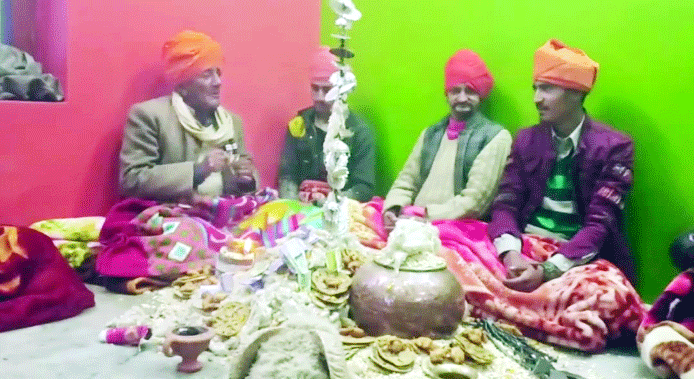
These two separate yagyas, varying in duration, are dedicated to Lord Shiva. A yogi or jogi, whose name generally ends with “Nath,” such as Mangal Nath, Shankar Nath, or Roop Nath, plays a central role in these rituals, which are indigenous to the Siraj area.
It is noteworthy that the jogis living in the area, though few in number, are buried in a seated position rather than cremated. They therefore have separate burial grounds. Additionally, instead of the usual salutations “Namaste” or “Namaskar,” they are greeted with “Aadesh Guru Ji.”
The jogi announces the dates of the yagya. No yagya of Khadaal or Ghanchakkar is considered complete without the sacrifice of an animal, usually a ram or a he-goat. People refer to the jogi as Guru Ji, and “Guru Ji Farman” is the customary phrase spoken at the time of the sacrifice.
During these yagyas, special hymns known as anjalis, dedicated to Lord Shiva and Mata Parvati, are sung throughout the night by the jogi and his team, called panjidaars. One end of the knotted string known as chhater remains on the ground with a heap of grains, bundles of wool, an oil lamp, an incense pot, and the severed head of the sacrificial animal, while the other end is tied upright. The host family and other clan members perform puja of the chhater until the yagya concludes.
Kud and Jatras
Kud and jatras are deeply rooted in the folk traditions of Siraj. They are characterised by traditional devotion, rhythmic circular dance, and well-composed music, showcasing the artistic, cultural, and spiritual expressions of the region.
Dhaku (kud) is a ritualistic community dance performed in honour of local deities. The dance involves slow rhythmic circular movements accompanied by folk instruments such as the dhol, flute, and trumpets. This ensemble of instruments is locally known as bainter, and the musicians are called baijantris.
Jatras, not to be confused with yatras, are festive mass gatherings where community members congregate at designated villages or places. It is during these gatherings that the kud dance or dhaku is performed. Kud and jatras are integral parts of Siraji culture, blending spiritual devotion with community celebration. They honour local deities and express gratitude for the protection of crops and livestock-the primary sources of livelihood in Siraj.
These celebrations are held across Siraj at places such as Bhagwah, Bijarni, Gadi, Kud-dhar, Garh-Kastigarh, and Jodhpur.
Magga
Magga, locally known as Magga, refers to evil spirits. Chelas of the deities predict the harm these spirits may cause to particular families in a village. According to local belief, magga are dayans (witches) who roam during certain nights of the year to cause death, misery, crop damage, or other misfortunes.
The chela forewarns the families likely to be affected and advises them on precautions to ward off the evil spirits.
To protect themselves, families are instructed to keep tiny twigs of the locally known drek tree beneath their pillows before sleeping on those nights believed to be haunted by magga. The twig is believed to guarantee safety during sleep. This superstition is deeply pervasive, and the precautions suggested by the chela are faithfully observed.
Prasad Offering
Every village, hamlet, and clan in Siraj has its own deity, represented in various forms from the Hindu pantheon.
Chelas occupy an important position in the devotional practices associated with these deities. Their words, spoken in a trance-like state, are regarded as divine oracles. Whether a Lord Shiva yagya such as Ghanchakkar or Khadaal has been successfully completed, or which families may be troubled during magga nights, all such pronouncements come through the chela.
The offering of “rote” to deities is also an integral part of Siraji culture, especially among the peasantry. Prasad, in the form of puri-halwa or simple/sweetened thick baked loaves made mainly of maize flour, is offered to propitiate the deities. Animal sacrifice also remains prevalent at the altars of many gods and goddesses across Siraj.
Folk Songs
The folk songs and ditties of Siraj express the emotions, ideals, and lived experiences of the community. Nature figures prominently in these songs. Though they contain vocabulary borrowed from other languages, they remain distinctly Siraji in spirit and ethos. They portray both the past and present of the Sirajis and provide ethnographic insight into their lives.
Shithni
Shithni is a traditional folk song sung by women during weddings. These songs often carry double meanings, combining satire with humour. Women from the bride’s side sing them to tease the groom, his family, and the wedding procession (barat). However, when sung by women from the groom’s side, the same verses transform into praise and appreciation.
Shithnis create a playful and light-hearted atmosphere during weddings.
Gurai
Gurais are folk songs sung in chorus by women during the festival of Tiyaar. They invoke various deities and narrate events associated with them. They also reflect the emotional bond of a married daughter with her mother and parental home, expressing affection, care, and nostalgia.
Gurais are performed in a dialogue form by two groups of women standing opposite each other with interlocked hands.
Ghati
Ghati is a folk genre indigenous to Saraz. Deeply rooted in the socio-cultural environment, ghatis consist of numerous couplets joined together, each complete in itself. These songs depict local life and use natural imagery as metaphors.
Farmers and herders who move to the highland pastures with their livestock during summer sing ghatis, which echo across the valleys and mountains.
Soju
Soju is another folk song associated with agricultural work. It is sung while sowing, weeding, and harvesting to facilitate and enliven farm labour.
Anjali
Anjali is a religious song blending Sarazi and Gaddi dialects, sung during Ghanchakkar or Khadaal rituals dedicated to Lord Shiva. A jogi usually leads the singing of these hymns.
Anjalis praise Lord Shiva in his various manifestations and depict the relationship between Lord Shiva and Mata Parvati. They also narrate the hardships Mata Parvati endured to win Lord Shiva’s affection and devotion.
The imagery of anjalis is closely connected with the belief system surrounding Manimahesh Kailash in the Chamba-Bharmour region of Himachal Pradesh, believed to be the abode of Lord Shiva.
Yatras
Deeply rooted in the cultural and spiritual traditions of Siraj are the annual yatras held with overwhelming participation by devotees. Among them, the Rudra Ganga Yatra, Chamunda Mata Yatra at Sarvadhar, Chandi Mata Yatra at Kulhand, and Chamunda Mata Yatra at Galladhar are especially noteworthy.
Other Practices
Shankhadaal, Zagra, Budh, Mal, and several other religious and pastoral practices are also unique traditions observed in the Siraj area.
(The author is a former KAS Officer)
 Follow our WhatsApp channel
