

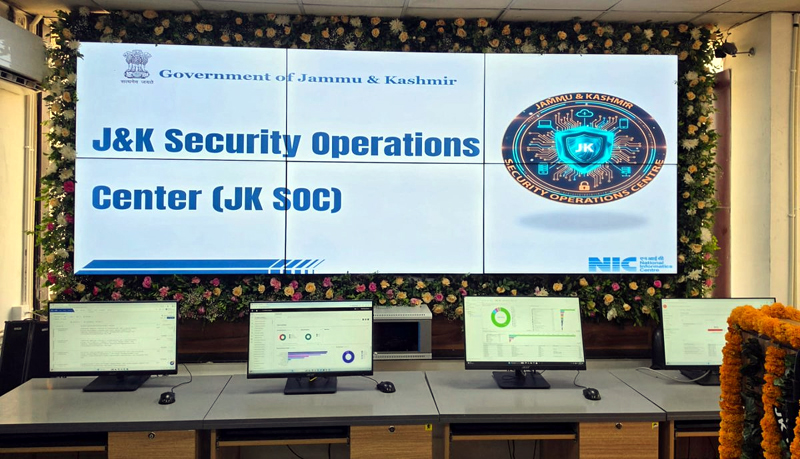
In an age where governance has migrated decisively into the digital realm, the security of that digital space is not merely a technical concern – it is a matter of public trust, national integrity, and administrative credibility. The inauguration of the Jammu and Kashmir Security Operations Centre (JK SOC) by the Chief Secretary represents far more than the launch of a facility. It signals a maturation in how the Union Territory thinks about, and acts upon, the imperative of cybersecurity. Jammu and Kashmir has, by any objective measure, distinguished itself as a frontrunner in the delivery of digital public services. To lead the country in the breadth and accessibility of online governance is no mean feat – it is an achievement that deserves both recognition and careful stewardship. Yet with that distinction comes a commensurate weight of responsibility. When more citizens depend on digital platforms for electricity billing, land records, grievance redressal, application tracking, and a host of other essential services, the stakes attached to the security and continuity of those platforms rise correspondingly. A leadership position in e-governance is only as strong as the infrastructure that underpins it.
The need for this realisation has not been without its sobering reminders. Not long ago, dozens of J&K Government websites were rendered non-functional following prolonged non-compliance with CERT-In verification and audit requirements. The spectacle of over a hundred departmental portals going dark – leaving citizens stranded and services suspended – was a cautionary tale about what happens when cybersecurity is treated as an administrative formality rather than a mission-critical obligation. The lesson was clear and unambiguous: digital governance without robust cybersecurity is a structure built on sand.
What made that episode particularly instructive was where the accountability truly lay. Agencies such as the National Informatics Centre provide indispensable expertise, technical guidance, and institutional support. But the onus of cybersecurity compliance ultimately rests with each individual department. Every ministry, directorate, and administrative unit that operates a digital presence must treat that presence as a frontline public asset – not a peripheral concern to be delegated indefinitely to external bodies. This cultural shift, from passive dependence to active ownership, is perhaps the most important reform required by J&K’s digital governance ecosystem.
The threats that necessitate this shift are neither hypothetical nor trivial. Cyber risks in J&K emanate from a uniquely complex threat landscape. Whilst individual bad actors and opportunistic cybercriminals pose a persistent danger, the more sobering reality is that hostile nations have, on multiple occasions, sought to disrupt Government portals and compromise sensitive data as part of broader destabilisation efforts. That these attempts have been thwarted consistently speaks to the vigilance and proactive posture maintained by NIC and the IT Department. However, vigilance at the national level must now be matched by robust capability at the local administrative level – which is precisely what the JK SOC delivers.
Equipped with advanced tools for real-time threat intelligence, vulnerability assessment, and security analytics, and operating on a round-the-clock basis, the SOC functions as a dedicated nerve centre for the UT’s digital assets. Its close coordination with CERT-In ensures that incident response is neither delayed nor siloed. For citizens engaging with Government portals, this translates into a measurably safer digital experience – one where their data and their interactions are shielded by a professional-grade monitoring apparatus that operates continuously, even when offices are closed.
It is equally worth acknowledging the consistent and engaged oversight that the Chief Secretary has brought to this domain. His periodic interventions on matters of cybersecurity compliance have demonstrably moved the needle, and his presence at the SOC inauguration underscores the seriousness with which the administration regards this infrastructure. Leadership attention at the highest level is not incidental – it is what transforms well-intentioned policy into concrete institutional change. The JK SOC is, in this sense, both a destination and a departure point. It consolidates the gains made thus far whilst creating the conditions for sustained, secure digital growth. As J&K continues to expand its e-governance footprint, this centre will serve as the guardian of that expansion – ensuring that the services citizens depend upon remain safely accessible. In the digital era, that assurance is not a luxury. It is the very foundation of modern, trustworthy governance.
 Follow our WhatsApp channel
