

Dr. Suman K Kasturi
sumankasturi@gmail.com
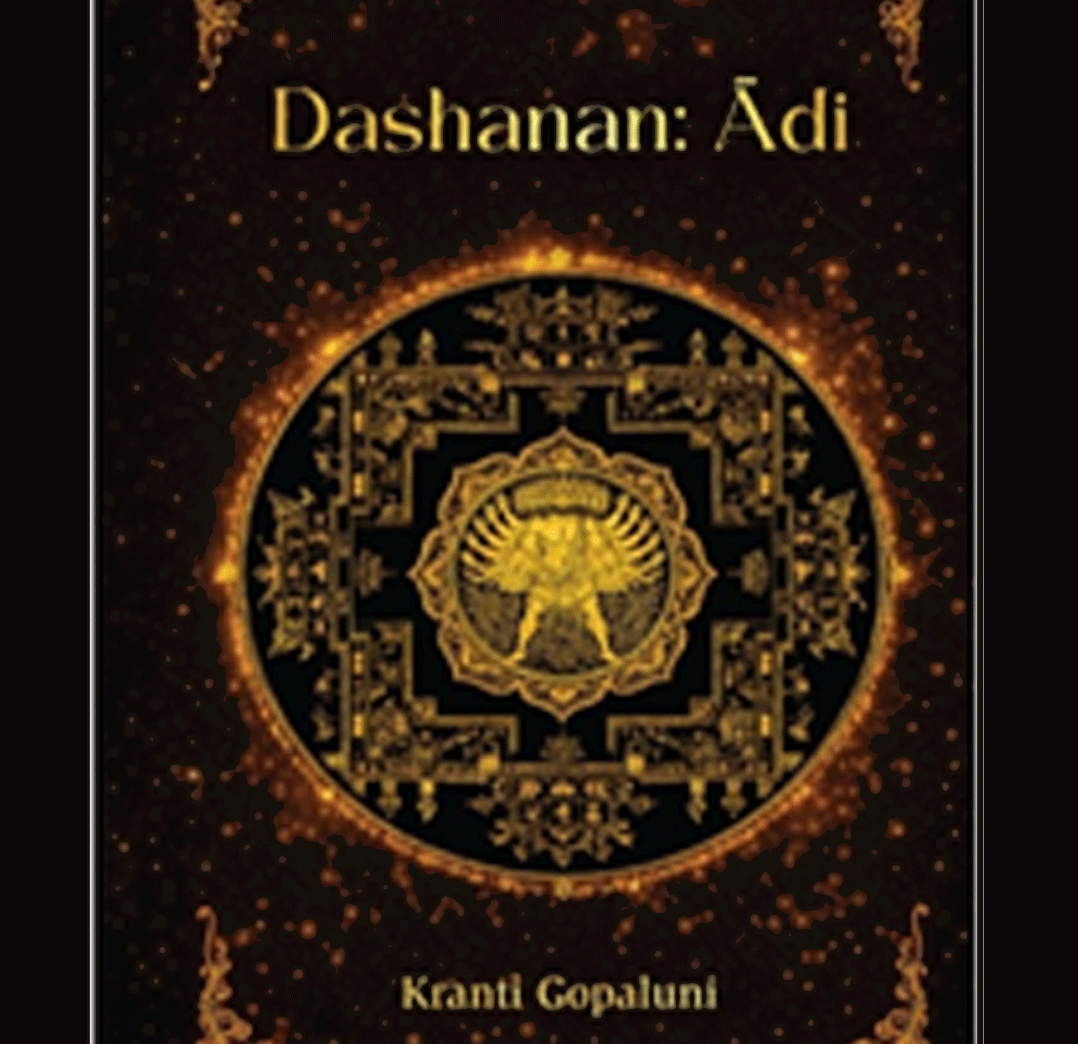
This book, titled “Dashanan: Ādi,” represents a unique endeavour that involvedly weaves together elements of fantasy and Indian mythology. In the introduction, the author states, “Dashanan is not a retelling and should not be mistaken for our itihasa. It is a resurrection—one that takes creative liberties to revive Dashanan.” In my opinion, for any aspiring author, the innate fear and exulansis act as a blindfold that obscures the clarity of their spirit. Surmounting such feelings is undoubtedly a considerable challenge in itself. There is no question that the author has, at a critical juncture, successfully triumphed over such persistent thoughts and brought his first novel to publication.
Insofar as Indian mythology is concerned, it constitutes a vast, dynamic tapestry of myths, legends, and philosophical narratives primarily grounded in Hinduism. It influences cultural practices, moral principles, and social frameworks throughout the subcontinent. These stories are far from static; they continuously evolve, connecting ancient origins with modern beliefs. To grasp this rich tradition, it is beneficial to analyse it through its primary literary sources, fundamental concepts, and defining themes. The wisdom embedded in Indian mythology is transmitted through several foundational layers of literature.
Dashanan: Ādi is fundamentally anchored in Indian Mythology — it represents an ambitious amalgamation of Indian mythology, speculative fiction, and philosophical narrative. Instead of merely retelling the Ramayana, the novel reinterprets Dashanan (Ravana) as a profoundly complex intellectual character — a scholar, devotee, strategist, and perhaps something that transcends historical confines. The premise poses a thought-provoking inquiry: What if Ravana’s narrative never truly concluded?
One of the most compelling features of the novel is its integration of mythology with science fiction. The narrative intertwines “molecular science, destiny, and design,” crafting a storyline that oscillates between ancient itihasa and futuristic conjecture. This combination imparts a tone that is somewhat reminiscent of mythological thrillers, which are more commonly found in Indian cinema than in literature. In this context, it is important to note that Dashanan: Ādi adopts a more experimental and philosophical stance.
Thematically, the novel appears to be focused on questioning simplistic dichotomies of good and evil. Ravana is depicted not merely as a villain but as one of the most intellectually intriguing figures in Indian epic literature. Readers who appreciate morally nuanced characters and reinterpretations of mythological tales may find this particularly engaging.
The initial setup — a child listening to a shocking tale of Dashanan’s resurrection from a grandfather — establishes an intergenerational storytelling framework that likely aids in grounding the broader metaphysical concepts. The atmosphere conveyed by the synopsis feels cinematic and is imbued with mystery.
“Beauty is in the eye of the beholder.” It is a fact that an individual’s perception and experience of the world are shaped by their true self. What one person sees may vary from another’s understanding. Numerous physiological, psychological, and other elements affect our cognitive processes. More specifically, I contend that the psychological theory of tabula rasa is relevant to every person’s existence. At the moment of birth, all individuals share similarities. It is the diverse influences, such as upbringing, environment, and context, that mould a person into who they will ultimately become. Undoubtedly, potential disadvantages may hinge on the expectations of the reader. Given that the novel heavily incorporates speculative mythology and philosophical ideas, readers seeking a straightforward retelling of the Ramayana may find it unconventional. Likewise, the integration of science-fiction elements into sacred epic traditions may create a divide among audiences: some will value the creativity, while others may lean towards a more conventional interpretation.
Although this book may not engage every reader, as profound insights are often only appreciated by those who resonate on a similar frequency or have undergone a comparable mental state, Dashanan: Ādi is undoubtedly a promising read for: enthusiasts of Indian mythology reinterpretations; readers who appreciate speculative fiction with philosophical nuances; those intrigued by Ravana as a complex historical-mythological figure; and readers who enjoy the fusion of ancient narratives with futuristic scientific ideas.
Palpably, the enthusiasm for writing exhibited by Kranti Gopaluni, also known as Sai Akash Gopaluni, the author of this book, is unmistakable. It is truly remarkable to produce a work of such magnitude, especially considering that his professional background is primarily based on data, experiments, and meticulous detail.
 Follow our WhatsApp channel
