

Over 13,000 MSMEs assessed by JKMHC
Excelsior Correspondent
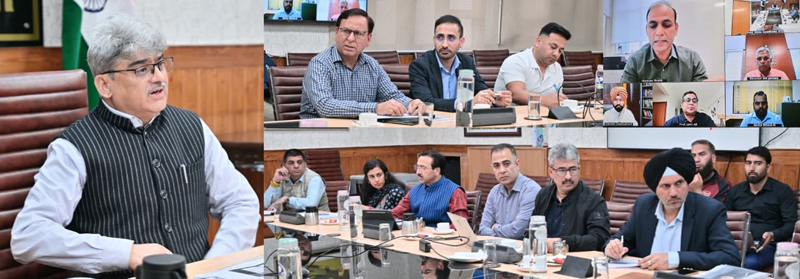
SRINAGAR, May 4: Chief Secretary, Atal Dulloo today chaired a comprehensive review meeting to assess the functioning and progress of the Jammu & Kashmir MSME Health Clinic (JKMHC), a digital initiative aimed at diagnosing, reviving and strengthening micro, small and medium enterprises across the Union Territory.
The meeting besides Commissioner Secretary, Industries and Commerce and Director, IIM Jammu was attended by Executive Director, JKEDI; Director, Industries Jammu; Director, Employment and other concerned officers.
During the meeting, Chief Secretary issued a series of strategic directions aimed at strengthening the effectiveness and institutional capacity of the MSME Health Clinic. He emphasized the adoption of an advanced, Large Language Model (LLM)-based solution for conducting root cause analysis of stressed units, with a mature agentic AI framework backed by appropriate guardrails.
He also directed that the system be trained on local datasets to enhance contextual relevance and explore development on indigenous platforms such as BharatGenetc.
Highlighting the importance of evidence-based interventions, the Chief Secretary called for the preparation of detailed case studies based on field-level diagnostics, citing the need for grassroots-driven analysis to inform policy and rehabilitation strategies.
He further stressed that capacity building should be a continuous process rather than a one-time exercise, directing that structured training programmes be conducted at least once every two months to build sustained expertise at the district level.
To strengthen institutional convergence, the Chief Secretary directed that experts from the Small Business Development Unit (SBDU) established under Mission YUVA be formally integrated into the MSME Health Clinic framework, with dedicated personnel deployed for implementation support.
He also called for inclusion of representatives from key institutions such as banks, NABARD and allied departments including agriculture, positioning SBDU as a nodal platform for coordinated guidance and execution at the grassroots level.
Clarifying institutional roles, the Chief Secretary underlined that IIM Jammu should primarily focus on training and capacity building, while implementation responsibilities should rest with field-level institutions. He further stressed the need to develop a robust pool of trained human resources at the district level through repeated and structured capacity-building interventions.
The Chief Secretary also directed the Industries & Commerce Department to convene joint meetings with the Labour Department and other stakeholders, while actively seeking inputs from leading financial institutions including J&K Bank, SBI and NABARD, as well as industry bodies such as FICCI, ASSOCHAM and CII. He called for greater stakeholder engagement to incorporate sector-specific expertise into the functioning of the MSME Health Clinic.
The meeting was apprised by the Commissioner Secretary, Industries and Commerce, Vikramjit Singh that the MSME Health Clinic has been conceptualized as an end-to-end mechanism to evaluate the financial and operational health of industrial units using real-time data sources such as GST filings, banking records, power consumption and EPFO statements.
Highlighting the scale of progress achieved so far, he informed that 13,357 enterprises have been digitally assessed so far by the MSME Health Clinic, out of which 86.26 percent have been categorized as stable, 13.36 percent as recoverable and a small fraction identified as prone to sickness. The initiative is focused on early identification of stress signals and timely handholding to prevent units from slipping into irrecoverable stages.
Giving details about the implementation of previous directions the Director, I&C Jammu, Arun Manhas informed that a responsive chatbot has already been integrated into the portal to enable enterprises to assess their health status and receive recommendations, while work is underway to upgrade it into an AI-enabled system for enhanced user experience.
 Follow our WhatsApp channel
