

*Releases publications on climate change, floriculture
Excelsior Correspondent
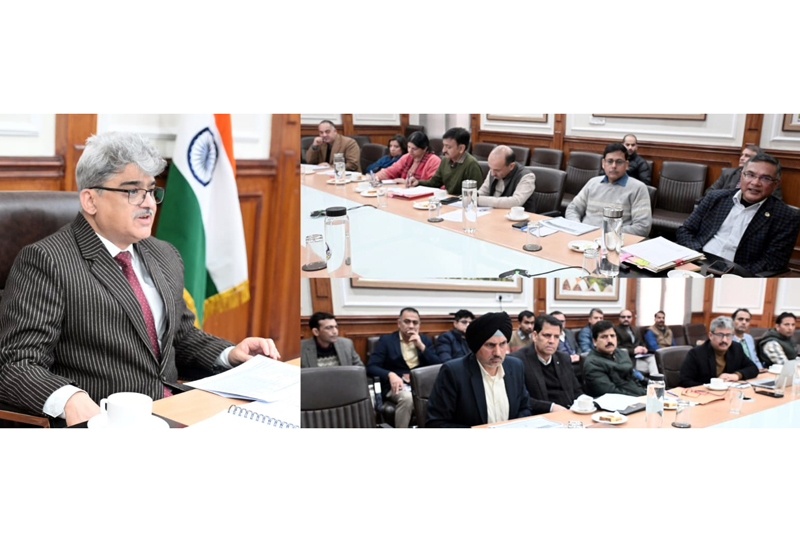
JAMMU, Dec 15: Chief Secretary, Atal Dulloo, today held a review to access the implementation of the newly rolled-out District Business Reforms Action Plan (D-BRAP) under the Ease of Doing Business initiative of the Government of India’s Department for Promotion of Industry and Internal Trade (DPIIT).
The review meeting, coordinated by the Industries & Commerce Department, was attended by Administrative Secretaries and Heads of Departments, along with Deputy Commissioners of all districts through either in person or through video conferencing.
During the meeting, the Chief Secretary took a comprehensive appraisal of department-wise services and reform parameters mandated under D-BRAP. He emphasized the need for the Industries & Commerce Department, as the nodal agency, to develop a common real-time dashboard providing a consolidated view of the status of all services across departments and districts. He further directed that all such services be mandatorily integrated with the Single Window System to ensure ease of access and transparency for users.
The Chief Secretary called upon all concerned departments to notify pending services under the Public Services Guarantee Act (PSGA) with clearly defined timelines and ensure that these services are delivered through online mandates, as envisaged under the D-BRAP framework.
Stressing the importance of grassroots-level implementation, the Chief Secretary directed the strengthening and capacity building of District Industries Centres (DICs) to enable effective, timely, and outcome-oriented implementation of the reforms. He also called for the preparation of a roadmap for the establishment of industrial parks as a key objective under D-BRAP to promote district-level industrial growth. Additionally, he asked the departments to address issues related to the Jan Sugam portal to enhance its accessibility, visibility, and operational efficiency.
Addressing the meeting, Additional Chief Secretary, (Financial Commissioner Revenue), Shaleen Kabra, apprised the participants of the implementation status of land-related reforms under the action plan.
Additional Chief Secretary, Power Development Department, Shailendra Kumar, underscored the importance of onboarding all districts onto a single standardized dashboard to ensure uniformity in service delivery parameters. He emphasized the need for a mission-mode approach, particularly in view of the DPIIT assessment scheduled for April 2026.
Principal Secretary, Home Department, Chandraker Bharti, highlighted the pivotal role of District Industries Centres as nodal agencies for the implementation of D-BRAP at the district level. He called for re-energizing and strengthening DICs to achieve the objectives of the reform plan in letter and spirit.
Commissioner Secretary, Industries & Commerce Department, Vikramjit Singh, presented the overall framework of the D-BRAP and informed that 46 services have been identified by DPIIT for digitization.
The Director, Industries, Jammu, Arun Manhas, briefed the meeting on the department-wise categorization of services, detailing the responsibilities of departments and districts in ensuring their smooth implementation.
Meanwhile, Chief Secretary released three books authored by Prof. Manoj Nazir and Ridhima Koul.
Congratulating the authors, the Chief Secretary called these publications much-needed to draw attention towards biodiversity, floriculture and climate-related challenges in an ecologically fragile region like J&K where such issues have often remained underrepresented in mainstream discourse.
He remarked that the authors deserve appreciation for documenting and highlighting these important yet neglected aspects through scientific and literary engagement.
The books released include Alchemy of the Red Rose by Prof. Manoj Nazir and Ridhima Koul, The Impact of Climate Change on Flowering by Prof. Manoj Nazir and Ridhima Koul, and Manoj Nazir: The Man Behind the Gladiolus Revolution in India authored by Ridhima Koul and Dr.Jyotsana Maurya.
Prof. Manoj Nazir is a distinguished scientist in the field of floriculture, widely recognised for spearheading the Gladiolus Revolution in India.
Ridhima Koul is a biotechnology researcher and author with significant research experience in floriculture and plant sciences.
Dr. Jyotsana Maurya is a biotechnology scholar and author, known for her research on medicinal plants and floriculture, and has contributed extensively through scientific publications and books.
 Follow our WhatsApp channel
