

‘J&K Govt visible only in elite functions: LoP
Suhail Bhat
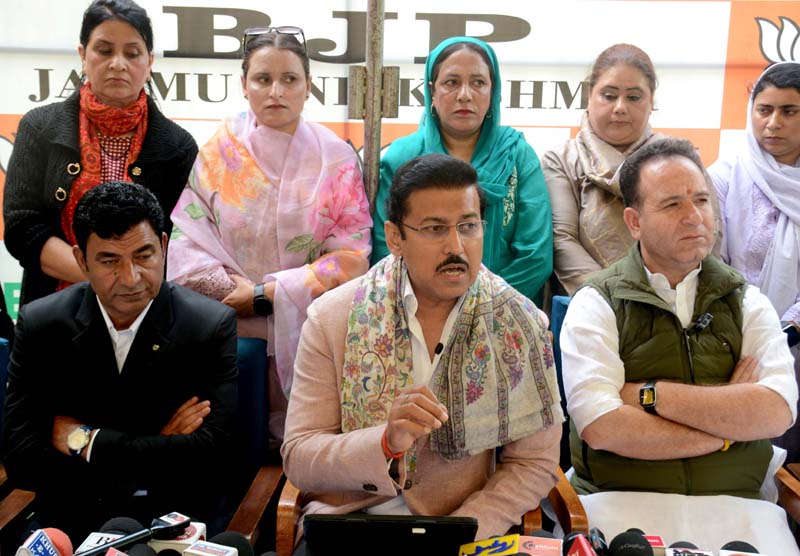
Srinagar Apr 23 Union Minister for Youth Affairs and Sports Rajyavardhan Singh Rathore today accused opposition parties, particularly Congress, of obstructing efforts to fast-track the implementation of women’s reservation in Parliament, saying delays linked to census and delimitation processes could prevent its implementation before the 2029 general election.
Addressing a press conference here, Rathore said the Government led by Prime Minister Narendra Modi had demonstrated “clear intent and political will” by passing the Women’s Reservation Bill in 2023, but acknowledged that its implementation remained tied to the completion of a national census and subsequent delimitation exercise.
“The bill that was passed in 2023 had an operative text. Its implementation was linked to census and delimitation. It cannot be executed on its own,” he said.
The Minister said three measures introduced on 16th April 2026 – the Constitution (131st Amendment), the Delimitation Bill 2026 and the Union Territories Law Amendment Bill 2026 – were intended to enable implementation in time for the 2029 Lok Sabha elections. “If we wait for the census, it can take 1.5 to 2.5 years. After that, delimitation can take another one to three years. That means it could reach the 2029 elections,” he said.
Responding to opposition, particularly the Congress party, questioning the need for fresh amendments, arguing that the law had already been passed. Rathore rejected that position. “To say it has already been passed and nothing more is required is a delusion. The earlier bill clearly deferred implementation to future processes,” he said.
He also addressed concerns raised by some parties about the potential impact of delimitation on representation in southern states, saying seat expansion would prevent any reduction. “The percentage is clearly increasing. Seats will increase proportionally in every state. There is no loss at all,” he said, adding that representation could see “marginal gains”.
On demands for including quotas for Other Backward Classes (OBCs), Rathore said the issue could be debated in Parliament but should not delay implementation. “There was already provision for SC/ST women in the 2023 law. Parliament is open for discussion on OBCs, but getting stuck on this is just a reason to stall,” he said.
The Minister said women’s reservation had been debated for decades, noting that similar proposals were introduced in 1996, 1998, 1999 and 2008 but were not passed. “There was a lot of discussion. The difference is clear: who discusses it and who has the power to implement it,” he said.
He added that the Modi Government had demonstrated its intent by passing the 2023 law unanimously and by attempting to ensure its implementation. “The Modi Government does what it says. When we brought the bill, it was clear we wanted to implement it,” he said.
Referring to Jammu and Kashmir, Rathore praised the “courage, resilience and leadership” of women in the region and said their role was an example for the country. “Women now want equal opportunity in law-making and policy-making. They should not just be a symbol but have a real place,” he said.
Responding to questions on why existing parliamentary seats could not be reallocated, he said the Government favoured expanding the Lok Sabha rather than reducing current representation. “We do not want to take from anyone. The Lok Sabha has been waiting for expansion for decades. Women’s seats should come through expansion,” he said.
He said informing the public through the media was essential in a democracy. “If the truth and details are known, people can make good decisions. That is why we are reaching out,” he said.
Meanwhile, the Leader of Opposition, Sunil Sharma alleged that the Government is largely absent at the grassroots level, saying it is visible mainly at high-profile events while key public issues such as roads, electricity and daily civic concerns remain unaddressed.
Sharma said demands for restoring statehood should not overshadow what he described as unmet public promises. He urged people to question Chief Minister Omar Abdullah over issues affecting daily life.
“You ask Omar Abdullah, where the cylinders have gone, where the 200 units of electricity have gone, where the 1-lakh jobs have gone,” Sharma said, referring to previous commitments.
He said that the restoration of statehood “has to come when it has to,” and “it will not come because he became the Chief Minister”. He added that statehood should not be associated with “a prince from Sheikh Muhammad Abdullah’s family.”
Sharma alleged that governance in the region had “come to a standstill,” citing what he described as a lack of ministerial presence on the ground and worsening public services. “There is a water crisis. There is an electricity crisis. The roads are in a bad state,” he said, adding that employees were also facing difficulties. He further claimed that the government was more visible at public events than in addressing administrative issues, saying it was “visible in marathons, cycling, skiing and Five Star dinners, but not visible anywhere on the ground.”
He also alleged an increase in corruption since October 2024, claiming that ordinary citizens were being forced to pay bribes to get routine work done at local offices. According to Sharma, “corruption is touching the sky,” and transfers had become an “industry.”
The opposition leader further criticised what he described as a lack of administrative oversight, saying the Chief Minister, who holds multiple portfolios, had not conducted adequate departmental reviews or engaged sufficiently with officials.
 Follow our WhatsApp channel
