

Sakharam Binder
Ravinder Kaul
JAMMU, Nov 29: Vijay Tendulkar’s ‘Sakharam Binder’, originally written in Marathi and first performed in 1972, is a play that avoids being decorative. It offers a raw and unflinching look at power, gender, hypocrisy, and survival. The work reveals the decay found beneath polite social appearances. Watching ‘Sakharam Binder’ is not a comfortable experience. However, this discomfort is exactly the playwright’s aim: he wants audiences to feel the itch, the sting, and the slow anger that arises from seeing human dignity treated like second-hand goods.
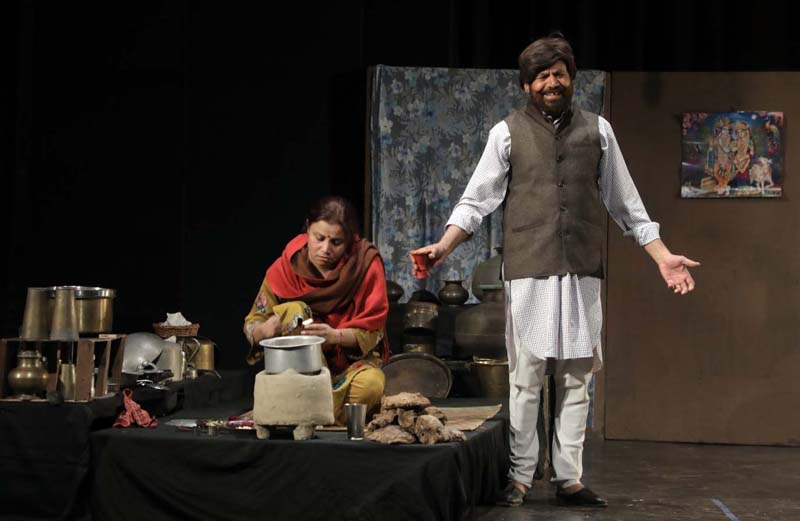
The performance of ‘Sakharam Binder’ in Dogri translation, by veteran writer Shiv Mehta, and presented by Aazaad Parindey Kala Manch in the Saptahik Rangdhara series conducted by J&K Academy of Art, Culture and Languages here this evening, had many positives to its credit. The translation was impeccable and the diction, idiom and colloquial flow of the language was such that it did appear like a story from the Dogra hinterland.
Another positive was that all the artistes gave a very good account of themselves. Beginning with veteran Janak Khajuria in the title role, he was able to evoke the desired feeling of revulsion among the audience. He also was able to, at times, show his helplessness and vulnerability. Both female characters Renu Sharma as Laxmi, a docile, religiously oriented woman and Pratiksha Sharma as Champa, a loud mouthed, boisterous and unapologetic person, lived their respective roles. Vivek Sangotra as Dawood and Manoj Dhamir Shammi as Hawaldar Shinda too were competent in their roles.
Music by Ankit Sharma was soothing and soulful at times and loud whenever required. Set execution by Mohit and Saksham was artistic and as per the mood of the play.
Mohit Singh Chib, whose design and direction made the play an extremely engrossing and enriching experience, is a young and promising director from whom the theatre of Jammu has many expectations. He fully succeeded in translating the vision of Vijay Tendulkar into a memorable performance in a land and language far removed from the Maratha land where the play was originally conceived.
‘Sakharam Binder’ avoids simple moral interpretations. The play challenges the idea of virtue and righteousness. It reveals how patriarchy undermines everyone’s moral imagination and how survival strategies can appear as complicity. Sometimes a woman’s ‘choice’ in the play arises more from deprivation and shame rather than real freedom; other times, she embraces a limited autonomy with fierce clarity. The play’s empathy is not sentimental; it exposes while also understanding.
Decades after it was written, ‘Sakharam Binder’ remains impactful. Its core issues-the commercialization of human connections, patriarchal control disguised as kindness, and the instability of vulnerable lives-are still painfully relevant today. It urges modern audiences to examine not only the clear oppressors but also the societal narratives that make exploitation seem acceptable. It is neither easy nor comforting, nor is it intended to be. It is a profound moral provocation: crude in language, rich in implications. The play forces the audience to remain unsettled. Characters are both familiar and disturbing, their motivations a mix of humanity and horror.
Great theater doesn’t let you leave unchanged. ‘Sakharam Binder’ is such a play; it highlights the small, ordinary actions that support structural injustice and exposes them to a harsh light. The play doesn’t provide answers; it presents the question in its rawest form and asks you to bear witness. That kind of moral artistry is, in itself, a form of resistance.
In conclusion it can be said that the Weekly Theatre series launched by J&K Academy of Art, Culture and Languages is a huge success and the plays performed in this series need to travel to other districts of Jammu and Kashmir so that theatre can enrich the lives of people of all parts of the land and create a congenial atmosphere where theatre does not only survive but thrive.
 Follow our WhatsApp channel
