

*Underscores UT’s immense dairy potential
Excelsior Correspondent
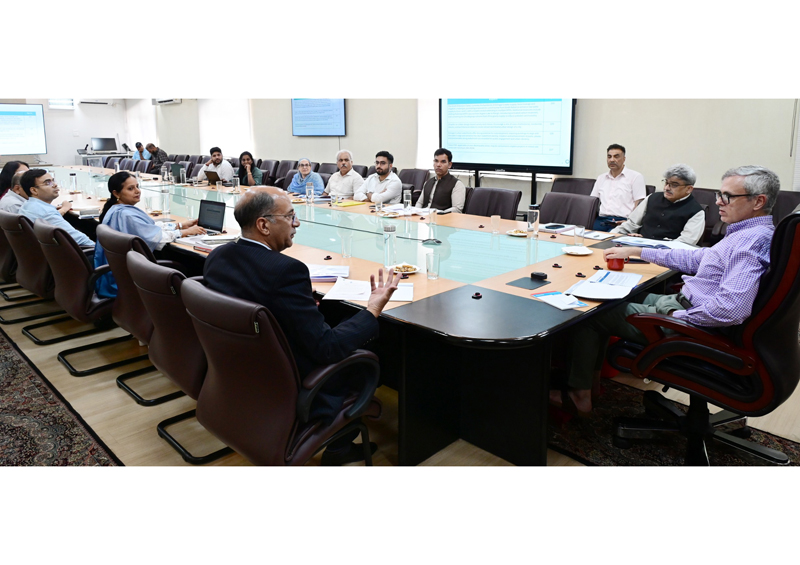
SRINAGAR, Aug 11: Chief Minister Omar Abdullah today chaired a meeting to review the Master Plans for the twin cities of Srinagar and Jammu, alongside the Unified Building Bye-Laws (UBBL) for Jammu and Kashmir.
The meeting was attended by Advisor to the Chief Minister Nasir Aslam Wani, Chief Secretary Atal Dulloo, Commissioner Secretary Housing & Urban Development Department (H&UDD) Mandeep Kaur, Divisional Commissioners of Kashmir and Jammu, Deputy Commissioners of Srinagar and Jammu, Commissioners of Srinagar Municipal Corporation and Jammu Municipal Corporation, Vice Chairpersons of Srinagar and Jammu Development Authorities, and other senior officials concerned.
The meeting held detailed deliberations on the Srinagar Master Plan-2035, Jammu Master Plan-2032, and the Unified Building Bye-Laws-2021.
Chief Minister emphasised that Master Plans must be realistic, implementable and reflect ground realities, rather than existing solely as vision documents.
He directed that the plans should take into consideration views of all stakeholders and it should be environmentally sustainable and capable of addressing future urban challenges while preserving the cultural and ecological identity of both cities.
He also directed all concerned departments to incorporate on-ground assessments, public feedback and inter-departmental coordination to ensure the successful implementation of the plans.
Meanwhile, Chief Minister chaired a high-level review meeting on the Jammu & Kashmir Dairy Processing Infrastructure Development Scheme (JKDPIDS), a Rs 1,433 crore initiative aimed at transforming the J&K’s dairy sector into a robust, organized and globally competitive industry.
During the review, the Chief Minister highlighted the vast potential of dairy in Jammu & Kashmir.
He stressed the urgent need to expand organized milk processing from the current 4% to at least 20% within the next seven years, ensuring better prices, regular payments, and market access for over 5 lakh dairy farmers.
Principal Secretary, Agriculture Production Department (APD), Shailendra Kumar, gave a detailed presentation on the scheme, implemented by the National Dairy Development Board (NDDB) as the nodal agency.
The Chief Minister called for close inter-departmental coordination to ensure timely provision of road connectivity, electricity, and water to the project sites.
He further instructed NDDB and the Animal Husbandry Department to expedite agreements on sexed semen production and fodder development to strengthen productivity at the grassroots level.
Chief Minister also asked NABARD to ensure prompt release of funds and strict financial monitoring, while emphasising that all departments must adhere to the set timelines for project execution, with quarterly progress reviews at the state level.
Highlighting the scheme’s projected impact, the Chief Minister said it will significantly boost cooperative turnover, create thousands of rural and skilled jobs, and ensure the supply of hygienic, export-ready milk.
He said the initiative represents far more than a sectoral upgrade—it is an economic transformation for rural Jammu & Kashmir. “Our dairy sector has the potential to be a pillar of rural prosperity and a driver of export excellence,” he remarked, urging all stakeholders to work with urgency and precision.
 Follow our WhatsApp channel
