

Shivani Vaid
vaidshiva@gmail.com
The introduction of On Screen Marking (OSM) amid technical chaos has left lakhs of students questioning their futures and demanding answers.
On May 13, 2026, lakhs of Class 12 students across India eagerly checked their CBSE results, a moment they had worked towards for years. For most of them, what followed was not relief or celebration but shock, confusion and heartbreak. The results were deeply disappointing and the reasons behind this go far beyond the difficulty level of the question papers.
Something went wrong and it went wrong at a systemic level.
The Numbers Tell a Worrying Story
Compare this year’s result data with last year’s, and a clear and troubling picture emerges:
More students appeared this year yet fewer passed. Fewer scored above 90%. Fewer reached above 95%. This is not a natural dip. This demands an explanation.
What is On Screen Marking and What Went Wrong?
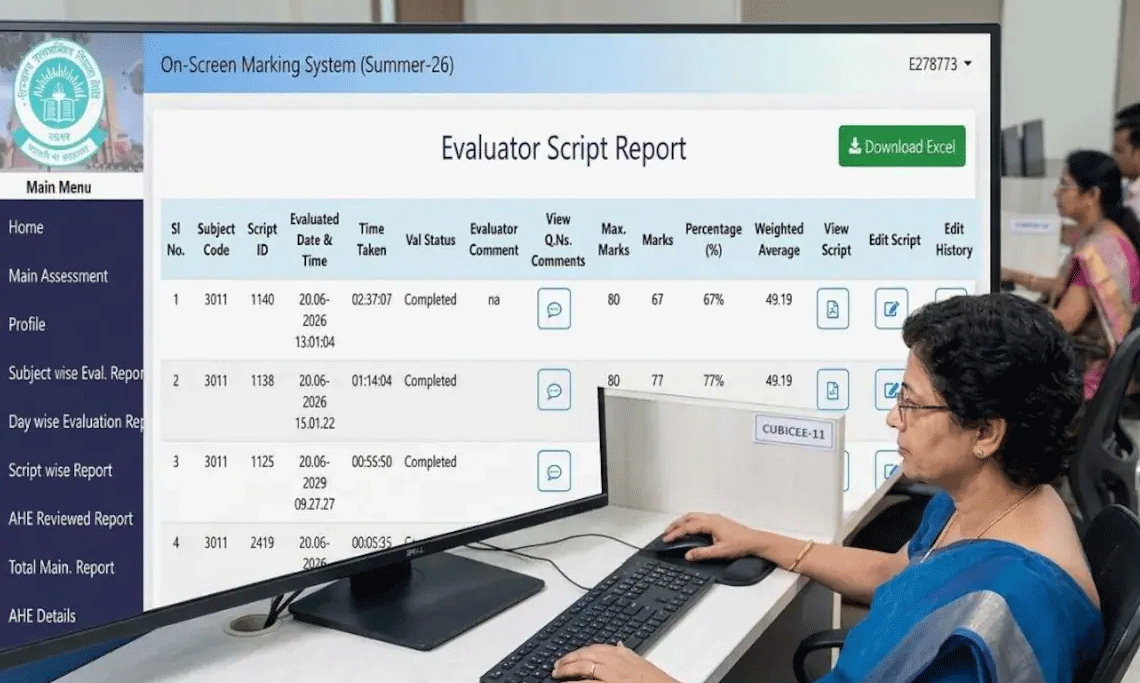
This year, CBSE introduced On Screen Marking (OSM) for the first time. A system in which teachers evaluate answer scripts digitally, on a screen, rather than on paper. In theory, OSM is a step forward: it is used successfully in several countries and can improve consistency and speed in evaluation.
But in practice, the implementation was deeply flawed.
Consider the scale: 98 lakh (9.8 million) answer scripts had to be evaluated. Only 70,000 teachers were assigned to check them. That means each teacher was expected to evaluate approximately 140 scripts and the entire checking process was compressed into just 8 days. Do the math: each teacher was checking around 18 scripts per day.
Is that enough time to read, understand and fairly assess a student’s answer script? Can justice be done to a child’s hard work in that kind of rush?
And it was not just about speed. The teachers themselves have reported serious technical problems throughout the evaluation process:
* Answer scripts were uploaded upside down, making them impossible to read correctly.
* Servers crashed repeatedly, interrupting the evaluation mid-process.
* Screens were blurry or unclear, making handwriting difficult to decipher.
* Weak internet signals caused frequent disconnections.
* Login and logout issues prevented evaluators from accessing scripts at all.
* In some cases, the system appeared to auto-check scripts without a human evaluator reviewing them at all.
The mock training provided to teachers before OSM was rolled out was also reported to be inadequate. Teachers were not prepared to handle the technical demands of this new system and when problems arose during actual evaluation, there was little support available.
This is not speculation. These are documented complaints from the very teachers who were responsible for checking the papers.
A System That Was Not Ready
CBSE deserves credit for wanting to modernise. OSM, when done right, can make the evaluation process more transparent and efficient. But introducing a system of this magnitude for 98 lakh scripts without properly equipping teachers, without a reliable technical infrastructure and without adequate time for evaluation is a serious failure of planning.
Innovation without preparation is not progress. It is risk and in this case, students paid the price.
Even as CBSE students struggle with these results, we are also witnessing the continuing crisis of NEET examination question paper leaks. Once again, a high-stakes national examination has been compromised. Once again, students who worked honestly find themselves penalised. These are not isolated incidents they point to a deeper, systemic problem in how we conduct and manage examinations in this country.
The Human Cost: Students in Crisis
Class 12 is not just an exam. It is the gateway to a student’s future to college admissions, to entrance examinations, to the career they have dreamed of. When results do not reflect what a student genuinely deserved, the consequences are devastating.
Today, thousands of students across India are ineligible for entrance examinations because their scores have fallen below cut-offs not necessarily because they failed to prepare but because the system that evaluated their work was broken.
These are young people who studied through pressure, through anxiety, through months of sacrifice. They had ambitions. They had plans. And overnight, those plans have been shattered not because of their own shortcomings, but because a hastily implemented technology failed them.
The mental trauma that students and their families are currently experiencing is real and profound. This cannot be brushed aside as an unfortunate statistic.
What Needs to Happen Now
The situation calls for urgent, concrete action:
1. A thorough and independent investigation must be conducted into the OSM evaluation process and its technical failures.
2. A comprehensive rechecking of answer scripts must be undertaken particularly for students where significant drops in marks are evident.
3. CBSE must be transparent with the public about what went wrong and must take responsibility.
4. The Ministry of Education must treat this as a crisis and intervene immediately.
5. Students who are affected must be given relief including revised eligibility criteria for entrance examinations where necessary.
The government and the education ministry cannot afford to remain silent on this. These are not just numbers on a result sheet. These are the futures of our children.
We owe it to every student who sat in that examination hall with hope in their hearts to investigate what happened, to make it right, and to ensure that no future batch of children is failed by the very system that is supposed to serve them.
(The author is a CBSE Resource Person with extensive experience in school education)
 Follow our WhatsApp channel
