

Suhail Bhat
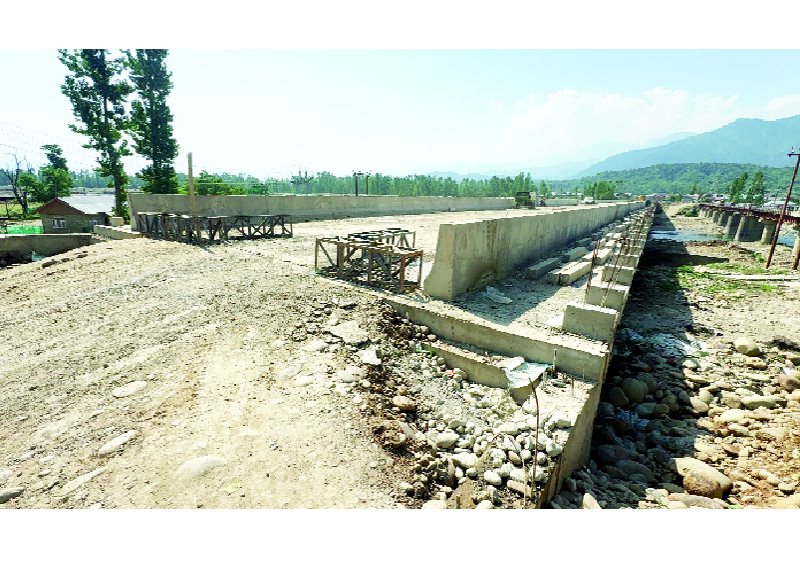
Srinagar, May 20: The Brazloo Bridge on the NH-444 bypass in Kulgam district has missed its April completion deadline, worsening traffic congestion and daily commuting problems as officials cite land acquisition delays and flood-related disruptions while assuring completion by the end of July
The 378-metre bridge, being constructed across the Vaishnav River, is part of the 8-km-long Kulgam bypass project from Pahloo to Lirow on National Highway-444. The project is being executed by the National Highways Authority of India at an estimated cost of Rs 25.92 crore.
NHAI began work on March 3, 2024, and the bridge was originally scheduled for completion in April 2026. Officials now claim that nearly 95% of the work has been completed.
“Land acquisition issues delayed the project, while floods also affected the pace of construction,” an official associated with the project said. He added that the bridge was expected to be opened to the public by the end of July, although the deadline could be formally extended because of construction challenges.
Residents say the delay has added to the burden on the existing bridge, which frequently witnesses heavy traffic congestion and long vehicle queues. “We expected the bridge to be completed in April, but now it is already May and the work still appears unfinished,” one resident said, adding “we hope the authorities complete it by July at least so that people can finally get some relief.”
Another resident described traffic jams in the area as a daily problem. “We face immense difficulties because traffic congestion has become routine here,” he said. He added, “People remain stuck for long periods, especially during peak hours.”
Locals also pointed to the project’s prolonged history. According to residents, the work was initially assigned to the Jammu and Kashmir Projects Construction Corporation in 2017, but construction stopped after about a year. The project was later retendered in 2022 and taken over by the Ministry of Road Transport and Highways.
Residents said the situation becomes particularly alarming during emergencies. “Traffic almost doubles during peak hours, and vehicles come to a complete standstill,” another local resident said. “Imagine an ambulance carrying a critically ill patient getting trapped in that gridlock
 Follow our WhatsApp channel
