

Fatima Baloch
The Baloch nationalist struggle, initiated by the Baloch Students Organization (BSO)-the ideological predecessor of the Baloch Liberation Army (BLA), Baloch Liberation Front (BLF), and other affiliated pro-independence movements-bears notable similarities to the Afghan Taliban movement. However, the Baloch national struggle predates the rise of the Taliban. The fundamental distinction lies in ideology: the Taliban movement is rooted in religious doctrine with nationalist undertones, whereas the Baloch struggle is entirely nationalist and secular. Despite this ideological divergence, both movements have fought for the dignity and sovereignty of their respective homelands.
Before the emergence of the Taliban in 1996, Afghanistan had already experienced decades of political upheaval, foreign interventions, and internal chaos. Power frequently shifted among warlords and externally backed regimes, leaving behind a legacy of instability, violence, and destruction.
In 1973, King Zahir Shah was deposed in a coup led by his cousin and former Prime Minister, Mohammad Daoud Khan. Although Daoud attempted to modernize Afghanistan, his policies strained relations with regional powers, particularly the Soviet Union.
Daoud’s government was overthrown and he was killed during the 1978 Saur Revolution, led by the communist People’s Democratic Party of Afghanistan (PDPA). Nur Muhammad Taraki assumed power, but internal rivalries soon escalated. Taraki was replaced and later assassinated by Hafizullah Amin, who was himself assassinated within months. This power struggle was marked by violent purges and a complete absence of constitutional governance.
In December 1979, the Soviet Union invaded Afghanistan and installed Babrak Karmal as president. This sparked a catastrophic proxy war. The United States, Pakistan, Saudi Arabia, and other countries backed various Mujahideen factions-ranging from tribal warlords and Islamist commanders to international jihadists like Osama bin Laden and Ayman al-Zawahiri. Pakistan, as a frontline ally of the West, gained significant financial aid and received vast quantities of free U.S. weapons while leading a proxy war against the Soviet-backed, pro-India Afghan government.
Despite Soviet efforts to retain control, the war devastated Afghanistan. Millions were displaced, many seeking refuge in Pakistan and Iran. A generation of Afghan youth-especially orphans-were raised in religious madrassas, which later became breeding grounds for extremism.
After the Soviet withdrawal in 1989, the Najibullah government collapsed in 1992. The Mujahideen factions, no longer united, plunged the country into a brutal civil war. Kabul was reduced to rubble, thousands were killed, and famine spread. Gulbuddin Hekmatyar, backed by Pakistan’s Inter-Services Intelligence (ISI), emerged as a powerful but divisive figure, controlling limited areas while the country remained in chaos. Amid this turmoil, Pakistan launched a new proxy force-the Afghan Taliban-in 1994, ironically turning against its former ally Hekmatyar.
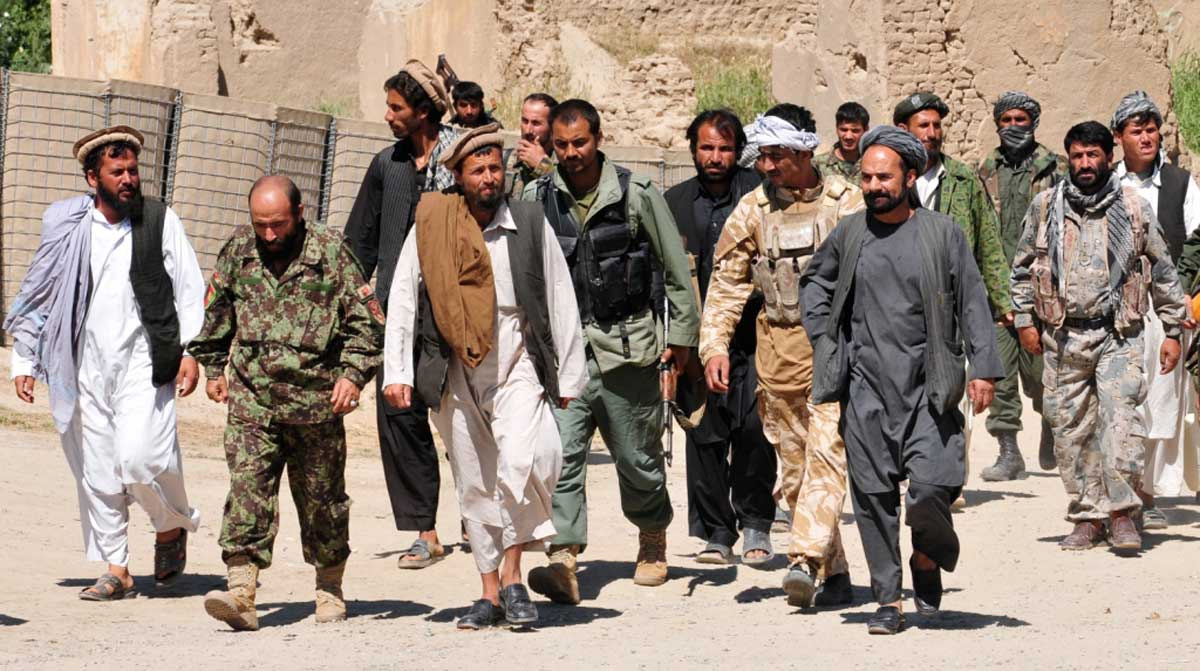
The Taliban, composed mostly of madrassa-educated youth, rose rapidly. By 1996, they captured Kabul and established a theocratic regime aligned with Pakistan and openly hostile to India.
Following the 9/11 attacks, the United States and NATO launched a military campaign to dismantle Al-Qaeda and overthrow the Taliban regime. Notably, Pakistan shifted its allegiance, joining the U.S.-led coalition for financial aid and military support. The Taliban regime was toppled, and a democratic government led by Hamid Karzai was installed. However, the Taliban regrouped and waged a persistent insurgency. The 2020 Doha Agreement paved the way for U.S. withdrawal, and on August 15, 2021, the Taliban returned to power-this time projecting a more nationalist image and showing greater independence from Pakistan.
Since their return, Afghanistan has experienced a reduction in overt conflict. The Taliban now present themselves as more nationalist, distancing from Pakistan due to its past cooperation with Western forces. They have even established diplomatic relations with India and several Arab states.
Balochistan has similarly endured foreign exploitation and internal betrayal. Its tribal structure has been manipulated by both Pakistan and Iran, with some tribal leaders serving as proxies. On March 27, 1948, key Baloch tribal chiefs supported the annexation of Balochistan into Pakistan. Since then, many tribal elites have received military patronage while neglecting-or actively suppressing-the aspirations of the broader Baloch population.
The BSO, founded in Karachi on November 26, 1967, originally advocated for student rights and the promotion of Balochi language and culture-both of which have been systematically marginalized by Pakistani and Iranian authorities. Baloch national languages are still not taught in schools or colleges, and Baloch cultural heritage continues to face neglect. Over time, the BSO evolved into a wider political movement that challenged both external occupation and internal feudal hierarchies, laying the ideological groundwork for militant resistance groups like the BLA and BLF.
Today, thousands of educated, secular Baloch youth have joined the BLA and BLF. They resist not only occupying military forces but also the tribal elites complicit in the occupation. In contrast to the Taliban-who have historically excluded women-the Baloch nationalist movement has seen active female participation, especially in the elite Majeed Brigade, known for its high-risk missions.
It is important to note that the Baloch people also have a significant presence in Afghanistan’s Nimroz Province. Many Baloch nationalist leaders are believed to maintain safe havens in Afghanistan. Historically, the Baloch have never interfered in Afghan domestic affairs. They have maintained cordial relations with every Afghan government-whether communist, civil war-era factions, the first Taliban regime, the democratic governments, or today’s nationalist Taliban government.
The leadership of the Baloch movement has transitioned from traditional figures such as Nawab Khair Bakhsh Marri and Nawab Akbar Bugti to a new generation of grassroots, educated leaders. Their sole objective is the establishment of a sovereign, democratic Balochistan.
The movement is now more organized, with intensified insurgent activities in areas under BLA control. It has developed specialized technical units, an intelligence wing (ZIRA), and a suicide unit known as the Majeed Brigade. Crucially, these groups enjoy increasing public support, fueled by years of state repression and systemic injustice against the Baloch people.
According to several international think tanks, Pakistan’s military is facing growing difficulty in suppressing the Baloch insurgency. If this trajectory continues, Pakistan could eventually lose control over Balochistan-paving the way for a sovereign Baloch republic.
This envisioned republic would be secular and democratic, led by moderate leadership. It would hold accountable those tribal elites who betrayed the national cause for personal gain. The future Republic of Balochistan would pursue friendly and strategic relations with Afghanistan and India-ushering in a new era of peace and prosperity in the region.
 Follow our WhatsApp channel
