

Dhurjati Mukherjee
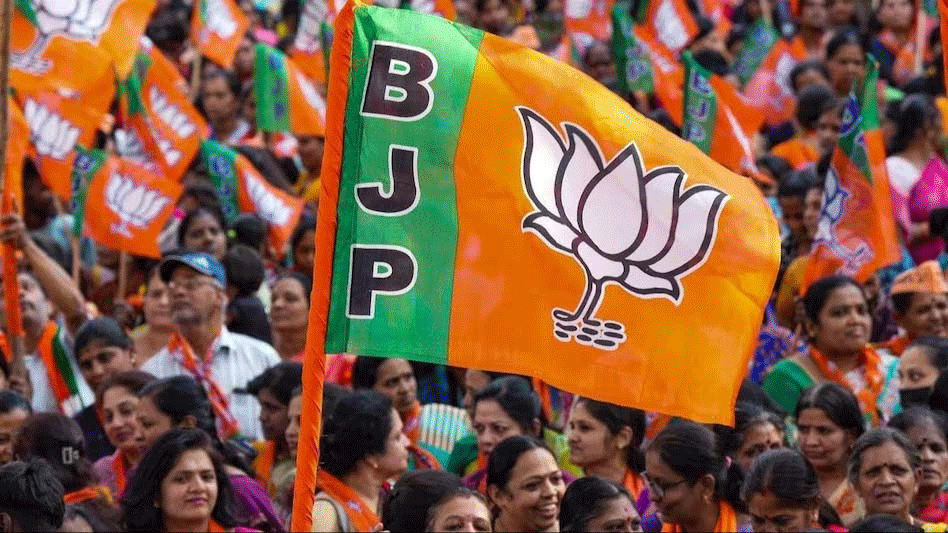
The formation of the governments of the BJP in West Bengal, Assam and Puducherry after a spectacular victory reiterated once again the fact that the party, with all its drawbacks, has been successful in mobilising public opinion towards good governance and upholding intrinsic Indian values through propagation of Hindutva. The unanticipated number of seats that BJP captured in Bengal and the absolute majority in Assam despite the anti-incumbency factor, are indeed notable achievements. All predictions regarding the BJP getting the number of seats in Bengal were belied as the party surged ahead with a two-thirds majority, winning 207 seats, which even most party insiders and analysts did not quite expect.
In Modi’s third term, the striking story has been the receding space of regional parties, particularly in Eastern India – BJD in Odisha, TMC in Bengal and even the AAP in the national capital. Defeats of TMC in Bengal and Congress in Assam show that a successful opposition to the BJP must go beyond narrow identity-centric narratives. In fact, the saffron party has been successful in integrating its own Hindutva with broader nationalism, thus allowing ambitious politicians from non-RSS streams to join in.
In Bengal, the biggest news was the defeat of the former chief minister, Mamata Banerjee at the hands of BJP leader Suvendu Adhikari, who has been made the new chief minister. The two factors that were responsible for dislodging the TMC government are known and may be attributed to corruption and joblessness along with a profound sense of hopelessness. The subsidies dished out failed to win the confidence of the people, particularly the youth.
The BJP’s aggressive campaign over minority issues and the issuance of land deeds to the families of tea plantation workers in Assam helped the party consolidate its traditional support base. The Opposition failed to set up a strong narrative around an alternative agenda of governance. Not just in Bengal but in Assam too BJP’s stunning victory raises concerns about increasing polarisation.
The credit for the victory in these states obviously goes to the image of Prime Minister Modi who is considered a father figure of the saffron dispensation. Whether the projection of Modi or the marshalling of the ground-level RSS workers or the disgust with the corruption-laden TMC in Bengal helped the BJP in its outstanding victory in the state or whether all these factors together in routing the ruling party here will be analysed by political scientists in the days to come. Union Home Minister Amit Shah also put in a lot of effort by gearing up the organisational machinery and uniting all groups and factions within it.
It is good to hear that Modi has repeatedly referred to the late Dr. Shyama Prasad Mookerjee and rightly stated that the party’s victory in Bengal was the fulfilment of his vision. He expressed the hope that the state would emerge as an industrial state, as envisioned by the first chief minister, Dr. B. C. Roy. Whether the template of industrialisation, which once found manifestation here, will witness a resurgence with Bengal’s inherent strengths remains to be seen but the new government has vowed to make this true.
Critics may say that the results show consolidation of Hindu votes, but the so-called secular parties have done little for the Muslim community over the years – neither by educating them and bringing them into the mainstream of life and society or even by projecting religion in the right manner. Mamata’s minority appeasement faced a backlash and her last-minute initiative to construct temples did not go well with the people.
Despite people’s mandate to the BJP, there’s a need to analyse the saffron party’s performance. Though it has done lot of work in developing the physical infrastructure, the work in the social infrastructure segment remains much to be desired. The health sector has been neglected as most states do not have funds to equip the sub-divisional and block hospitals with the Centre not taking any initiative. However, it’s good to hear the Central scheme of Ayushman Bharat, which was resisted by the TMC government, will be implemented in the state at the first cabinet meeting. In education, the situation is the same with the BJP government not coming up with at least one model school in every sub-division.
However, in recent years, there has been some change in its outlook towards the marginalised sections that is the tribals, the OBCs and the Dalits. But funding for state universities, more scholarships for research, ensuring a free atmosphere in higher educational instructions and giving them power without State interference remains to be done. It can’t be denied the party has done little for impoverished and marginalised segments and uplifting their conditions.
The main challenge for BJP in Eastern states would be providing employment opportunities to the youth and improving workers condition in the informal sector. This indeed is a herculean task but it’s expected BJP will come up with the right strategy of promoting labour-intensive sectors. Unfortunately, some of the finest scholars, including engineers, doctors, managers etc. are leaving the state as employment opportunities don’t exist and they are building careers in Bengaluru, Mumbai, Hyderabad and even abroad. The electorate has voted for this to end.
The Eastern sector, including Bihar and Odisha will all be ruled by the saffron party, which needs to weave a proper strategy. Already Odisha is showing spectacular results, and the Centre is focussing its attention on that state, which a few years back, was considered backward.
Another big challenge which the BJP, at least in Bengal, will find success is the rooting out corruption from the grassroots to the upper levels. Honest officers, both in the administration and in the police, will have to be appointed in key positions while in municipalities and panchayats there has to be rigorous monitoring of corrupt dealings and practices. If corruption is brought down – and it is understood that both in Bihar and in Odisha this has been possible, there is hope for Bengal.
However, the new BJP government has to take over a huge debt of around Rs 8 lakh crore left over by the TMC government. Plus, the question of giving DA to state government employees as per Central government levels, and upheld by the Supreme Court, must be considered. Meanwhile, the effects of US war on Iran will also affect all the states and the possibility of inflation can’t be ruled out.
The change that is expected, not just by the people of Bengal but also of Assam and Odisha would put a further challenge on BJP and it must rise to the challenge by identifying the problems and fixing priorities. A democratic system must function not from the top but from the panchayat levels and identifying and solving the problems of the common man.
Finally, it needs to be said that where religious demography is changing adversely for Hindus, and this includes Bengal Assam and Kerala, BJP will probably occupy centre stage. But development also must occur and people are eagerly awaiting whether the BJP would be successful in showing the way for a better future. —INFA
 Follow our WhatsApp channel
