

Ashok Ogra
ashokogra@gmail.com
For a long time, the Bengali voter has been associated with a strong cultural orientation-often identifying more with culture,debate and political engagement than being defined primarily through a religious lens. Material ambition and overt displays of wealth were also often viewed with some restraint.
Politics in Bengal has not been confined to formal institutions; it has also found expression in literature, theatre, music and everyday conversation. This helps explain the continued popularity of literary and film festivals, as well as book fairs, which attract large crowds, often exceeding the attendance seen in cities such as Delhi. Intellectual self-image invariably triumphs economic pragmatism.
This identity has developed over time, shaped by phases such as the Bengal Renaissance and figures like Rabindranath Tagore.
However, this cultural and intellectual orientation has, in recent years, been accompanied by a growing sense that economic outcomes have not kept pace. This has contributed to a widening gap between its ‘legacy identity’ and its ‘present-day competitiveness’ (advertising guru, Partha Sinha, phrase).
Now, the state’s political journey appears to have come full circle. There was a time when Marxist thought shaped much of public discourse, Bengal became associated with the Naxalite movement, and right-wing politics or market-oriented economics remained limited in appeal. Today, however, the state appears more open to aspiration, entrepreneurship, economic growth along with a wider acceptance of the BJP as a major political force.
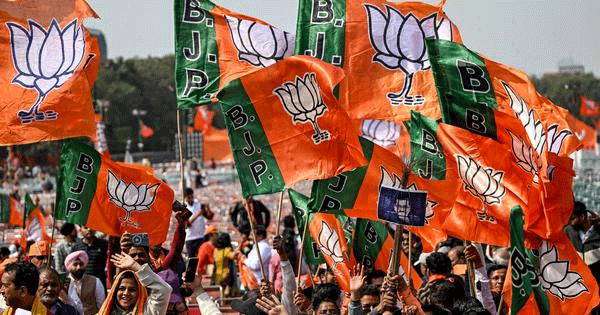
The 2026 election verdict in favour of the right-wing politics of BJP point to a shift in voter priorities. This change reminds one of George Bush Sr who, pithily remarked, ‘People vote with their pocketbook.’
A a sense of fatigue during the tenure of the TMC created space for this change. Economic concerns: employment, income, governance quality, corruption and law and order-have gained urgency. In addition, issues such as illegal migration and minority appeasement too became part of the political discourse – though they operated alongside broader economic concerns rather than overshadowing them.
Remember, this shift on the part of the voter does not represent a permanent break from Bengal’s past. As noted, political scientist Partha Chatterjee has argued, language, literature and everyday practices form an “inner domain” that continues to shape political understanding. Cultural identity remains a steady influence; what has changed is the relative weight given to economic concerns in voter decision-making.
It is true that the state has recorded a significant reduction in the proportion of people living below the poverty line. According to data for 202425, West Bengal has an estimated 8.06% of its population below the poverty line. This is notably lower than comparable figures for Bihar (26.59%), Uttar Pradesh (17.40%), and Madhya Pradesh (11.61%), states that have been governed by the BJP or BJP-led alliances for an extended period.
Also, as per the economic survey presented in February 2025, West Bengal’s fertility rate is around 1.6, closer to developed states like Tamil Nadu and Kerala, which have completed the demographic transition. In contrast, Uttar Pradesh records about 2.4, and Bihar close to 3.0.
However, the economic backwardness and contrast become clearer through other basic indicators. West Bengal’s per capita income as per the date of 2023-24, is about Rs.1.57 lakh. In comparison, Tamil Nadu reports around Rs.3.50 lakh, Karnataka around Rs.3.31 lakh, and Maharashtra above Rs.2.89 lakh. However, Bengal’s per capita income remains higher than Bihar (around Rs.59,000) and Uttar Pradesh (around Rs.96,0000), placing it in an intermediate position within the national economy.
Similar dismal story is seen in FDI Inflows (October 2019 to March 2024): Bengal receiving a paltry $1.69 billion as compared to Maharashtra, which received $69.08 billion, and Karnataka $51.03 billion.
No wonder, employment trends reinforce this contrast. Cities such as Chennai, Pune, Hyderabad, Delhi, Bengaluru and Mumbai continue to attract investment and generate formal employment at scale. In West Bengal, a larger share of employment remains informal, and migration to other states continues, particularly among younger workers seeking better opportunities. Over time, this movement of workers has become a regular feature of the state’s economic pattern.
It is useful to recall that the Bengal region once held a central position in global trade and prosperity. Murshidabad was a major centre of trade and finance, often compared with leading cities of its time. Its decline began after the Battle of Plassey (1757), when power shifted to the East India Company and later to Kolkata. With this shift, Kolkata emerged as the principal colonial capital and economic centre of British India.
At its peak, Calcutta was described as the “second city” of the British Empire. Its administrative systems, legal institutions and urban layout reflected British influence. Its large buildings and avenues led to the description “City of Palaces.” It functioned not only as a centre of governance but also as a hub of commerce, finance and intellectual activity, attracting merchants, professionals and scholars.
Sadly, over time, this position weakened. The division of Bengal, followed by the famine of the 1940s and later Partition, brought significant disruption. In the years after Independence, Kolkata faced further challenges, including loss of hinterland, labour unrest and slower industrial growth. Economic activity gradually shifted to other regions, reducing its relative importance.
The immediate focus, therefore, for the new government is governance-improving administrative efficiency, supporting investment, expanding employment, addressing corruption and maintaining social balance. Also, the issue of the illegal migration too needs clear policy direction and effective implementation.
Expectedly, the attention now turns to new leadership. The choice of Chief Minister will influence how this shift is reflected in governance. Inexperience, as seen in the case of Rekha Gupta in Delhi, or concerns regarding past reputation, as associated with Samrat Choudhary in Bihar, have raised questions about leadership selection processes. Whether these perceptions are fully justified or not, they underline the importance of credibility, maturity and administrative experience in leadership roles.
Meanwhile, there has to be genuine acknowledgment in Delhi that Bengalis of today who voted for BJP are seen as people engaged as much with ideas and culture as with material concerns. They treasure political protests, debates, discussions, and dissent as it supplies necessary oxygen to keep the locals going.
Therefore, the larger challenge lies in aligning Bengal’s socio-political and cultural strengths with economic activity and rising aspirations, so that identity and development complement rather than remain separate from each other.
Fortunately, there appears to be a growing openness and acceptance- particularly in economic terms-towards a more pragmatic outlook, often associated with the Chinese communist ideologue, Deng Xiaoping and the phrase linked to him: “To get rich is glorious.”
It is hoped such a balance may help restore some of the prominence that Bengal (West) and Calcutta (Kolkata) historically enjoyed.
(The author works for reputed Apeejay Education, New Delhi)
 Follow our WhatsApp channel
