

Pushp Saraf
pushpsaraf@yahoo.com
Pakistan’s south-western province of Balochistan remains on fire. That grim reality was brought home once again when a suicide bomber struck a shuttle train in Quetta on May 24, killing at least 24 Pakistani security personnel and their family members. The attack is the latest in a sustained and deliberate pattern of strikes targeting trains, security forces, and critical infrastructure. There is no sign of abating.
The violence, however, is only one dimension of a crisis that has now acquired an unmistakably political character. In a measured but consequential speech at a function in Lahore on February 8, veteran Baloch leader Sardar Akhtar Mengal triggered what can only be described as a political earthquake. Pakistan, he declared, had gone beyond the “point of no return” on Balochistan, and the two should now “live like good neighbours”. Coming from a man who spent years working within Pakistan’s constitutional framework, the words carried extraordinary weight. It is a barely veiled argument for peaceful separation.
Islamabad had, in fact, long been warned. Mengal had consistently pleaded for a political solution to the Balochistan crisis, only to be ignored. On September 3, 2024, he resigned from the National Assembly in protest against what he called the “systemic marginalisation” of the province. Pakistan’s response was characteristically brusque. It formalised his exit by accepting his long-pending resignation on February 11 – three days after his Lahore speech. There was no attempt at outreach or reconciliation. By shutting the door on one of the most moderate and persistent Baloch voices, Islamabad has deepened a political challenge it seems increasingly ill-equipped to manage.
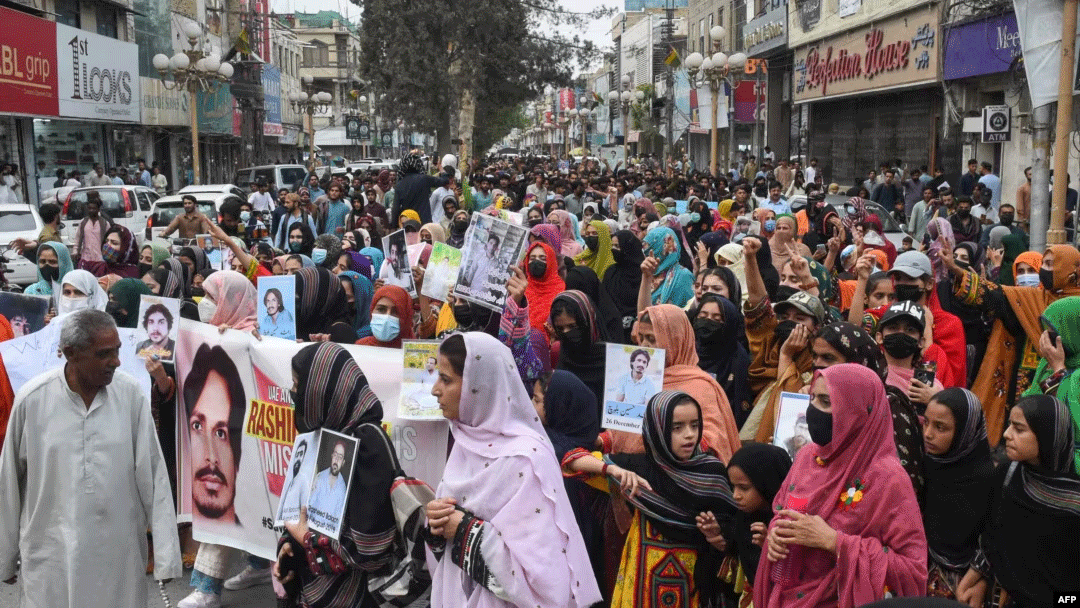
A parallel story of courage and consequence is that of Mahrang Baloch, the popular woman human rights activist who has remained behind bars since her arrest on March 22, 2025. Her imprisonment, which in effect is punishment for campaigning against enforced disappearances and other abuses, has drawn global attention and condemnation. She is widely regarded as one of the bravest women in the world today and has been nominated for the Nobel Prize.
Shutting doors on everyone
Together, the fates of Mengal and Mahrang Baloch illuminate a broader and more troubling pattern. Pakistan has estranged not only its older, constitutionalist Baloch leadership but also the province’s younger generation. This generation is more assertive in its demands for genuine political participation, democratic space, and a fairer share of the prosperity generated by Balochistan’s vast mineral wealth. It is not afraid to confront the symbols of the Pakistani state or its Chinese allies working on joint projects.
That estrangement found its most violent expression in the opening weeks of 2026, when the Balochistan Liberation Army (BLA) launched a series of coordinated attacks across multiple districts. Schools, hospitals, banks, markets, security installations, police stations, a high-security prison, and civilian areas were all targeted. On January 23, the BLA killed 48 Pakistani nationals, including 31 civilians, drawing rare condemnation from the United Nations Security Council. Pakistan responded with a full-fledged military operation from January 30 to February 5, claiming to have eliminated 216 militants at the cost of 22 security personnel.
As is invariably the case in such conflicts, Islamabad and the BLA have offered sharply divergent accounts of casualties on both sides. What neither side disputes is that the week was among the deadliest in recent memory in terms of the intensity of the fighting, the scale of the violence, and the human cost on all sides. The BLA is the region’s most powerful militant outfit, which is fighting for an independent Baloch state. Of all the militant organisations operating in the province, it remains the largest and most capable, and it moves in step with a local sentiment that is deeply and openly hostile to the Pakistani state.
The United States Congressional Research Service describes it as an ethnic-based separatist group numbering several thousand armed militants, one that employs guerrilla warfare tactics including strikes targeting Chinese nationals and China-funded projects in the province. In April this year, the BLA announced a significant expansion of its operational reach – a new naval wing called the Hammal Maritime Defence Force, named after Mir Hammal Jiand, a 16th-century Baloch hero said to have resisted Portuguese naval incursions. The wing wasted little time in making its presence felt. On April 12, 2026, it claimed its first strike with a swift attack on a Pakistani security patrol craft near the strategic coastal town of Jiwani.
One conclusion is becoming increasingly difficult to ignore: Pakistan has failed to establish its writ in one of its most resource-rich provinces. Worse, it appears to have methodically burnt the bridges between the state and the Baloch people bridge by bridge, leader by leader, gesture by gesture. What that portends for the region, and for Pakistan itself, demands careful examination. Peace has become the most serious casualty of all. The situation is now widely described as the worst human rights and security crisis in South Asia.
Politically adrift, clueless
On the political front, Pakistan is equally adrift, with no discernible strategy for dealing with figures like Sardar Akhtar Mengal and Mahrang Baloch.
Mengal inflicted serious and lasting blows on Pakistan’s body politic at a conference held in Lahore to commemorate the memory of human rights activist Asma Jahangir. He spoke of repression and enforced disappearances, of torture and the absence of democracy, and of Pakistan’s compulsion to resolve every dispute through brute military force in a system that resembles military rule in all but name. His words have continued to echo across Pakistan, and most sharply in Balochistan itself.
Three of his utterances, in particular, have acquired a life of their own. The first: “It is better that some distance remains between us. Instead of living under one roof, tearing at each other’s flesh, chewing each other’s bones, and throwing each other’s children into the fire of a furnace, it is far better that we separate and live as peaceful neighbours.” The second: “You accuse them of being terrorists, but when a system relies solely on military brute force, torture, and enforced disappearances, what other path is left for the youth?” And the third which is perhaps the most resonant of all was not even his own words but a slogan borrowed from history: “Yaha Hum Sahi, Waha Tum Sahi” (“We are right here, you are right there”). This was a phrase that rang across undivided Pakistan at the time of the creation of Bangladesh in 1971.
This was a new Sardar Akhtar Mengal. He had clearly travelled a long and disillusioning distance from the man who once lamented, not so long ago: “The Baloch militants consider me a traitor while the security establishment also treats me as an enemy.” That earlier Mengal was a man trapped between two worlds, still hoping the state would hear him. The Mengal who spoke in Lahore had stopped hoping. Pakistan had not driven him underground or into exile; it had done something more consequential: it had driven him out of belief in the possibility of a shared future.
Then there is Mahrang Baloch, leader of the Baloch Yakjehti Committee, who remains at the receiving end of what can only be called ruthless institutional oppression. She continues to be held in detention on shifting pretexts, tried inside prison without access for the media or independent observers, and repeatedly denied bail even as her family has raised serious alarm about a significant deterioration in her health. The opacity surrounding her treatment has been near total. The one slender silver lining is that democratic forces and human rights advocates across the world have refused to look away. Their sustained vigilance appears to have ensured that she has been nominated for the Nobel Peace Prize.
Mahrang herself has responded with characteristic selflessness. In a post on X, she wrote: “I am deeply honoured by this nomination, but it is not about me. It is about the thousands of Baloch who have been forcibly disappeared and the families demanding justice.” She added that she and her partners in struggle would “continue our peaceful resistance.”
It is a sentence worth pausing on. Pakistan would do well to recognise what a fragile and precious thing that is. Provinces do not burn all at once. They burn slowly, quietly, and then all at once. And the fire in Balochistan has been burning for a very long time.
 Follow our WhatsApp channel
