

Pushp Saraf
pushpsaraf@yahoo.com
When this writer first visited the Pakistan-occupied territory-locally referred to as “Azad” Jammu and Kashmir (“AJK”)-in 2000, Raja Muhammad Farooq Haider Khan was a close political aide to the late Muslim Conference (MC) stalwart Sardar Abdul Qayum Khan. Much has changed on both sides of the Line of Control (LoC) since then. Today, Farooq Haider is a leading figure in the “AJK” chapter of the Pakistan Muslim League (Nawaz) (PML-N), which heads Pakistan’s ruling coalition. In the intervening years, he also served a term as the PML-N “Prime Minister” of “AJK”.
His political journey is perhaps the clearest illustration of how the region’s politics have evolved over the past two decades.
The visit to PoK was occasioned by the wedding of Sajjad Lone-son of the charismatic Kashmiri leader Abdul Ghani Lone-to Asma, daughter of Jammu and Kashmir Liberation Front (JKLF) founder Amanullah Khan. The celebrations and receptions surrounding the wedding provided a rare opportunity to interact with almost the entire political leadership of the occupied territory as well as prominent figures from Pakistan. Sajjad’s elder brother, Bilal, and his wife, Farhat, lived up to the family’s tradition of hospitality despite the challenging circumstances. Among the distinguished guests at the Walima receptions in Islamabad were Vijay Nambiar, the then Indian High Commissioner to Pakistan, and his wife.
It was evident that the entire activity – visas included – carried the quiet blessings of Prime Minister Atal Bihari Vajpayee and Pakistan President Pervez Musharraf, both then willing to give peace a chance by encouraging people-to-people contact. When the elder Lone was assassinated at Srinagar’s Idgah ground on May 22, 2002, Vajpayee paid an emotional tribute, saying he was killed “because he was working for peace.” Sajjad is a prominent legislator today.
Relentless interference
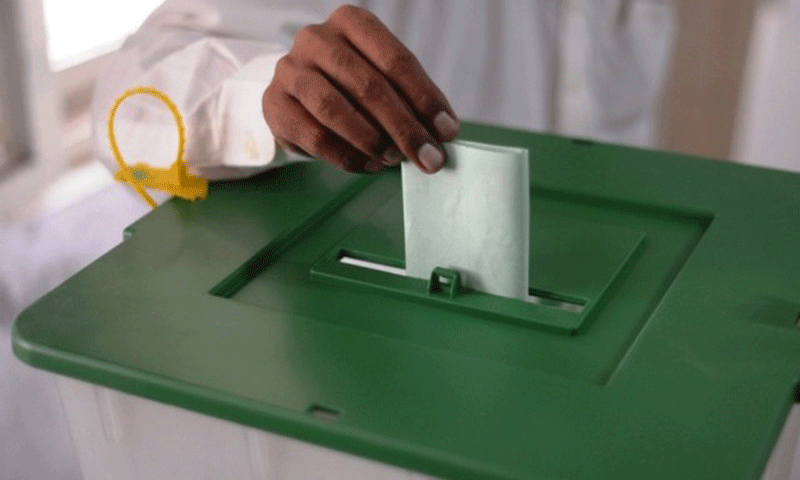
The trajectory of Farooq Haider comes to mind as “AJK” heads toward scheduled Assembly elections in July. Pakistan’s relentless interference in the territory’s politics has steadily hollowed out the MC and erased all signs of secularism. Its three mainstream parties enter the contest armed with perks, patronage, media access, money, and organisational muscle – enough to lure away all but the most steadfast local politicians. The MC possesses none of these advantages. Its current leader, Sardar Attique Ahmed Khan – son of Sardar Abdul Qayyum Khan and himself a former “PM” – is left struggling to preserve a fading legacy.
A pattern has thus hardened into political doctrine: whoever rules in Islamabad ultimately installs his own man in Muzaffarabad. The result is that the MC – once the pre-eminent party of the undivided princely State of Jammu and Kashmir before 1947 – has been reduced to a pale shadow of its former self. There is a bitter irony the party must now confront: it cast its lot with Pakistan, and Pakistan has nearly erased its identity.
The evidence of Pakistan foisting its favourites on the region stretches back more than a decade. In 2011, with Asif Ali Zardari as the country’s President, the Pakistan People’s Party (PPP) swept the “AJK” Assembly elections, propelling local party chief Chaudhary Abdul Majid to the office of “PM” and ending the MC’s hold on power. Five years later, with Nawaz Sharif’s PML-N firmly entrenched in Islamabad, it was the turn of the party’s local chapter to triumph. Farooq Haider assumed office as “PM” following the 2016 elections.
By 2021, Pakistan’s political landscape had changed considerably. Imran Khan, the cricketer-turned-politician who came to power in 2018, did not disturb the PML-N government in “AJK” before the completion of its Assembly term. His Pakistan Tehreek-e-Insaf (PTI) had spent those years methodically building its local organisational machinery. When the elections arrived, PTI emerged victorious, and its nominee Sardar Abdul Qayyum Niazi took office as “PM”. His tenure, however, was short-lived as intra-party rivalries intensified alongside Imran Khan’s own political troubles in Islamabad following his fallout with the military establishment.
Turmoil in Imran’s party
The PTI’s local unit faced turmoil after the party lost power in Pakistan, with Imran Khan becoming the country’s first Prime Minister to be removed through a no-confidence motion. In the ensuing instability, Sardar Tanveer Ilyas replaced Niazi in 2022. The emergence of the PPP-PML-N coalition government in Pakistan further unsettled the region’s politics. In 2023, Chaudhry Anwar ul Haq, a founding member of PTI, defected and became “PM” with the backing of the PPP, the PML-N, and other defectors.
Today, the PTI’s “AJK” chapter stands deeply fragmented, including within the legislature itself. One of its breakaway factions has since formally affiliated with the PPP, helping prop up the government of Faisal Mumtaz Rathore, which has been in office since November 18, 2025.
In February, the entire opposition – PML-N included – briefly made common cause to bring down the PPP government. The effort produced noise but little else; the alliance could not advance beyond a joint press conference. The PPP clings to a wafer-thin majority in the legislature. The episode has at best generated some friction between the two parties at the local level. It has done nothing to disturb their relationship in Islamabad, where the PML-N-led government continues to enjoy PPP support from outside.
The two parties, governing together in Islamabad, will in all likelihood script the narrative of the coming “AJK” polls. They will probably play friendly adversaries, careful not to let their contest in the territory destabilise their arrangement at the centre. What both know – and what is well understood by all serious observers – is that neither will be permitted to cross certain lines by the military, which has repeatedly usurped political power in Pakistan. The army’s overriding priority at the moment appears to be the complete political isolation of Imran Khan, whom it holds responsible for the May 9, 2023 attacks on its installations, attributed to supporters enraged by his arrest. The PTI, in this climate, is unlikely to be given any meaningful room in the “AJK” polls.
Mass movement
That the elections will be held on schedule is now widely assumed, following the long-delayed appointment of Justice (retired) Ghulam Mustafa Mughal as Chief Election Commissioner on February 20. The vacancy had gone unfilled for over a year.
The most striking feature of the territory’s current political spectrum lies, for the moment, outside the formal party system altogether. A powerful civil pressure group, the Jammu Kashmir Joint Awami Action Committee (JKJAAC), has emerged as a force capable of commanding the kind of public mobilisation that conventional political parties can only envy.
The JKJAAC has rallied mass support around a set of bread-and-butter issues: the abolition of elite privileges enjoyed by ruling politicians and bureaucrats, reductions in wheat, flour, and electricity prices, free education and healthcare, and greater investment in infrastructure. Every strike call issued by the organisation has effectively brought the region to a standstill, underscoring both its reach and its organisational strength.
One of its demands carries particular electoral significance – the abolition of the twelve Assembly seats reserved for Kashmiri refugees residing in Pakistan. These seats, critics argue, tilt the contest in favour of Pakistan-based parties, whose reach and resources allow them to mobilise refugee voters at will, leaving regional outfits like the MC, with no comparable machinery, at a structural disadvantage. For now, the JKJAAC has kept its distance from electoral politics. But if it eventually decides to enter the fray, it could well emerge as a formidable dark horse.
 Follow our WhatsApp channel
