

K D Maini
kdmainipoonch@gmail.com
Hill Kaka is a lost inhabited village in the foothills of Tatakutti (15,650 ft), the highest peak of the Pir Panjal Range of mountains, which bifurcates the Kashmir Valley from the Poonch-Rajouri districts. It is an isolated habitation in the center of the 65 km long “Hill Kaka Bowl,” which starts from Bagla Hill on the top of Chandimarh in the east to Sunkh Top towards Mandi on the western side, and 47 km in breadth from Bhawan Top in the north to the Ranjati Range in the south. This bowl-shaped area is surrounded by snowy peaks, thick forests, green meadows and pastures, the crystal-clear waters of the Akal Katha stream, wanderings of wild animals, and the whispering of forest birds.
Except for Hill Kaka village, where 95 families of Kalas Gujjars, a few Paharis, and Kashmiris reside permanently, this bowl remains largely uninhabited. However, there are 127 Dhoks (clusters of small hutments made of wood and mud) in the forest area where grazers and tribal families reside during the summer season. They enter the Hill Kaka Bowl at the beginning of spring with their families, cattle, flocks of sheep, herds of goats, fleets of horses, baggage, and dogs, and settle in their allotted Dhoks. As per one estimate, about 15,000 tribals, grazers, and shepherds migrate every year to the forest area of the Hill Kaka Bowl during summer. They live there for about five months and enjoy a tension-free life, cool climatic conditions, and a natural atmosphere before returning to their native villages in Mendhar, Surankote, and Balakote areas with the onset of autumn. However, after 1998, the Hill Kaka Bowl came into the limelight when foreign militants converted this bowl into a battlefield.
Poonch-Rajouri district had remained under the grip of Pakistan-sponsored militancy from 1990 onwards. However, after the successful conduct of Assembly elections in Jammu and Kashmir during 1996, in which Farooq Abdullah’s NC Government came into power, the new government involved the youth of this area in developmental activities on a large scale and also provided employment avenues. Due to this, the alienation factor among the public was reduced to a great extent, and militants lost their support. Therefore, it became difficult for militants to strike and survive in the villages without the help of locals.
In this context, the militants shifted from the villages of Rajouri-Poonch and took refuge in the vast depopulated area of the Hill Kaka Bowl. They established their command center in Lal Dhok and renamed their terrorist organization as the Pir Panchal Regiment, with its headquarters in Hill Kaka village. They also set up 47 training camps in the Dhoks of the Hill Kaka Bowl, ranging from 5 to 15 youths in each camp. Simultaneously, they started recruiting youth for militancy purposes. Whoever resisted was killed. Fazal Din Tahir (who recently passed away) of Marah village was the first person who openly revolted against the militants along with his followers and established his own organization under the name of Pir Panchal Scouts, enrolling tribal youth to fight militancy in the area. Later on, two more such groups were organized against militants in Marhote and Sangla villages, the exit points towards the Hill Kaka Bowl.
Around the year 2000, the prominent persons of the tribal community residing in Pir Panchal were fed up with the militancy scenario because people were being harassed by the militants. Therefore, a group of such prominent persons met the Deputy Prime Minister and Home Minister, Lal Krishna Advani, apprised him of the deteriorating situation in the Hill Kaka Bowl, and requested safety measures. In response, the central government ordered the defence forces to flush out the terrorists from the area. Accordingly, a dynamic, brave, and courageous Major General H.S. Lidder (who later retired as Lieutenant General) was posted in the ROMEO Force to combat terrorism in the Rajouri-Poonch area and took action against militants in the Hill Kaka Bowl. General Lidder had already worked as Brigade Commander in the Poonch area and was familiar with the local realities. Therefore, after receiving orders, he immediately started working against the activities of militants in the Hill Kaka Bowl, from where they were targeting not only Rajouri-Poonch district but also the Kashmir Valley.
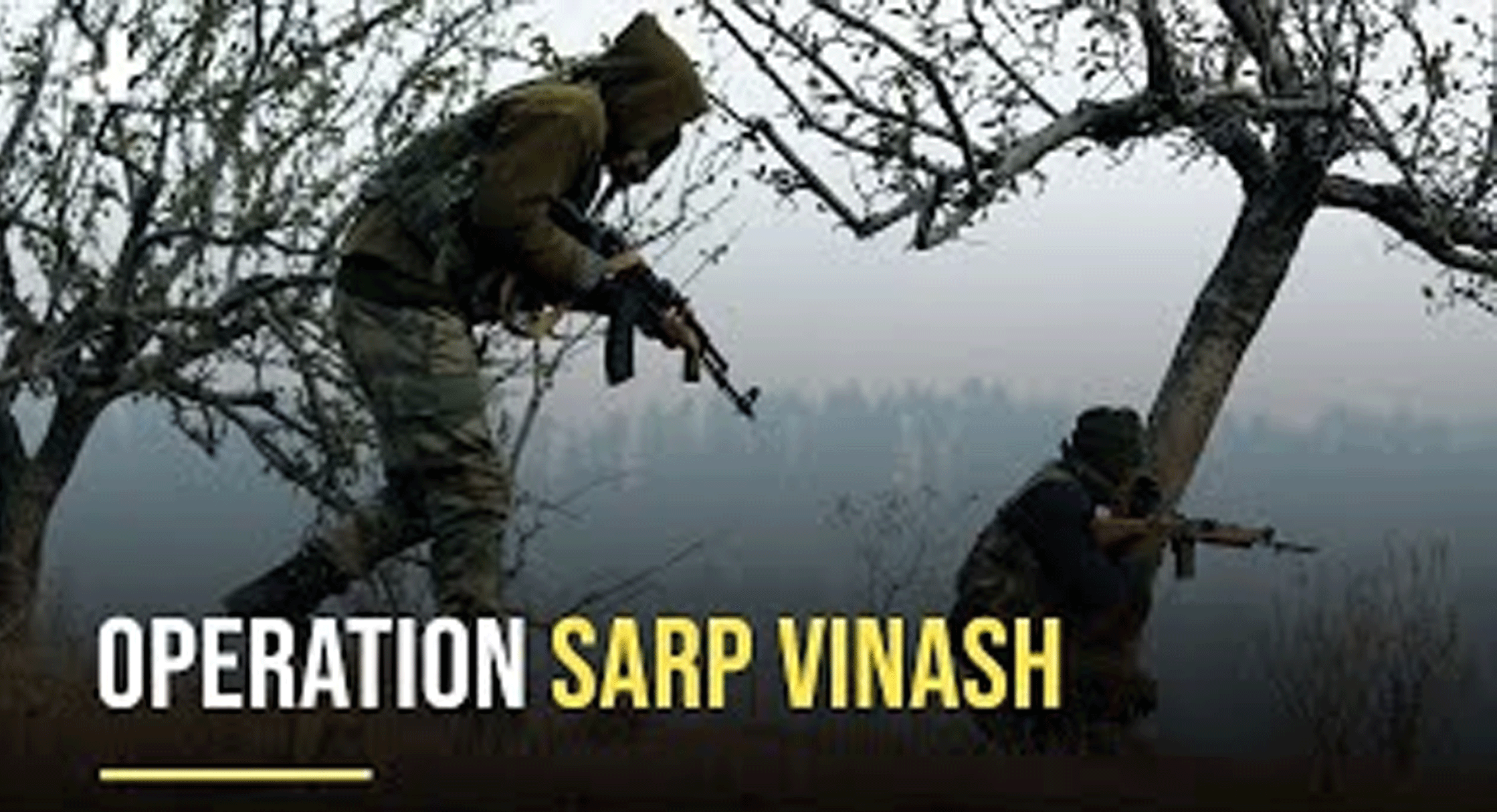
General Y.M. Bomai writes in his book War Against Insurgency and Terrorism in Kashmir that General Hardev Singh Lidder conceived a well-planned operation under the name of “Sarpvinash,” which was carried out in the Hill Kaka Bowl. It was a large-scale and highly successful operation in which the help of the Air Force was also taken. The final operation was planned, and forces moved on 26th January 2003 from Ranjati, Dosafli, and Marhote to seal the routes of militants leading towards Hill Kaka, with the help of the Air Force and local groups of Pir Panchal Scouts, including the main group of Fazal Din Tahir of Marrah.
During the winter of 2003, the ROMEO Force received information about the presence of a large number of militants along with their commanders in the Hill Kaka Bowl. Therefore, the operation was started on 23rd March 2003 towards Hill Kaka. There were three main exit points leading towards Hill Kaka: first via Marhote village, second via Kalali Marrah, and third via Sangla Ranjati Top. Pir Panchal Scouts from tribal communities were deployed at these exit points under the guidance of the 16 RR ROMEO Force.
The main operation was launched on 22nd April 2003 towards Hill Kaka village, the main hideout of the Pir Panchal Regiment. The ROMEO Force moved from three exit routes towards Hill Kaka village via Marhote, Kalali, and Ranjati. After tough battles with militants and capturing their hideouts in Dhoks located in dense forest areas, the jawans of the ROMEO Force stormed the main headquarters of the so-called center of the Pir Panchal Regiment in Hill Kaka village on 23rd May 2003. After hand-to-hand fighting, five bodies of terrorists were recovered from the main hideout. Sixteen youngsters were also liberated during the final operation. Hundreds of militants escaped from the site due to the thick forests and disadvantageous terrain. Operation Sarpvinash, which started on 22nd April 2003, was completed successfully with the capture of Hill Kaka village on 23rd May 2003. Seventy-eight militants were killed during this period under the able command of Major General H.S. Lidder.
Immediately after Operation Sarpvinash, Major General H.S. Lidder took a bold step to link Hill Kaka village with a motorable road so that such a scenario might not be repeated in the future. Accordingly, within months, a 16 km motorable road from Buffliaz to Kalali was constructed. However, with the transfer of General Lidder, the further road from Kalali to Hill Kaka could not be completed.
With the capture of the Hill Kaka Bowl from mostly foreign militants in May 2003, the backbone of terrorism in Jammu and Kashmir was broken, and thereafter the militants were unable to get support from local people. In these circumstances, after assessing the situation, the then President of Pakistan, Pervez Musharraf, declared a unilateral ceasefire on the LoC on 23rd November 2003. The Government of India also welcomed Pakistan’s decision, and the ceasefire was effectively implemented. After three months, the SAARC conference was held in Islamabad on 4th January 2004, and both India and Pakistan started CBMs on the LoC. Two roads across the LoC were opened, and a new era of peace and prosperity for people living on both sides began. Peace prevailed on the LoC for about 10 years due to the successful Operation Sarpvinash in Hill Kaka village, conducted by the Army under the leadership of Major General H.S. Lidder.
 Follow our WhatsApp channel
