

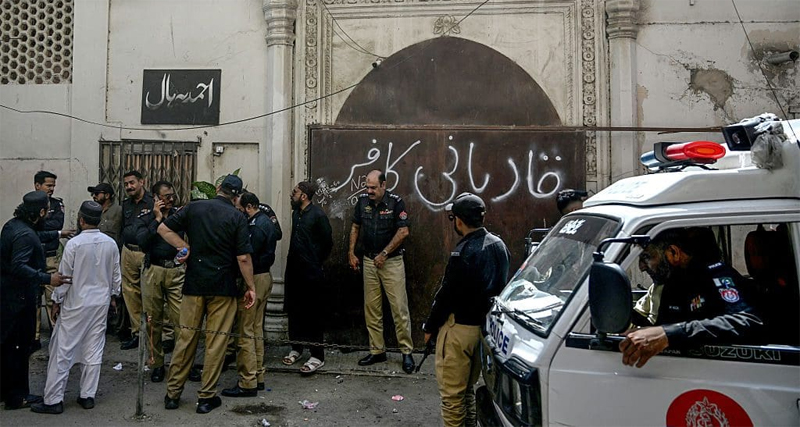
KARACHI, May 26 : Members of Pakistan’s minority Ahmadiyya community have alleged that police in Karachi are seizing their sacrificial animals ahead of Eid-ul-Azha, saying they were being targeted because of their faith.
“We have to face religious persecution and discrimination every time there is a religious festival,” community representative Amir Mahmood said.
He said members of the community in Karachi were finding it difficult to buy or keep sacrificial animals ahead of Eid-ul-Azha on Thursday due to police intimidation.
In several parts of the city, police were “illegally” confiscating animals belonging to Ahmadis because Pakistan does not recognise them as Muslims and, therefore, they cannot perform animal sacrifice during Eid, he said.
Pakistan’s Parliament declared Ahmadis non-Muslims through a constitutional amendment in 1974.
Later, during the rule of military dictator General Zia-ul-Haq in 1984, laws were introduced making it a criminal offence for Ahmadis to call themselves Muslims, “pose” as Muslims, or describe their places of worship as mosques.
The community is also barred from preaching publicly and from travelling to Saudi Arabia to perform Hajj or Umrah as Muslims.
Mahmood said state-sanctioned restrictions and threats from hardline Islamist groups have made it impossible for Ahmadis to hold public celebrations, offer communal prayers or openly perform animal sacrifice during Eid.
“Whatever we do is within our homes, but now even our animals are being seized by police,” he said.
The Ahmadiyya community differs from mainstream Islamic belief on the issue of Khatam an-Nabiyyin, or the finality of prophethood. While mainstream Muslims believe Prophet Muhammad was the final prophet, Ahmadis regard their founder, Mirza Ghulam Ahmad, as a prophet or reformer who came after him.
Videos circulating on social media purportedly showed policemen forcibly loading a goat into a police vehicle in Karachi’s Malir area, with users claiming the animal belonged to a member of the Ahmadiyya community.
There have been several incidents in the past of hardline Islamist groups attacking Ahmadiyya places of worship and homes in Karachi, while members of the community have also been killed because of their religious identity.
Human rights activists say Ahmadis in Pakistan also face workplace harassment and dismissal from jobs because of their faith.
In Pakistan, around 10 million out of the 220 million population are non-Muslims.
According to Pakistan Bureau of Statistics data released in 2021, Muslims make up 96.47 per cent of the country’s population, followed by Hindus at 2.14 per cent, Christians at 1.27 per cent, Ahmadis at 0.09 per cent and others at 0.02 per cent.
Minority communities in conservative Muslim-majority Pakistan have often complained of harassment and intimidation by extremist groups. ()PTI)
 Follow our WhatsApp channel
