

Excelsior Correspondent
NEW DELHI, May 16 : Union Minister of State (Independent Charge) for Science & Technology; Earth Sciences and Minister of State for PMO, Personnel, Public Grievances and Pensions, Department of Atomic Energy and Department of Space, Dr. Jitendra Singh today said that quantum and Artificial Intelligence (AI) sovereignty, along with indigenous ecosystems will define India’s next-generation growth.
The Minister said, India’s future growth in deep-tech sectors will depend on the country’s ability to adopt a trusted integrated approach. And this is precisely what prompted the launch of the “Research, Development and Innovation (RDI) Fund” Scheme, which is aimed at accelerating private sector participation in research and development.
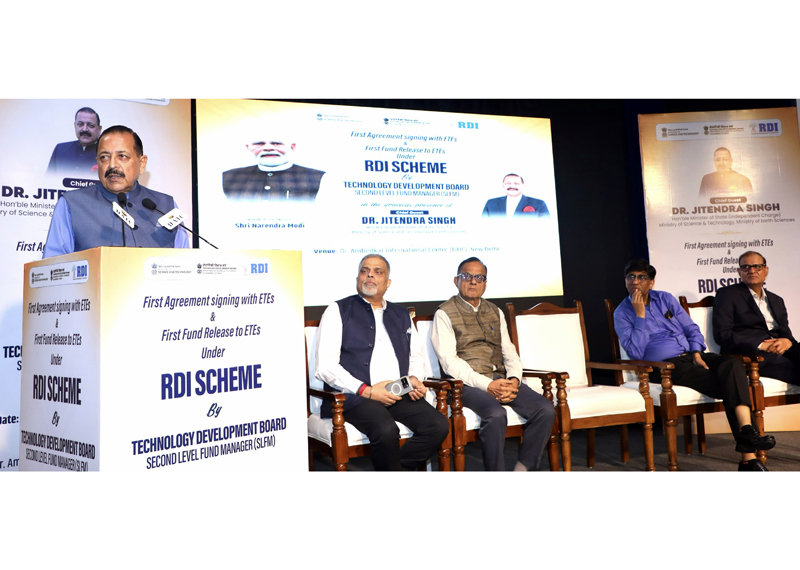
Addressing a programme organised by the Technology Development Board (TDB), Department of Science & Technology, at Dr. Ambedkar International Centre, New Delhi, the Dr Jitendra Singh highlighted that India is moving towards a new phase of innovation-driven growth through coordinated initiatives in quantum technologies, deep-tech financing and industry-led research ecosystems.
During the programme, agreements for five projects under the RDI Fund Scheme were signed, the first electronic fund disbursement under the scheme was released, a compendium on the status report of the RDI Scheme was launched and a report on “Quantum-Safe Ecosystem in India” was formally released.
M/s e-TRNL Energy Pvt. Ltd., Maharashtra, signed an agreement for the development and manufacturing of advanced Lithium-ion battery cells based on its patented 3-Dimensional Electrode Architecture (3DEA) technology. The project aims to redefine multiple aspects of lithium-ion cell design and manufacturing, including materials processing, cell architecture, compact automated manufacturing systems, and cost-efficient battery production, thereby strengthening India’s domestic battery manufacturing ecosystem.
M/s Dhruva Space Private Limited, Hyderabad, Telangana signed an agreement for “Project Garud” – an indigenous, modular, communication payload-agnostic 500 kg-class satellite platform designed for mass production and constellation-scale deployment. The project aims to establish India’s capability in scalable, flat-pack, modular satellite systems that can support resilient communication networks for strategic, commercial, and scientific applications.
M/s Eyestem Research Private Limited, Bengaluru, Karnataka signed an agreement for the development of first-in-class cell therapies targeting two globally incurable diseases – Geographic Atrophy associated with Age-related Macular Degeneration and Idiopathic Pulmonary Fibrosis. The project represents a major advancement in regenerative medicine and indigenous cell therapy platforms aimed at addressing critical unmet healthcare needs.
M/s Noccarc Robotics Pvt. Ltd., Uttar Pradesh, signed an agreement for the development of the Intelligent Mobile Life Support System (iMLSS), a portable ICU-grade emergency and critical care platform designed specifically for Indian conditions. The system integrates advanced ventilator support, patient monitoring, AI-assisted clinical guidance, multilingual voice support, and connected healthcare capabilities to strengthen emergency and rural healthcare delivery.
M/s EndureAir Systems Private Limited, Noida, Uttar Pradesh signed an agreement for “Project Sabal-200,” an indigenous unmanned helicopter platform capable of carrying payloads exceeding 200 kilograms. Designed for high-altitude and rugged operational environments, the system is expected to support logistics, disaster response, surveillance, and strategic applications through advanced propulsion and endurance technologies.
Principal Scientific Advisor to the Government of India, Prof. Ajay Kumar Sood, described the RDI Fund as a potentially transformative initiative capable of catalysing large-scale private investment in deep-tech research and innovation.
Secretary, TDB, Rajesh Kumar Pathak, highlighted the rapid operationalisation of the RDI initiative and stated that TDB became the first Second Level Fund Manager to launch project proposal calls, sign agreements and release funds under the scheme.
The programme was attended by Principal Scientific Advisor to the Government of India, Prof. Ajay Kumar Sood; Secretary, Department of Science & Technology and Chairperson, TDB, Prof. Abhay Karandikar; Secretary, TDB, Rajesh Kumar Pathak; senior officials, members of the TDB Board, investment committee members and representatives from industry, StartUps and research institutions.
 Follow our WhatsApp channel
