

Doctrine of restitution, unjust enrichment invoked
Orders refund of Rs 2.61 cr excess payment
Mohinder Verma
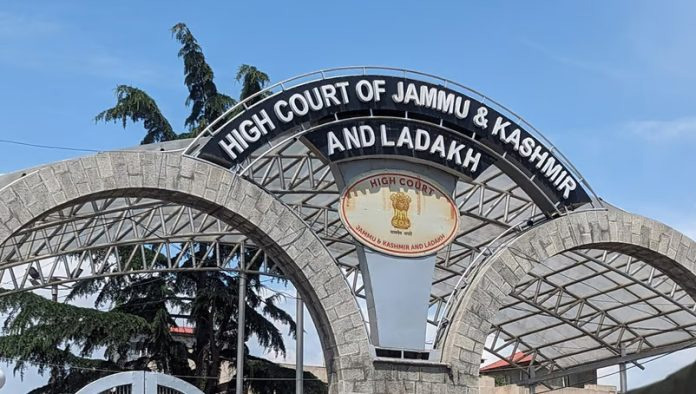
JAMMU, May 8: Observing that no person can be permitted to retain a benefit not legally due to him and that allowing retention of excess compensation would amount to clear unjust enrichment at the cost of public funds, the High Court of Jammu & Kashmir and Ladakh has upheld recovery of over Rs 2.61 crore paid in excess in a land acquisition case related to the Srinagar-Jammu National Highway project.
Justice Wasim Sadiq Nargal ruled that the doctrine of restitution, embedded in Indian jurisprudence, mandates restoration of any amount received beyond lawful entitlement and held that public money must not be allowed to remain with a private party beyond lawful entitlement.
The High Court upheld the orders passed by the Principal District Judge, Anantnag, directing Ali Mohammad Dar of Sangam to deposit Rs Rs 2,61,34,972 along with 6% annual interest within one month, failing which the amount shall be recovered as arrears under the Land Revenue Act.
The High Court further observed that the petitioner had invoked Article 227 jurisdiction on false and flimsy grounds despite absence of any perversity, jurisdictional infirmity or patent illegality.
The petitioner had challenged two orders passed by the Principal District Judge, Anantnag, whereby an application filed by the National Highways Authority of India seeking recovery of excess compensation was allowed and the subsequent review petition was dismissed.
According to the petitioner, land measuring 6 kanals and 2 marlas, along with structures at Sangam, Bijbehara, had been acquired for four-laning of the Srinagar-Jammu National Highway and the compensation awarded by the Reference Court in 2014 had already attained finality up to the Supreme Court.
The petitioner argued that an amount of Rs 1,02,54,693, paid towards demolition of structures, was not part of compensation and had wrongly been treated by the trial court while calculating excess payment. It was also contended that the lower court had become functus officio after the award attained finality and, therefore, could not entertain proceedings under Section 151 CPC.
Rejecting these arguments, Justice Nargal said the trial court had not reopened or modified the award but merely exercised inherent powers under Section 151 CPC read with Section 17-B of the J&K Land Acquisition Act for a limited and well-defined purpose-to correct an arithmetical or clerical error resulting in disbursement of an amount in excess of what was lawfully due under the award.
“Such exercise is aimed at ensuring that the court’s process is not abused and that its orders are not rendered instruments of injustice,” the High Court said, adding that “the conclusions arrived at by the court below are borne out from the record, supported by objective material and based on a rational appreciation of facts”.
Follow the Daily Excelsior channel on WhatsApp
“No perversity, arbitrariness or non-application of mind is discernible. On the contrary, the impugned orders reflect a careful exercise of jurisdiction aimed at preventing unjust enrichment and safeguarding public funds,” the Court observed.
Referring to the doctrine of restitution, the High Court said, “the court, in exercise of its inherent powers, is duty-bound to correct its own mistake and to restore the parties to the position which they would have occupied”.
Regarding the petitioner’s contention that the amount paid towards demolition of structures could not have been considered for adjustment, the High Court observed that compensation under land acquisition is not confined merely to the value of the land acquired, but extends to all interests therein, including structures and assets attached to such land.
The High Court further said that the payment was inextricably linked with the process of acquisition and constituted recompense for structures standing upon the acquired land.
“Once the Reference Court, while determining compensation in the award dated 15.07.2014, had categorically directed that the amount already received by the petitioner shall be deducted from the total compensation so awarded, the direction necessarily encompassed all payments made to the petitioner in relation to the acquired land and the assets appurtenant thereto,” the Court observed.
The High Court further held that a conjoint and purposive reading of Section 17-B of the Jammu & Kashmir Land Acquisition Act makes it abundantly clear that the statute itself contemplates the possibility of excess payment at the stage of acquisition and provides a definite mechanism for its adjustment and recovery.
Holding that the petitioner had enjoyed the benefit of the excess amount for a considerable period, the Court found the direction to pay 6% interest just, reasonable and in consonance with settled principles of law.
“This court is mindful of the settled law that governs the doctrine of restitution. The principle is not merely equitable but has been consistently recognised as an integral part of Indian civil jurisprudence,” Justice Nargal observed.
The Court further said that once it is shown from the record that the petitioner has retained an amount not lawfully due to him, such retention becomes impermissible in law, thereby mandating restoration of the excess amount along with interest.
Stating that filing of the review petition after dismissal of the application under Section 151 CPC read with Section 17-B of the Land Acquisition Act was a tactics to avoid depositing of the excess public money, the High Court dismissed the petition and upheld the impugned orders dated 04.02.2026 and 27.04.2026 passed by the Principal District Judge, Anantnag.
 Follow our WhatsApp channel
