

Krishen Kemmu
kemmu60@gmail.com
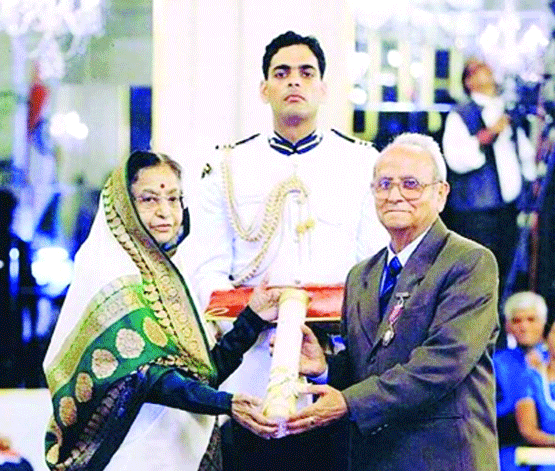
Anybody would feel great if nominated for a national honour/Award. How many people get a national award or recognition twice in life? In the field of writing, the Sahitya Academy Award is a national honour that a person can get once in a lifetime. Similarly, the Sangeet Natak Academy award is a national honour, a person gets towards contribution in the field of drama and dance, once in a lifetime. How many people have got both these awards? Sh. Moti Lal Kemmu was not just a recipient of both these national honours; he was also honoured with the Padma Shri and the Varisht Nagrik Sammaan thereafter. Thus, honoured by the GOI with a national award four times in his lifetime. To receive a national award is a matter of great honour and prestige; to receive it twice is phenomenal, and to receive it four times is nothing but legendary!
Describing Sh. Moti Lal ji, in a few sentences, would be a gross injustice to a man of his calibre and talents. He was a multifaceted person with a dynamic personality that could be replicated by none other than the maestro himself! A doyen in the field of theatre, a legend of a writer, a satirist, a social reformer, a revivalist; he revived the folk theatre form of Kashmiri known as the Bhand theatre. He was an absolute authority on Kashmiri language and culture and an organiser par excellence.
Born on 24th June 1933, his interests in dance and drama were discovered early in life during school days. Impressed with the performances of ‘Gupa Bacha’, he decided to pursue dance. After graduating in 1953, he received a scholarship and enrolled in Kathak dance under Prof Sunderlal Gangani at Baroda University (1957-58). However, he had to discontinue and return to the valley due to then-compelling family circumstances at home. After some time, he again enrolled at Baroda University under a national scholarship for Drama (1961-64). It was here, while learning the finer aspects of acting and drama, that he met his Guru, Prof. Shri Chandravadan Chamanlal Mehta, popularly known as ‘Chandamama’. It was during the course at Baroda University that his Guru, Prof. C.C. Mehta, advised him to start writing, and the writer in him was born. He wrote the first three plays in the Hindi language. The first three plays were: ‘Sandhya Beeti’, ‘Nangey’ and ‘Darpan Antahpur Ka’. These plays were later published in a book titled ‘Teen Asangat Ekanki’
While his Guru persuaded him to stay back and continue in Baroda, the destiny lay elsewhere. The family conditions were such that he had to return to his home and look after the family. He was the only son in the family with three sisters. So, he took up a job with the J&K Academy of Art, Culture and Languages as a Special Officer. He continued to work with the state Cultural Academy and retired as the Secretary in the year 1991.
All of these, except the ‘Pashu Gatha’ and ‘Bhand Natyam’, are plays in the Kashmiri language, and their Hindi versions. ‘Pashu Gatha’ is a novel written in Hindi and was serialised in the Koshur Samachar after the exodus. Besides drama, he also wrote well-researched articles on folk theatre, music, dance and culture of Kashmir in Kashmiri, Urdu, Hindi and English, which were published in various prestigious journals. Bhand Natyam was the result of one such comprehensive research work into the Bhand Theatre.
DRAMATIST/ REVIVALIST/ THEATRE PERSONALITY: A DOYEN
He was associated with the revival of the theatre movement in the Valley. He had been actively connected with the Rangmanch, Navrang and Kala Kendra theatre groups and was a founder member of the Abhinav Bharati theatre group. These groups were also involved in the performance of his plays, some years or the other. But perhaps the greatest contribution to the culture and theatre movement in Kashmir was his revival of the Bhand theatre, which was otherwise a dying form of traditional theatre.
He studied the folk theatre of Kashmir and trained Bhands, and reorganised them into various professional groups. Some of these were Kashmir Bhagat Theatre, Akingam; National Bhand Theatre, Wathora; Wullar Theatre, Zainagir; Kounsar Theatre, Shopian; Shahwali Luka Rang, Drugmulla; Bomai Luka Theatre, Bomai, Sopore; Arnimal Theatre, Palhallan. The documentary film ‘The Bhands of Kashmir’ by Sidharth Kak was produced under Mr Kemmu’s expert guidance.
Not just the Bhand theatre, He was also instrumental in reviving the Dhamali form of dance and the Hafiz Nagama, a popular form of dance in Kashmir. He even founded the Dhamali dance centre.
“There was no tradition of theatre in Kashmir except folk theatre, which too was at a dying stage. Therefore, I had to write my plays, guide other amateur theatre activists, revive the dying folk theatre form with modern sensibility,” he said in one of the interviews.
ORGANISER/MANAGER PAR EXCELLENCE
During his association with the J&K Cultural Academy, he organised numerous seminars, Conferences, Mushairas, Workshops, artists’ camps, Writer’s Camps, Children’s Painting Competitions, Music Competitions, Sculptors camps. etc., etc. He was also instrumental in organising many Theatre Festivals, Theatre Workshops, Folk Theatre Workshops, and Playwriting Workshops.
He led many Cultural Troups from J & K to Delhi, Mumbai, Tamil Nadu, Kerala, Assam, Manipur, Bangalore and Himachal Pradesh and played a huge role in discovering new artistic talents. He also led the state contingents on the Republic Day celebrations many times.
The Tagore Hall of Srinagar, which he was in charge of for a few decades, was always bristling with activity, with drama competitions, Dance festivals, painting competitions, and exhibitions. He had managed to bring many an artist (Dancers, Singers etc,) of national repute to perform at the Tagore Hall.
Satirist and a social reformer
In his plays, you find a theme of social reform and political satire. While Lala ba Drayas Lo Larey exposes the dowry system and atrocities against women, Shaaph is more about the empowerment of women. Manzilya Nikka and Haram Khanuk Aana expose the corruption in the system and the political machinations of the day. The Pashu Gatha is about the politics of the time. Dakh Yeli Tsalan, written during the jihadi turmoil in Kashmir, highlighted the role the Folk artists could play in bringing out a revolution. Many of his plays also have a historical context and are deeply rooted in the culture of Kashmir.
Authority on the Kashmir Culture & Language
He was an authority on the Kashmiri Language and culture. His books were prescribed as textbooks for an MA degree in the Kashmiri language. Having travelled across the length and breadth of the state and having interacted with a wide and diverse set of people from different regions of the state, he had an acute sense of the culture and its preservation.
Awards and Accolades
In 1960, he received the Best Actor Award from the state academy.
In 1960, he also received the best Drama director award.
Best book award for his Hindi play Teen Asangat Ekanki in 1966.
Best book award for TRUNOV in 1969.
Best Hindi Playwright of Kashmir– from Rashtra Bhasha Prachar Samiti – 1972.
Best book award for TSAI in 1973.
Best book award for NATAK TRUCHE in 1980.
Sahitya Academy Award (National award) for the play Natak Truch in 1982.
Best Book Award for Tota Tu Aana in 1985
Sangeet Natak Academy Award (National award) for Playwriting in Kashmiri in 1997
Ramakrishna Jaidayal Harmony Award in 1997
‘Robe of Honour’ Felicitated by Sunder Lal Patwa, then Chief Minister of Madhya Pradesh, at the 10th All India Annual Session of SANSKAR BHARATI at BHOPAL, 1991.
NATIONAL FELLOW, Human Resource Development Ministry (1996-98)
Padma Shri in 2012
Varisht Nagrik Samman (National Honour) in 2014
With his passing, the stage dimmed, yet the stories he revived and the traditions he preserved continue to breathe through every performance and every artist he inspired. He did not merely study culture—he lived it, shaped it, and passed it on as a living legacy. Though the curtain may have fallen on his life, his spirit will forever linger in the rhythm of art and the soul of drama. The heritage he safeguarded and the voices he amplified will continue to resonate across generations. In every performance rooted in tradition and every creative expression seeking meaning, his influence will endure. He was both the storyteller and the story—bridging past and present through art and drama. His script remains unfinished, carried forward by those he inspired.
He ensured that the stories of the soil were never lost to time. His life itself was a performance of dedication—one that will continue to inspire future generations. His profound contributions ensure that the traditions he cherished and the narratives he explored will continue to thrive.
His spirit lives on. Folk theatre will continue to thrive—and so will his legacy within it.
 Follow our WhatsApp channel
