

Lalit Gupta
lalitguptajammu@gmail.com
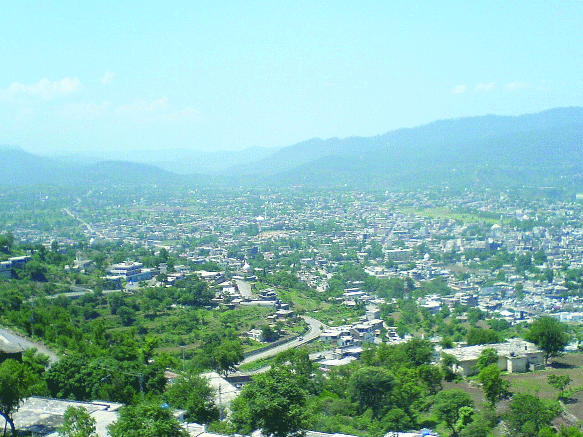
Nestled along the banks of the Poonch River, Kotli once stood as a flourishing town of the Chibbhal region, boasting a vibrant social and cultural life. The events of 1947 changed its destiny and displaced its people, yet Kotli continues to live in the memories of those who were forced to leave their ancestral homes. For them, the town is not merely a geographical entity across the Line of Control, but a cherished inheritance preserved in remembrance and passed from one generation to the next.
Early Historical References: Kotli (old name Kalanjara), presently under the occupation of Pakistan (PoJK), is an ancient city of the Chibbhal area, located about 180 kilometres from Jammu. Kotli, as an ancient settlement, is mentioned as Kalinjar in Book VII of Rajatarangini, the 12th-century chronicle attributed to Kalhana. The text refers to Raja Kaleh and his daughter Megh Manjari. In Book VIII, a ruler named Padam-rath is associated with the region. Mughal-era sources also refer to Kotli as Kalanajr. According to certain historical traditions, Kotli came under the control of Raja Mangar of the Mangral Rajput lineage in the 12th century.
Etymology: The name Kotli is commonly linked to the term Koh-tali, literally meaning “under the mountain,” reflecting its topographical setting surrounding hills. Another explanation attributes the name to the late 18th century, when the Raja of Poonch, Ali Gohar, is said to have renamed the area, Kot Ali, after gaining control of the Kalinjar fort in 1785. Over time, the name is believed to have evolved into Kotli.
Archaeological and Cultural Landscape: Strategically positioned, Kotli served as an important cultural, religious, and economic corridor in ancient times. Archaeological discoveries around Kotli—including prehistoric shelters, rock-cut caves, limestone boulders bearing carved human figures, ancient water reservoirs, mounds, and pottery fragments—indicate continuous, prolonged human habitation from the 4th millennium BCE through the early modern period. The discovery of numerous temples, inscriptions in Brahmi and Sharda scripts on boulders, and baolis adorned with Hindu deities testifies to Kotli’s integral place in the broader pan-Indian cultural sphere.
Political Developments (18th–19th Centuries): intermittently controlled by the Rajas of Poonch and Bhimbar. In 1827, it was incorporated into the territories of the Sikh Empire (Khalsa Sarkar) and granted as a jagir to Raja Dhian Singh, brother of Gulab Singh. Subsequently, from 1845 onward, Gulab included the area within his expanding dominion and brought relative stability to the region inhabited by tribes such as the Manghrabs, Nasmas, and Chib Rajputs. During the Dogra period (1846-1947), administrative and revenue organisations consolidated in the region. Historical accounts also note efforts towards surveying and documenting antiquities and ethnological features within the state’s territories.
Situated at 33°30’20”N latitude and 73°53?57?E longitude, at an elevation of approximately 2,000 feet, Kotli was a thriving town built around a long central bazaar. The city featured prominent chowks, open plains, and a parade ground.
The town’s water supply relied significantly on natural springs, notably Naban, which served as an important freshwater source. Additional springs were used by different sections of the population. The southern part of the city included a beautiful garden known as “Mandi,” associated with Sufi dargahs. Religious and social institutions in Kotli included temples, thakurdwaras, mosques, gurdwaras, and organisations such as the Sanatan Dharam Sabha and Arya Samaj.
Accessed through dhakkis, the riverbank was marked by wells, akharas (wrestling arenas), and spaces for seasonal fairs (melas), including gatherings during Baisakhi and the month of Chait. Recreational and cultural activities included wrestling matches and other traditional forms of entertainment.
The Events of 1947: Political developments of 1947 significantly altered Kotli’s trajectory. Following the decision regarding the accession of Jammu and Kashmir to India, in Srinagar, on 19 July 1947, armed conflict erupted against Dogra rule. In the Kotli region, resistance was led by Colonel Sher Ahmad Khan. Dogra forts such as Trochi (13 km from Kotli) were attacked, and some Muslim soldiers in the Dogra army mutinied and joined Pakistani tribal forces.
Siege of Kotli: The fall of Kotli and Mirpur in 1947 was one of the most tragic episodes of the Indo-Pakistani War of 1947–48. Besieged for 56 days by Pakistan-backed tribal forces, the town was eventually evacuated by the Indian Army under Brigadier Pranjpe on 24 November 1947. The evacuation saved thousands of Hindu and Sikh refugees and ensured their safe passage to Jammu.
Role of Volunteer Organisations: Before the fall of Kotli, the town had a strong presence of volunteers from the Rashtriya Swayamsevak Sangh (RSS), Arya Samaj, and Sanatan Dharma Sabha. They assisted state forces and residents as Pakistani forces advanced toward the town. During the violence, many volunteers engaged in relief efforts, while some took up arms to defend civilians.
On 6 October 1947, Pakistan-backed tribal forces attacked the nearby town of Pattan. As villages were burned and civilians targeted, Hindu and Sikh families from surrounding areas sought refuge in Kotli. Swayamsevaks, with community support, arranged shelter, food, and security for the displaced.
Kedar Nath Sahani—later Governor of Goa and Sikkim—was then the Zila Pracharak of the RSS in the Kotli-Mirpur area. He played a key role in coordinating with state forces to organise the town’s defence, reportedly in consultation with Colonel Baldev Singh Pathania. During the migration of Hindus and Sikhs from Kotli to Jammu, when the newly formed administration provided limited assistance, RSS leaders and volunteers—including Jagdish Abrol, Kedar Nath Sahani, and Durga Dass—arranged food, shelter, and up to thirty buses from Jhangar to facilitate their journey. Women, children, the elderly, and the sick were given priority.
There are accounts of RSS volunteers retrieving ammunition boxes dropped by Indian Air Force aircraft under heavy enemy fire. Many young volunteers were killed during one such operation.
Refugee Crisis and Aftermath: Following the change in government in Jammu and Kashmir, many Hindu and Sikh refugees arriving in Jammu faced severe hardships. Relief conditions in camps were difficult, with overcrowded tents, extreme summer heat, poor sanitation, and inadequate food supplies. Volunteer organisations stepped in to assist where official arrangements were perceived as insufficient. Over time, Hindu and Sikh refugees from Kotli resettled in Udhampur, Jammu (including colonies such as Rehari, Sarwal, and Reshamgarh), Pathankot, Himachal Pradesh, Delhi, and other parts of India.
Today, Kotli and its surrounding areas, presently under occupation of Pakistan, remain inaccessible to many of those whose families once lived there. The memory of pre-1947 Kotli survives primarily in oral histories, community records, and the region’s collective memory.
 Follow our WhatsApp channel
