

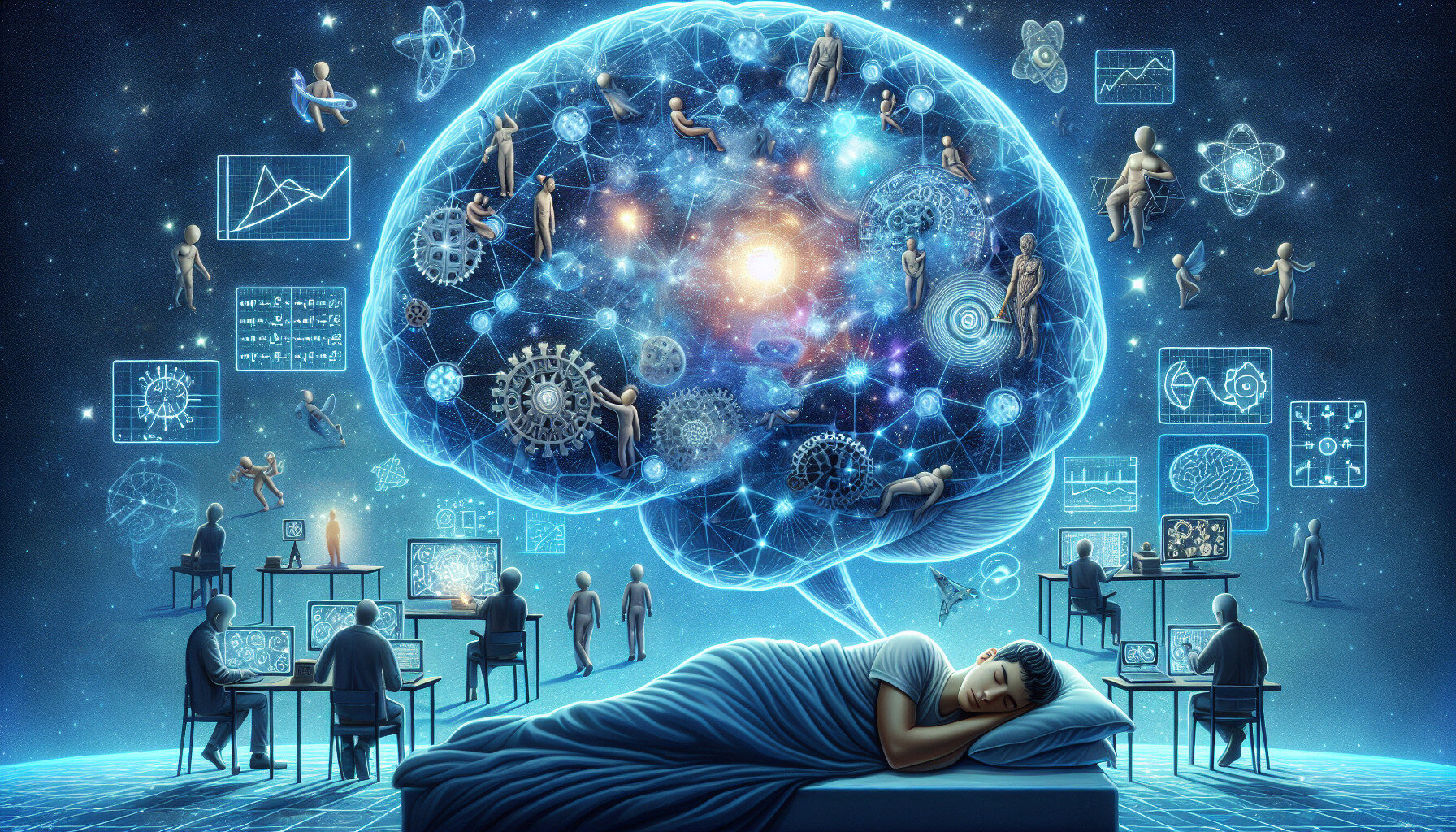
NEW DELHI, Apr 28: The contents of a dream may not be random or chaotic, but could instead reflect a complex interplay between personal traits, such as one’s tendency to mind-wander, interest in dreams, and sleep quality, and external events, including large-scale societal experiences like the COVID-19 pandemic, according to a new study.
Researchers at Italy’s IMT School for Advanced Studies Lucca analysed over 3,700 reports of dream and waking experiences collected from 287 participants aged 18 to 70.
Over two weeks, the participants recorded daily experiences, while the researchers gathered information about sleep patterns, cognitive abilities, personality traits, and psychological characteristics.
The researchers analysed the words the participants used to describe both their daily lives and their dreams.
Rather than simply replaying waking experiences, dreams appear to reinterpret them, they said.
Elements from daily routines, such as work environments, healthcare settings, or education, do not reappear as they are — they are instead reorganised into vivid, immersive scenarios, often blending different contexts and shifting perspectives into unfamiliar landscapes, the team said.
The results suggest that dreams do not just reflect reality, but actively reshape it, integrating fragments of past experiences with imagined or anticipated ones to create novel, sometimes surreal, scenarios, they added.
“Relative to waking reports, dreams shifted from self-referential, thoughtcentred narratives to perceptual experiences dominated by visuo-spatial details, multiple characters, and bizarre events,” the authors wrote in the study published in the journal Communications Psychology.
“Stable traits, including attitude toward dreaming, mind-wandering propensity, and subjective sleep quality, selectively influenced dream content,” they said. Lead author Valentina Elce, a researcher at the IMT School for Advanced Studies Lucca, said, “Our findings show that dreams are not just a reflection of past experiences, but a dynamic process shaped by who we are and what we live through.” “By combining large-scale data with computational methods, we were able to uncover patterns in dream content that were previously difficult to detect,” Elce said.
The transformations in dreams were also found to vary across individuals — for example, individuals more prone to mind-wandering tended to report more fragmented and rapidly changing dream scenarios.
However, those with a strong belief in the value, meaning, and significance of dreaming in general, and with regard to their own dreams in particular, experienced perceptually richer and more immersive dream content, the researchers said.
A second independent dataset collected during the first 2020 COVID-19 lockdown and involving 80 participants allowed the researchers to examine the impact of a major external stressor on dreams.
During lockdown, dreams showed an increased reference to limitations and heightened emotional intensity, reflecting the broader social context, the team found.
The effects were seen to gradually diminish over time, suggesting that dream content evolves in parallel with psychological adaptation to major life events, they said.
The findings show that stable individual traits and incidental experiences jointly shape dream semantics, the researchers said. (Agencies)
 Follow our WhatsApp channel
