

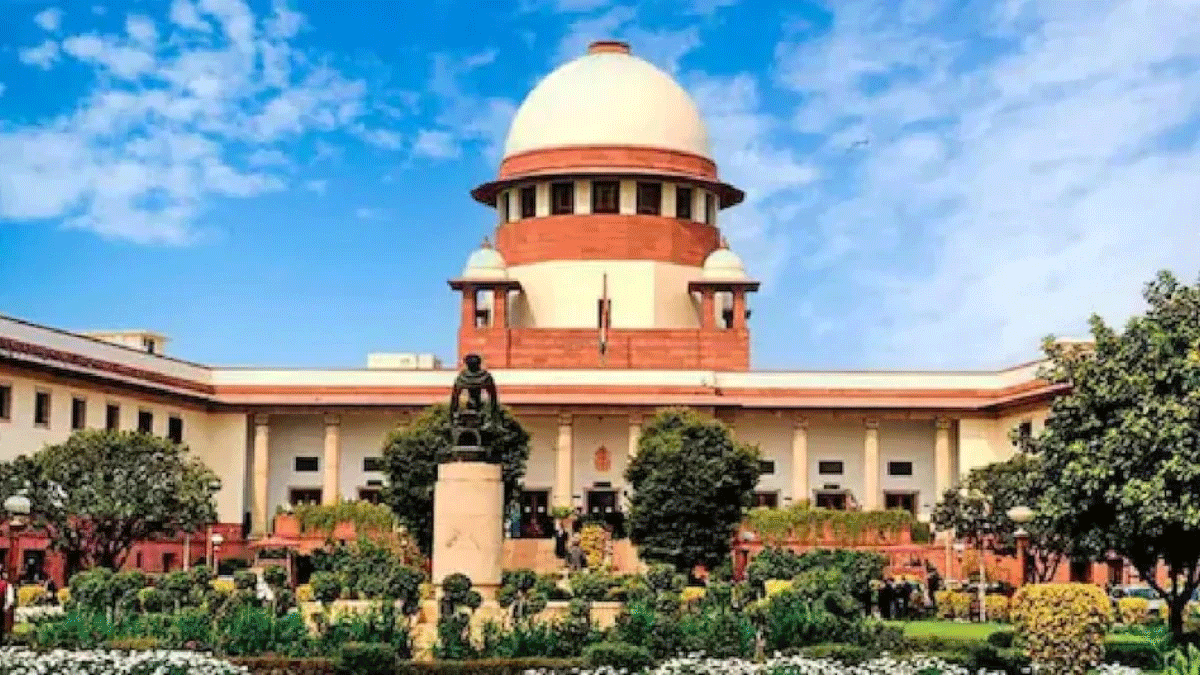
In a landmark intervention, the Supreme Court has taken decisive steps towards establishing dedicated, exclusive courts for cases pertaining to terrorism and narcotics. The directive seeks to end the backlog that has allowed some of the most dangerous criminals in the country to exploit procedural delays and languish in legal limbo for years. Terror and drug-related cases are not ordinary criminal matters. They are not disputes over property, contractual disagreements, or isolated acts of individual violence. They represent the calculated operations of dangerous syndicates – sophisticated criminal enterprises that conspire systematically against the nation, its people, and the very foundations of civil society. A single act of terrorism can shatter the economic equilibrium of an entire region within hours. Investment flees, tourism collapses, businesses shut, and the livelihoods of thousands are devastated. The ripple effect of one bomb blast or one targeted killing can set back a region by years, if not decades.
Beyond the economic damage lies something equally corrosive – the social fracturing that terrorism engineers. Terror incidents are frequently designed to inflame religious and communal tensions, to sow distrust amongst communities that have coexisted for generations, and to trigger political and social upheaval that weakens the democratic fabric of the nation. A society divided along religious lines is a society more easily manipulated and destabilised. This scenario is precisely the calculus of terror, and it must be met with the full, swift force of the law.
The narcotics menace is equally grave, and its consequences are equally far-reaching. Drug trafficking is a sinister, coordinated plot to destabilise regions and incapacitate the most vital resource a developing nation like India possesses – its youth. When an entire generation is rendered dependent, addicted, and incapacitated, the social and economic consequences are catastrophic. Human potential is extinguished, families are destroyed, and the workforce upon which India’s aspirations of development depend is steadily eroded. For those who orchestrate this trade, the suffering of millions is simply collateral damage in a ruthless enterprise driven by profit and geopolitical manipulation.
Nowhere is the deadly intersection of drugs and terror more evident – or more urgent – than in Jammu and Kashmir. The region has, for decades, grappled with a double onslaught that is unique in its viciousness. The same networks that smuggle narcotics are smuggling arms and ammunition. Drug money directly finances terror. The proceeds from heroin and contraband fund the purchase of weapons, the radicalisation of vulnerable young men, and the logistics of violence. In Jammu and Kashmir, the nexus is not a matter of conjecture – it is a documented, operational reality. Dismantling one without dismantling the other is an exercise in futility, and the judiciary’s decision to bring both within the ambit of dedicated special courts is therefore of particular and urgent significance for the region.
Yet for all the gravity of these offences, justice has been unconscionably slow. Courts across the country are burdened to the point of collapse, with judges simultaneously assigned non-NIA cases alongside UAPA trials, resulting in neither category receiving the focused attention it demands. Terror and drug cases have dragged on for years, in some instances for over a decade. When the guilty walk free or are left in prolonged pre-trial detention, neither the rights of the accused nor the rights of the victims are served. The Supreme Court has correctly identified that early disposal is the only mechanism that balances both.
The suo motu intervention by the Apex Court, directing that NIA courts exclusively handle UAPA and related trials without the encumbrance of other cases, is both timely and correct. The Ministry of Home Affairs framework – providing up to Rs 1 crore annually per court for operational expenses and a one-time infrastructure grant of the same amount – demonstrates that the financial scaffolding is in place. What is now required is speed and political will at the local level. State Governments must move swiftly to provide the space, infrastructure, and administrative support necessary to operationalise these courts without further delay. India’s message to those who deal in terror and narcotics must be unequivocal: justice will be swift, certain, and severe. The safety of the nation – and the future of its people – demands nothing less.
 Follow our WhatsApp channel
