

Sunny Dua
sunnydua55@gmail.com
The cable-stayed steel bridge that once rose gracefully over the River Tawi in Katta Battal area was more than an engineering structure – it was a symbol of connection, devotion, and progress. For the people of Nagrota constituency and the villages of Soura, Ladgan and Bhaid on other side of the sacred river, this 260-metre span was their lifeline and a centre of attraction for travellers and local tourists besides pilgrims. Built in 2014, the bridge magnificently linked the region to the sacred Baba Bhaid Devta, a revered shrine where devotees arrive not through the lens of caste, creed, region or religion, but through pure faith.
For years, this bridge carried pilgrims, students, farmers, elders, tourists, and traders – all bound by their everyday needs and their devotion to Bhaid Devta. It became the artery through which livelihoods flowed: small shops, cafés, and resting spots bloomed along the approach road at Kattal Battal, as footfall from across Jammu, Udhampur, Punjab, Himachal, and other regions surged. What was once a quiet cluster of villages was now emerging as a religious, cultural, and even adventure-tourism spot.
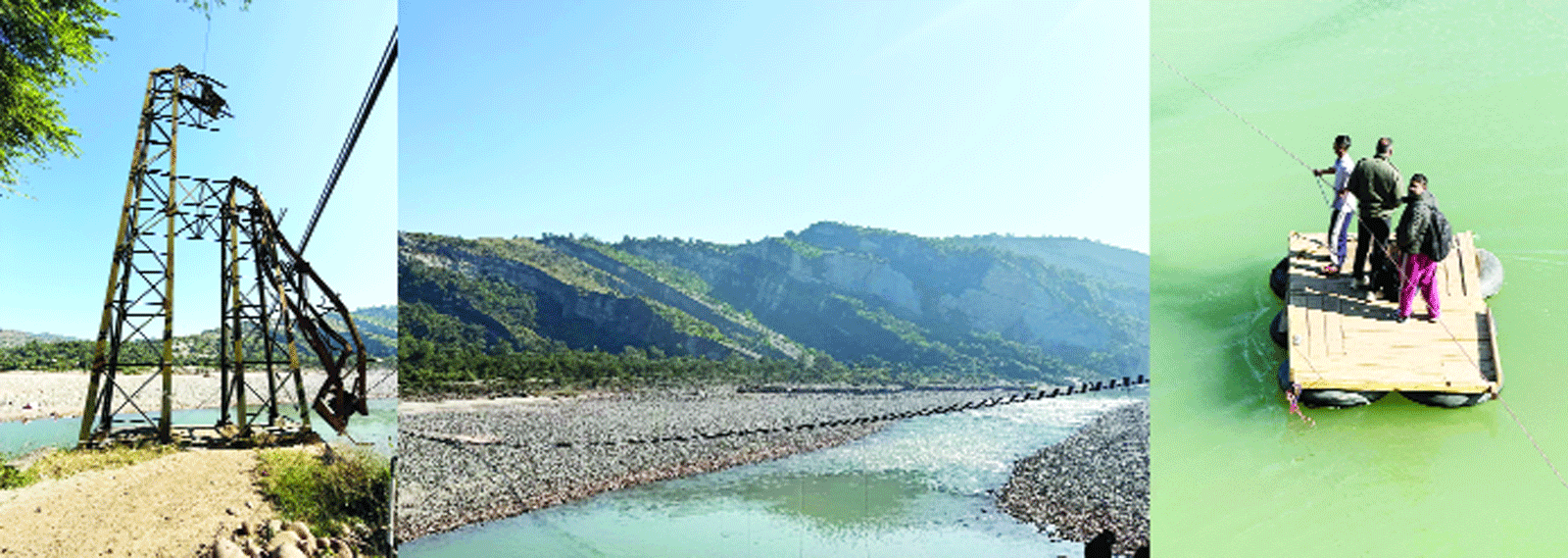
Everything changed on 26 August 2025 at exactly 2:38 pm when the furious Jammu floods swallowed the bridge. The river had swollen to a monstrous level that afternoon. Water surged higher and began touching the bridge deck while locals watched helplessly from the banks. Within minutes, the elegant structure started swaying with the force of the current and the high-velocity winds. Then came the moment of devastation. The cables snapped one after the other, the steel girders bent and broke, the towers twisted, caved in and finally gave way.
The entire bridge collapsed into the raging Tawi. A video captured by Gaurav Sharma, a café owner, went viral across social media as the bridge that had served thousands fell like a defeated giant. Today the steel structure lies twisted and scattered on the riverbed, a reminder of both nature’s fury and human neglect. And with it lies the routine life of three entire villages. It has been three long months, yet the bridge has not been rebuilt. The villages of Soura, Ladgan, and Bhaid with a combined population of nearly 800 households remain physically cut off from Kattal Battal and the rest of the constituency.
Instead, locals themselves have erected a makeshift boat, a frightening contraption of tyre tubes covered with wooden planks. For Rs 30 per person, villagers risk their lives daily to cross the icy waters of Tawi. There are no life jackets, no safety ropes, no regulated load.
People hurry, fearing the rains. They crowd the improvised raft. It sways dangerously under the weight. “We manage crowds ourselves. Even the Army has helped during rush hours. But this is no way for children or the elderly to travel,” says Raj Singh, Lambardar of Kattal Battal. He adds, “Two proper boats were promised. None came. In rains or winter, this becomes a matter of life and death.”
Children, school-goers, the elderly, women carrying infants, patients who need to reach Jammu for treatment, all step onto the shaky raft knowing that a slight imbalance could overturn it. When it rains for several days, the river swells again and the villagers become completely stranded. How can a sick person, asks Bhushan Sharma of Soura, or a small child cross the Tawi like this? The Army has helped manage crowds at times, but nothing beyond that. Two proper boats were promised by authorities, yet none has been delivered.
Sources confirmed that after the earlier bridge was damaged due to heavy rains, the government has now initiated plans to construct a brand-new concrete bridge that will significantly improve connectivity in the region. The new 370-metre prestressed concrete bridge estimated at ?33.70 crore including approaches will provide better access to Bhaid Devta and the surrounding villages, opening the way for fresh area development. This improved connectivity is expected to enhance tourism, support pilgrimage routes, and strengthen the local economy.
Officials claim that a Detailed Project Report (DPR) has already been prepared and submitted for approval. Once the sanction is accorded, the project will move to the geotechnical investigation stage after which tender will be floated and bridge constructed under the Standard Road Fund. This, they believe will be a game changer for the people of area and also enhance their socio-economic life. Meantime, the villagers say, “what hurts the most is that the collapse could have been prevented”. They say the JKPCC, responsible for the bridge’s upkeep, never carried out the much-needed periodic repairs.
The bridge often swayed dangerously during strong winds and villagers repeatedly requested maintenance and even illumination, but nothing was done. “Had repairs been done from time to time, the bridge could have survived the floods,” says Gaurav Sharma. The people feel that the negligence weakened the structure, making it vulnerable when nature unleashed its fury.
The fall of the bridge has also deeply affected the spiritual life of the region, especially the pilgrimage to Baba Bhaid Devta. The shrine carries centuries-old legends – stories of Raja Bhaid, son of Vasuki Nath, born with extraordinary divine power and raised under mystical circumstances involving river Tawi, Samundra Devta and protective fishes known as Mach. Villagers say that even today, sacred fish appear whenever devotees feed them and vanish mysteriously during turbulent times such as war, only to return afterwards, sometimes injured, as though sharing the suffering of the people.
This sacred place is the Kul Devta of many families, including those who have moved away but return for blessings. Muslims, Sikhs, Punjabis, Himachalis – all visit the shrine with equal devotion. Losing access to such a place has deeply wounded the emotional and spiritual rhythm of the community, said Sat Pal Magotra, retired defence personnel. Baba Bhed Nag, revered in local folklore as the illustrious son of Vasuki Nag, the serpent king, is believed to have brought the waters of the Tawi from the Kali Kundi glacier in Bhaderwah to Jammu with the help of Kaliveer and the blessings of Kalika Mata, after which Vasuki Nag entrusted the rule of Jammu to Raja Bhed Devta.
Many Rajput clans of the region therefore regard Baba Bhed Devta, along with Kaliveer, as their Kuldevta. Rooted in ancient Shaivite traditions and the serpent-worshipping culture of the early Nagas of North India, the legend surrounds the shrine located in Bhed village, perched on a large rock by the Tawi river, where a natural deep-water pool called a Dawar is home to fish considered sacred and protected; devotees feed them kneaded flour, and fishing is strictly prohibited, creating a natural sanctuary.
Now that the steel bridge is no more there, schoolchildren, often as young as six or seven, wait at the riverbank and cross only when the river calms. During medical emergencies, the situation becomes terrifying. “How can a patient cross on tubes?” asks Bhushan Sharma of Soura village. “This is cruel. When water rises, we are cut off completely.” For days after heavy rainfall, the river refuses to recede trapping villagers on one side or the other, breaking their connection to schools, ration supplies, health services, and markets.
For locals, the bridge was not merely a physical link – it was the path to Bhaid Devta, a sacred site that carries centuries of lore, devotion, and mysticism. Villagers unanimously claim that the bridge, despite its elegance, needed timely maintenance something they say was never done. They allege that the JKPCC, the agency responsible, ignored repeated requests for repairs, including structural checks and illumination for night safety. “The bridge used to swing even in high winds. We had complained,” says Gaurav Sharma. “Repairs were never carried out. Not even once. And when floods came, the weakened structure couldn’t fight back.” The collapse, villagers insist, was preventable.
For the people of Kattal Battal and the surrounding villages, the loss of the bridge is not merely an inconvenience it is a wound that has changed their lives. Their businesses have withered. Their children’s education has been disrupted. Their pilgrimage route to Baba Paid Devta, the most sacred part of their existence, has become dangerous. This was a bridge of faith, livelihood, and identity. Its absence is felt deeply, every single day. Villagers earnestly believe that a proper vehicular bridge and a pucca road to Bhaid Devta will not only ensure safety but also revive pilgrimage, tourism, help traders, encourage cultural visits, and restore normal life.
Despite the fact that there’s no bridge, the faith of the devotees remains unshaken. A number f pilgrims from Jammu as well as other states are continuing to visit the place overcoming all hurdles. They hope the government listens and action replaces promises. They hope, once again, to walk across a bridge – safely, proudly, and without fear because for them, the bridge was not just steel and cables. It was their connection to the world and to their Devta.
(The writer is senior journalist)
 Follow our WhatsApp channel
