

J. Charles Davis
davischarlesj76@gmail.com
What happens on Good Friday?
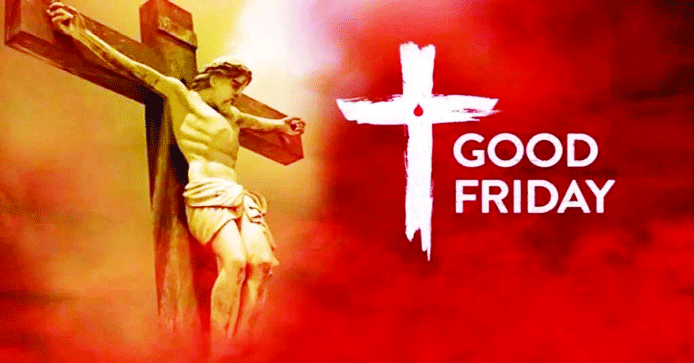
Jesus spoke truth and stood for justice but Jewish authorities accused Jesus of blasphemy and persuaded Roman authorities to charge him with treason but all were part of the fulfilment of the divine prophecy. Jesus is brought before the governor Pontius Pilate. As governor of the Roman occupying power, Pilate is the most important secular authority in Jerusalem. Pilate did not find anything wrong with Jesus but the Pharisees succeed in inciting the people against Jesus and the crowd ultimately demands his death, and finally Pilate pronounces his verdict: The Son of God is scourged and must carry his cross himself to the hill of Golgotha. There he is nailed to the cross. Shortly before he dies at the ninth hour (that is, at 3 pm), Jesus cries out: ‘My God, my God, why have you forsaken me?’ He is laid to rest in a cave.
On Good Friday, the Church holds no service in the conventional sense. The altar is stripped bare, the bells are silent, the tabernacle is empty – the Church commemorates the suffering and death of Jesus. In many parishes, a Way of the Cross service takes place in the morning. This roughly corresponds to the time when Jesus carried his cross through Jerusalem up to Skull Hill, known as Golgotha.
In the afternoon at 3 pm, the Great Good Friday Liturgy takes place. It is customary for altar servers to summon the congregation to the liturgy with ratchets or clappers instead of bells. The great intercessions and the veneration of the Cross by the priest and congregation form the focal points of the memorial service. Alongside Ash Wednesday, Good Friday is a day of obligatory fasting and abstinence.
The Arrest of Jesus
Jesus was arrested at night and was brought to the high priest Caiaphas for questioning. The high priests and the Sanhedrin sought witnesses to give statements that would result in a death sentence for Jesus. Many gave false testimony, but it was not sufficient for a conviction. Then the high priest asked Jesus if he was the Messiah, the Son of God, and Jesus answered, “I am.” (Mark 14:62). In the eyes of the Sanhedrin and the high priests, this made Jesus guilty of blasphemy, and they demanded his condemnation to death on the cross.
Peter’s Denial
While Jesus was being questioned, Peter waited in the courtyard of the palace. Three times he was asked if he was with Jesus, and three times he denied him. When the rooster crowed, Peter remembered Jesus’ words and began to weep (Mark 14:66-72). Jesus himself had predicted this betrayal to Peter the evening before.
The Sanhedrin had Jesus brought to the Roman governor Pontius Pilate, who was to pronounce the death sentence on Jesus. Pilate also questioned Jesus, but he remained silent regarding the accusations, and Pilate doubted the charges the Sanhedrin brought against Jesus. Since it was customary during the Passover festival for the governor to release one prisoner chosen by the people, Pilate asked the crowd who it should be. The people, incited by the chief priests, demanded the release of Barabbas and the crucifixion of Jesus (Mk 15:1-15). Jesus was forced to carry the cross on the way to Golgotha. The soldiers placed a crown of thorns on him, and mocked him. Then Jesus had to carry the cross himself to the hill Golgotha, a hill outside Jerusalem.
But along the way, he kept collapsing under the weight, and a man named Simon of Cyrene, who happened to pass by, had to carry the cross for him (Mk 15:21). At the place of execution, Golgotha, the soldiers crucified Jesus along with two criminals. At the cross, he was mocked by the Roman soldiers and the onlookers. Instead of despising his tormentors, Jesus asked his heavenly Father to forgive them: “Father, forgive them, for they do not know what they are doing” (Lk 23:34).
Around the sixth hour, the sky darkened, and when Jesus died on the cross after three hours, the earth shook and the curtain in the temple was torn in two (Mt 27:45-51). In the individual Gospels, the final words Jesus spoke before his death on the cross differ:
Mt 27:46 Eli, Eli, lema sabachthani? My God, my God, why have you forsaken me?
Mark Mk 15:34 Eloi, Eloi, lema sabachthani? My God, my God, why have you forsaken me?
Luke Lk 23:46 Father, into your hands I commit my spirit.
John Jn 19:30 It is finished!
In the evening, Joseph of Arimathea asked Pilate for the body of Jesus. He laid it in a rock tomb and sealed it with a large stone. Mary Magdalene and Mary, the mother of Jesus, watched where Joseph of Arimathea laid the body (Mk 15:42-47).
The Celebration of the Passion and Death of Christ
In the Catholic Church, the main service on Good Friday is the so-called Celebration of the Passion and Death of Christ. The service usually takes place at 3 p.m., the traditional hour of Jesus’ death. On Good Friday, no Holy Mass is celebrated, so the service consists of a liturgy of the Word, veneration of the cross, and the communion service.
During the simple service, the Church is completely unadorned, there are neither candles nor flowers on the altar, the eternal light is extinguished, and the organ and bells remain silent until Easter night. In some places, rattles or clappers replace church bells and altar bells. Children, mostly altar boys, walk through the streets with the noise-making instruments and call the faithful to the service.
Word of God service
At the beginning of the Word of God service, clergy and altar servers enter the church in complete silence. The priest and deacon lay on the ground as a sign of deep humility before Jesus, and the congregation kneels.
As the highlight of the Word of God service, the Passion narrative of Jesus from the Gospel of John is read in distributed roles.
After a short sermon, the Great Intercessions are presented. In ten prayers, the concerns of the Church, the world, and those in need are prayed for. First, the priest presents the prayer intention, then the deacon calls for kneeling and silent prayer. After the invitation “Lift up your hearts,” the congregation stands up again, and the priest summarizes all the intentions in a subsequent prayer, to which the congregation responds with “Amen.”
Veneration of the Cross
During the veneration of the cross, the priest brings a cross covered with a purple Lenten cloth into the altar area. He holds it up three times (the so-called Exaltation of the Cross) and uncovers the cross a little each time until it is completely revealed before the altar. At each elevation of the cross, the priest invites the congregation with the sung prayer call: “Behold the wood of the cross, on which hung the salvation of the world. Come, let us worship!”
Alternatively, the priest carries the unveiled cross in a procession from the entrance of the church to the altar. During this, the cross is raised three times, and the priest calls the congregation to veneration of the cross with the prayer call. When the cross has arrived in the altar area, clergy and congregation kneel and kiss it in veneration. In some places, it is also customary to lay flowers before the cross, which are then used for the later Easter decorations in the church.
Communion service
On Good Friday, there is no Eucharistic celebration with the transformation of bread and wine. Instead, so-called pre-consecrated hosts from the Mass of the Last Supper on Maundy Thursday are kept. Good Friday is the only day in the church year on which no hosts are consecrated. After the introduction with the Lord’s Prayer and preparatory prayers, the priest distributes communion with the pre-consecrated gifts. Finally, the priest says a prayer of thanksgiving. After the silence of prayer, the celebration of the Passion and Death of Christ concludes with a blessing prayer over the people. The priest does not make the sign of the cross, but instead extends his hands in blessing. The congregation then leaves the church in silence.
The liturgical color for Good Friday in the Catholic Church is red. It symbolizes the blood of Jesus shed on the cross and his death. The use of incense is omitted.
Good Friday processions and Stations of the Cross devotions
In many places, the Passion story is vividly and impressively portrayed in Good Friday processions. In the processions, the Passion of Jesus is enacted in various stations.
It is also a widespread custom to hold Stations of the Cross services on Good Friday. In this, the suffering and death of Jesus is commemorated in 14 stations, from the condemnation by Pilate to the burial. The individual stations are usually pictorial representations that depict the events of the Passion narrative.
(The author is Episcopal Vicar, Diocese of Jammu-Srinagar St. Marys Garrison Church, Jammu)
 Follow our WhatsApp channel
