

Excelsior Correspondent
NEW DELHI, Sept 3: Even as Parliament is considering to amend the RTI Act to exclude political parties from its ambit, Chief Minister Omar Abdullah today made strong pitch for opening their records to the public through the transparency law.
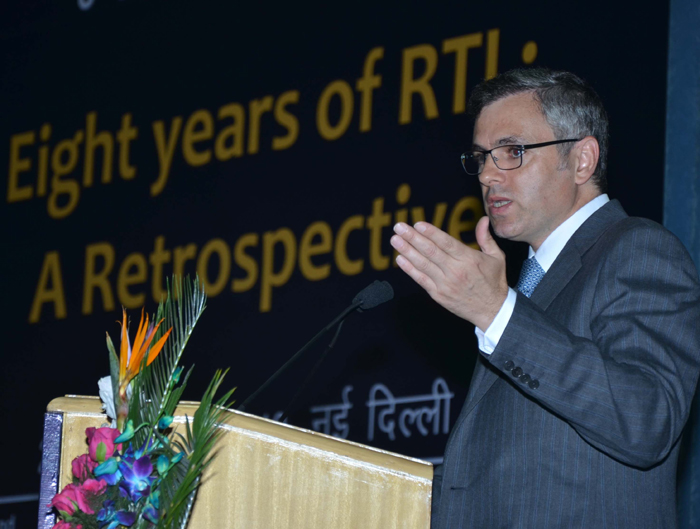
In his valedictory speech at the eighth convention of the Central Information Commission, Omar said he was not sure whether his party would agree with his views but if political parties are availing Income Tax exemption, they should be accountable to the people.
“As of now, my party is not on that list of parties that have to be part of the right to information and I don’t know whether my party will agree with what I have to say. But if I they did ask me what I thought, I would believe it is justifiable for my party to come under the purview of the Right to Information,” the Chief Minister said.
He said the Income Tax exempted to political parties could otherwise be used else where for developmental work.
“…But I am not paying that income tax and therefore I should necessarily be accountable not just to the Election Commission, not just accountable to the Income Tax Department but I should be accountable to the country,” he said.
Stressing that he did not wish to pick a fight with other political parties, Omar said he does not see any problem in sharing records of day-to-day functioning of political parties with people.
“At the end of the day, nobody can force us to collect information that we don’t ordinarily collect or that we don’t ordinarily use in our day-to-day operations. As a political party, if there are records that I keep about functioning of my political party, then those records should be made available to the people. And if I don’t keep those records, then I can’t be forced,” he said.
Omar also said while the political class claims to be the guardian or custodian of transparency, it looked a little strange that although its seeks transparency for everybody else but does not apply the same principle to themselves.
He said the same principle applies to other institutions and organisations which are availing Income Tax exemptions.
“Why should BCCI ask for the exemption from the Right to Information Act? By all means, take exemptions but then pay the Income Tax and make yourself at par with other organisations. You cannot have your own cake and eat it too,” he said.
Omar said such organisations cannot say they would not pay Income Tax, take various concessions and at the same time would not open themselves to scrutiny.
The Chief Minister said the RTI Act has made him cautious regarding the use of state’s assets.
“If you have certain amount of concern about how you are perceived, how you are seen, then yes the Right to Information will impact how you decide to function,” he said.
Omar said he was far more casual about the use of state aircraft or helicopter till RTI application regarding the number of trips started coming to his office.
“Everytime I have to take a flight, I sit back and ask myself: is there a commercial option I can exercise before I exercise the option of state aircraft and this is purely the result of the RTI Act because I know that at some point of time somebody is going to ask my Chief Information Commissioner to get this information about how many flights I have taken…Why should I then not amend”? he said.
The two-day convention had three technical sessions on RTI and inclusive growth, RTI-an anti-corruption tool and Media and RTI which were addressed by a number of eminent personalities.
Speaking at the session on RTI–an anti-corruption tool, former Chief Election Commissioner J M Lyngdoh spoke about the need for electoral reforms and the role the RTI Act can play in that.
He said with the implementation of the Act the people have become empowered to see, check and inspect any information which does not come under the exemption list, as such, the Government and governance have come under the scrutiny of most important stakeholder—the public.
This, he said, is not the end of matter. “What is needed for the RTI Act to be more poignant and broad based is public awareness about the legislation. It will only be then the objectives to combat corruption and bring about transparency and accountability in Government functioning can be achieved”, he said.
Referring to the State Right to Information Act, the Chief Minister said that State Information Commission was fully functional by appointment of Chief Information Commissioner and the two Information Commissioners in 2011. He said adequate staff and logistic support has been provided to the Commission as per its requirements.
Omar said that provisions of Section 4 of RTI Act, considered to be the soul of the transparency law, are being followed and almost all Administrative Departments in the State in the Civil Secretariat have launched their websites for easy dissemination of the information pertaining to these departments.
He said that the response of the general public seeking information under the Act has been very encouraging which is reflected in the number of applications received under the Act. “The pace with which information has been made available to the information seekers is also a matter of satisfaction for us. This can be judged by the fact that in my State 15,000 applications were received during the last year as compared to 741 in 2009-10”.
Omar said that the implementation of RTI Act, reconstitution of Accountability Commission, constitution of Vigilance Commission and enactment of historic legislation of Public Services Guarantee Act in the State by his Government has given ample powers to the people to question the Government for all its actions and omissions.
He said “we have given legal authority to people to demand listed public services within the fixed time frame besides empowering them to make queries to the Government about its functioning, delivery of services, financial transactions and other aspects of governance”. He said that under the RTI Act a common man is at par with a legislator to ask question to the Government and that too throughout the 365 days of the year.
The Chief Minister appreciated the functioning of State Information Commission and said that the Commission has strengthened the implementation of the Act and has created good public awareness about the use of RTI Act provision to seek information from the Government Departments.
The Chief Minister added that the critical analysis of the applications reveal that people are by and large seeking information with respect to the employment related matters, promotions and seniority issues.
“Whereas, there is a need to bring transparency in the recruitments at every level, the information seekers should also focus on development activities, and issues of urgent public importance and interests. If it is done, I am sure real benefits of development will accrue to the common masses. There are hundreds of development schemes implemented by the Centre and State Governments in involving huge funds. the best way to ensure the benefits these schemes percolate to the grass root level and ensure transparency in spending, the RTI activists should work as Watch Dog”, he elaborated.
Omar said that the desired results under any Act or law cannot be achieved unless common people or aware about the legislation. “I feel people even at the National level are not fully aware of the benefits and public interest provisions of various legislations. The people living in villages, remote areas and far-flung places need to be educated properly about the RTI”, he added and underlined the need for imparting educate training to PIOs and First Appellate Authorities and others associated the implementation of the Act.
Omar emphasized on the role of Non-Governmental Organizations in implementing the provisions of Act and said that credible NGOs have a vital role in the implementation of the Act.
The Chief Minister said that annual conventions like the one arranged by Central Information Commission are big leap towards assessment of the success and failures under the Act. He said these conventions give an opportunity to share the view points and learn from the experiences of one another.
 Follow our WhatsApp channel