

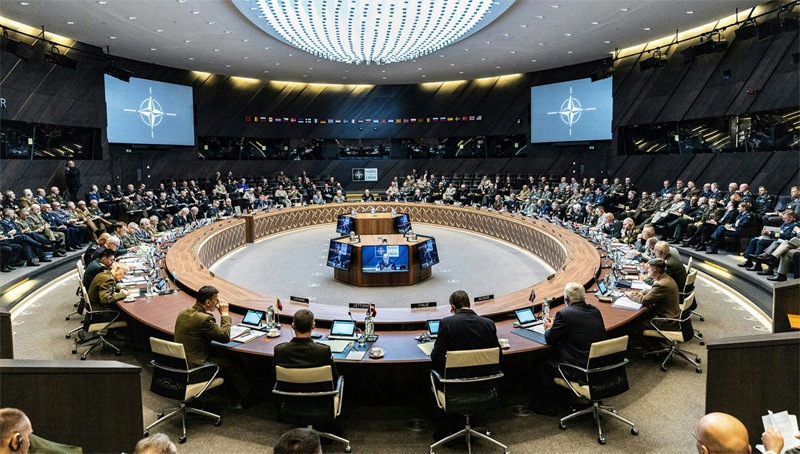
SINGAPORE, May 31 : Admiral Giuseppe Cavo Dragone, Chair of the NATO Military Committee, on Sunday called on allied nations to go beyond building resilient defence systems and instead cultivate what he termed “antifragility” a condition in which institutions, partnerships, and societies not merely withstand shocks but emerge from them demonstrably stronger.
NATO’s most senior military official argued that mere resilience is no longer sufficient and that the alliance must pursue “antifragility” in the face of accelerating global fragmentation. He delivered the remarks at the Shangri-La Dialogue in Singapore, addressing Panel 6 on “Evolving Security Partnerships in a Fragmenting World.”
The annual forum, which draws defence ministers, military chiefs, and security analysts from across the Asia-Pacific and beyond, provided a prominent stage for the admiral’s assertion that the current moment demands a fundamental reappraisal of how the alliance conceptualises security.
“Our goal is not just resilience , it is antifragility,” Dragone said. “Partnerships and societies should be strengthened to the point where they do not merely absorb shocks, but emerge stronger from them.”
The NATO official warned that the war in Ukraine, now entering its fifth year and has witnessed millions of casualties, both reflected and accelerated global fragmentation, underscoring the need for deeper cooperation among allies and partners.
He noted, ” NATO is clear-eyed and acting.”
Dragone highlighted NATO’s recent commitments to increased defense investment, noting that all 32 alliance members agreed at the Hague Summit to allocate 3.5% of GDP to defense spending and an additional 1.5% to security-related infrastructure.
“Europe and Canada invested $574 billion last year alone – a 20% increase,” he said. “We are turning billions into battalions.”
However, he stressed that financial commitments must translate into operational capability, calling for faster procurement processes and stronger industrial cooperation. According to Dragone, defense acquisition systems designed for a more predictable era are no longer suited to today’s rapidly evolving threat environment.
“Defense industry must accelerate,” he said. “The time to move faster is now.”
A central theme of his remarks was the importance of partnerships in maintaining military effectiveness and deterrence. Dragone argued that cooperation on standards, doctrine, data sharing, artificial intelligence, and industrial interoperability is essential to overcoming fragmentation and strengthening collective defense.
“Partnerships are not a talking point,” he said. “They are how we counter industrial fragmentation, build interoperability, and project credible deterrence.”
“Partnerships are not a talking point. They are how we counter industrial fragmentation, build interoperability, and project credible deterrence. Standards, doctrine, data, AI – together we can outperform,” he said.
Highlighting that “Defence industry must accelerate,” adding, “procurement cycles designed for a predictable era are no match for today’s threats.”
The NATO official called on partners to move faster, saying security is a “whole-of-society endeavour” and that the time to advance both capability and partnership agendas is now.
The NATO official said the objective was not merely resilience but “anti-fragility”, building partnerships and societies strong enough to withstand disruptions without being significantly affected.
The NATO official said capability development and partnership initiatives must progress in tandem ahead of the NATO meeting in Ankara.
He also emphasized the growing connection between security challenges in the Euro-Atlantic and Indo-Pacific regions, describing them as increasingly interdependent and inseparable.
Beyond military cooperation, Dragone called for a whole-of-society approach to security, urging greater involvement from academia, industry, local governments, non-governmental organizations, and citizens.
“Security is a whole-of-society endeavor,” he said. “Every citizen is a participant, not merely a beneficiary.”
Looking ahead to NATO’s upcoming summit in Ankara, Dragone said capability development and partnership-building must advance together if the alliance is to remain effective in an increasingly uncertain global environment. (UNI)
 Follow our WhatsApp channel
