

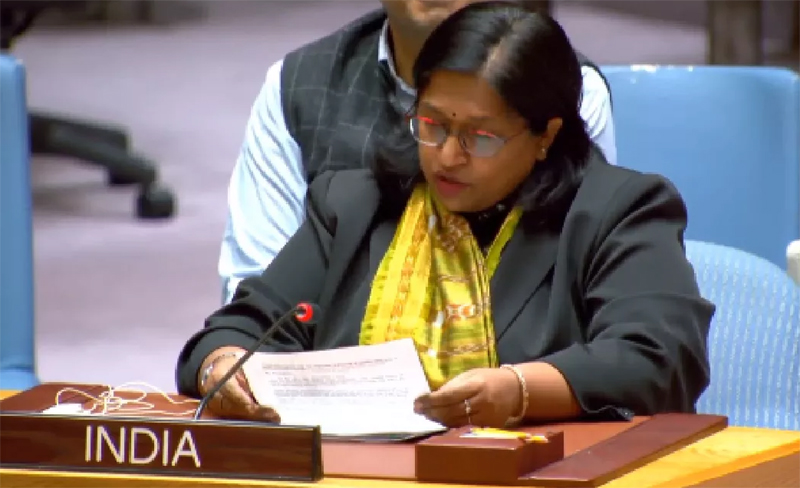
NEW YORK, April 28 : At a UN Security Council open debate, India on Monday called for the immediate restoration of safe and unimpeded maritime passage through the Strait of Hormuz, warning that recent attacks on commercial shipping in the vital waterway threaten global peace, energy security, and economic stability.
Delivering India’s statement at the UN Security Council’s high-level open debate on “The Safety and Protection of Waterways in the Maritime Domain” under the agenda of maintaining international peace and security, Indian representative Yojna Patel underscored that safeguarding critical maritime routes is vital for global trade and stability.
Calling for renewed international cooperation to protect waterways, Ambassador Yojna Patel said such incidents are “unacceptable” and have already resulted in the loss of Indian seafarers’ lives, underscoring the human cost of rising maritime insecurity.
Yojna Patel stressed that critical sea lanes like the Strait of Hormuz carry a substantial share of global energy supplies and trade, and any disruption has far-reaching consequences for international stability.
“Any threat to critical waterways has far-reaching implications for international peace and security, given that the bulk of global energy supplies and trade flows through these routes,” Patel said.
She emphasised that freedom of navigation and lawful commerce through vital chokepoints like the Strait of Hormuz must be fully respected in accordance with international law, urging the immediate restoration of safe and unimpeded maritime passage.
India has reaffirmed its commitment to a free, open and rules-based maritime order, strongly backing adherence to international law, particularly the United Nations Convention on the Law of the Sea (UNCLOS), as the cornerstone for ensuring freedom of navigation and secure global trade.
India reiterated that maritime security remains central to global economic prosperity and stability. As one of the world’s largest suppliers of seafarers, accounting for nearly 13 percent of the global workforce, India expressed deep concern over the safety and welfare of seafarers.
“Any disruption or obstruction of vital waterways directly impacts global trade, energy flows and humanitarian supply chains,” Patel said, adding that ensuring secure and open seas is essential for long-term global peace and inclusive growth.
Highlighting India’s proactive role, the envoy recalled that New Delhi had convened the first-ever UN Security Council open debate on maritime security in August 2021, laying the groundwork for a more coordinated global approach to maritime challenges.
India outlined key priorities to address the current crisis, including ensuring navigational safety, maintaining supply chains, especially humanitarian ones, enhancing maritime situational awareness, and strengthening communication mechanisms for seafarers.
As part of its response, India’s Directorate General of Shipping has operationalised a 24/7 helpline for seafarers of all nationalities, which has already handled thousands of distress calls and communications.
Further, India called on member states to increase coordination with the Information Fusion Centre – Indian Ocean Region (IFC-IOR), a New Delhi-based hub that facilitates real-time maritime information sharing. With liaison officers from 36 countries and links to international frameworks such as the Djibouti Code of Conduct, the centre plays a critical role in ensuring maritime domain awareness and supporting safe navigation.
The Indian representative also raised concerns over the risk of environmental disasters due to attacks on commercial vessels, stressing the need to strengthen global mechanisms for maritime monitoring and coordination.
(UNI)
 Follow our WhatsApp channel
